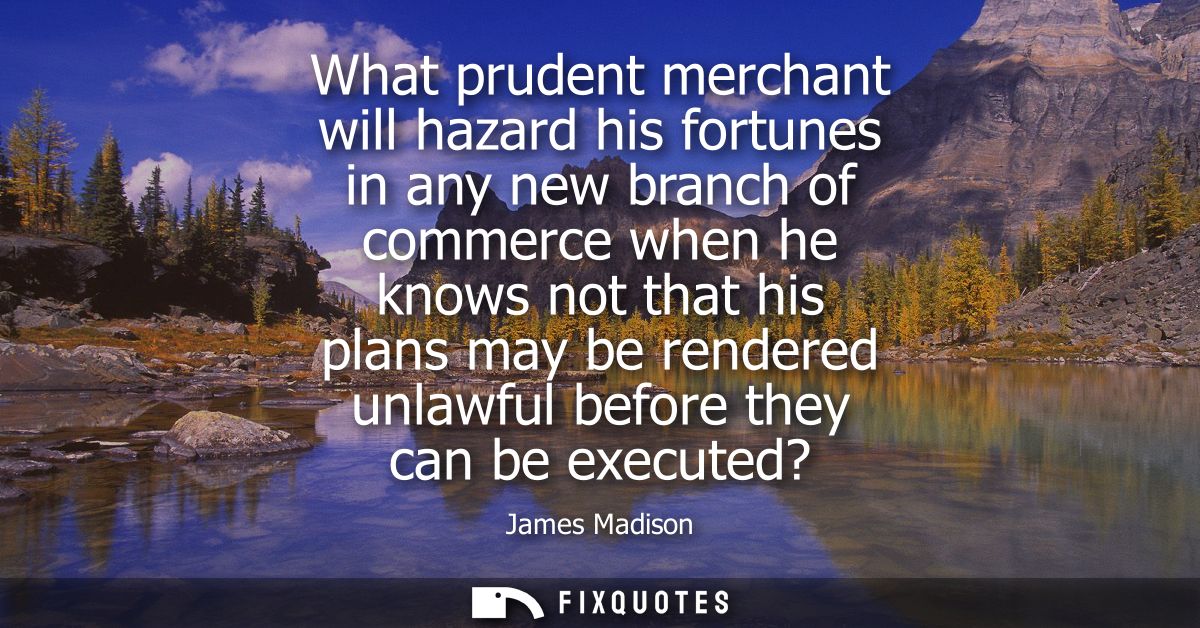
"What prudent merchant will hazard his fortunes in any new branch of commerce when he knows not that his plans may be rendered unlawful before they can be executed?"
About this Quote
The line also smuggles in a constitutional argument without sounding like one. “Rendered unlawful” points to arbitrary government power: laws that arrive too late, too suddenly, or too selectively. Madison is warning that when legislatures behave like weather, citizens start acting like survivalists. Commerce, in his framing, is a referendum on governance. Capital is skittish; it flees not only violence but caprice. The subtext is that liberty isn’t only about grand rights; it’s about predictable institutions.
Contextually, this is Madison the system-builder, obsessed with checks and balances and the dangers of faction. He’s arguing for a framework in which rules are knowable and durable - not because merchants deserve special sympathy, but because economic confidence becomes civic confidence. The rhetorical move is classic Madison: translate abstract fears about power into a concrete scenario, then let self-interest do the persuading. If even the cautious won’t “hazard” their fortunes, the republic’s prosperity - and legitimacy - becomes a gamble too.
Quote Details
| Topic | Entrepreneur |
|---|---|
| Source | Help us find the source |
| Cite |
Citation Formats
APA Style (7th ed.)
Madison, James. (2026, January 18). What prudent merchant will hazard his fortunes in any new branch of commerce when he knows not that his plans may be rendered unlawful before they can be executed? FixQuotes. https://fixquotes.com/quotes/what-prudent-merchant-will-hazard-his-fortunes-in-19618/
Chicago Style
Madison, James. "What prudent merchant will hazard his fortunes in any new branch of commerce when he knows not that his plans may be rendered unlawful before they can be executed?" FixQuotes. January 18, 2026. https://fixquotes.com/quotes/what-prudent-merchant-will-hazard-his-fortunes-in-19618/.
MLA Style (9th ed.)
"What prudent merchant will hazard his fortunes in any new branch of commerce when he knows not that his plans may be rendered unlawful before they can be executed?" FixQuotes, 18 Jan. 2026, https://fixquotes.com/quotes/what-prudent-merchant-will-hazard-his-fortunes-in-19618/. Accessed 1 Apr. 2026.