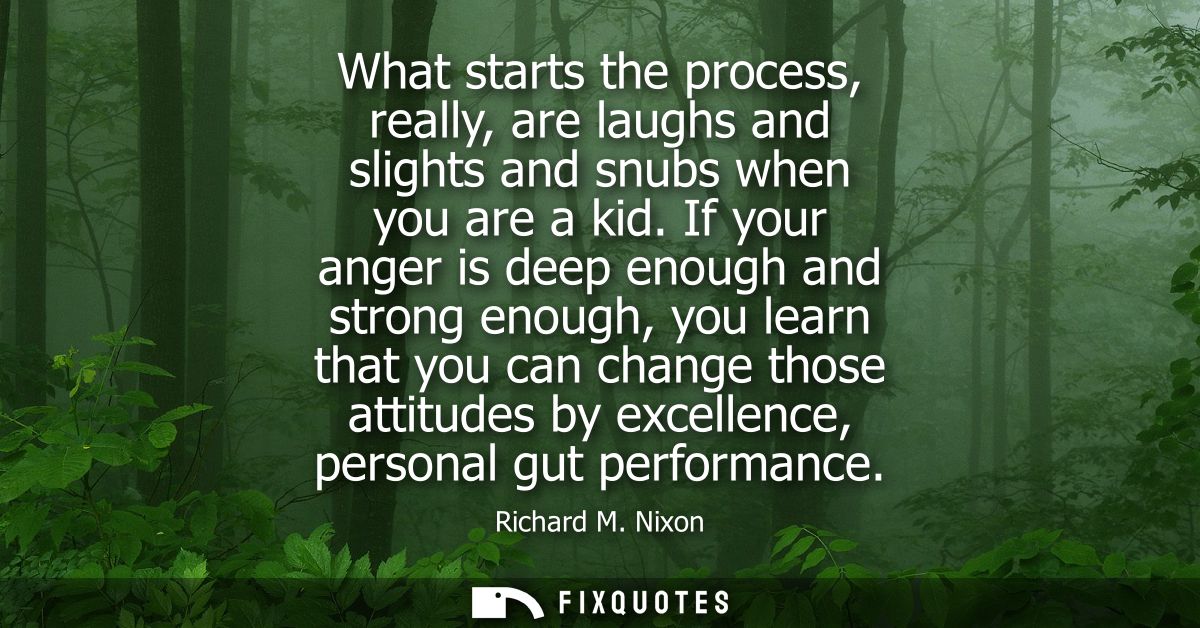
"What starts the process, really, are laughs and slights and snubs when you are a kid. If your anger is deep enough and strong enough, you learn that you can change those attitudes by excellence, personal gut performance"
About this Quote
Nixon frames ambition as a wound that learns to walk. The engine, he insists, isn’t lofty civic purpose; it’s childhood humiliation - “laughs and slights and snubs” - the petty cruelties that lodge in the body and metastasize into drive. The blunt list matters: it’s not one grand trauma but a drip of social vetoes, the kind that teach a kid exactly where the hierarchy is and where he’s been placed in it.
Then comes the turn that’s pure Nixon: anger isn’t denied, it’s refined into strategy. “If your anger is deep enough and strong enough” treats resentment as a resource, almost a fuel grade. He offers a Protestant, meritocratic alchemy: convert injury into “excellence,” a phrase that sounds noble until he tightens it with the more visceral “personal gut performance.” That wording is telling. It’s not just achievement; it’s a physical, solitary proving of self, as if politics is an arena where the only reliable currency is outworking the people who dismissed you.
The subtext is simultaneously self-justifying and faintly accusatory. If you still don’t like me, Nixon implies, I can force you to revise your judgment through undeniable results. It’s a theory of respect that never quite becomes affection, rooted in a lifelong sensitivity to elites and insiders. In context, coming from a president whose career oscillated between fierce competence and deep paranoia, the quote reads like an origin story for both: the chip on the shoulder that can build a statesman - and the hunger for vindication that can corrode one.
Then comes the turn that’s pure Nixon: anger isn’t denied, it’s refined into strategy. “If your anger is deep enough and strong enough” treats resentment as a resource, almost a fuel grade. He offers a Protestant, meritocratic alchemy: convert injury into “excellence,” a phrase that sounds noble until he tightens it with the more visceral “personal gut performance.” That wording is telling. It’s not just achievement; it’s a physical, solitary proving of self, as if politics is an arena where the only reliable currency is outworking the people who dismissed you.
The subtext is simultaneously self-justifying and faintly accusatory. If you still don’t like me, Nixon implies, I can force you to revise your judgment through undeniable results. It’s a theory of respect that never quite becomes affection, rooted in a lifelong sensitivity to elites and insiders. In context, coming from a president whose career oscillated between fierce competence and deep paranoia, the quote reads like an origin story for both: the chip on the shoulder that can build a statesman - and the hunger for vindication that can corrode one.
Quote Details
| Topic | Motivational |
|---|
More Quotes by Richard
Add to List