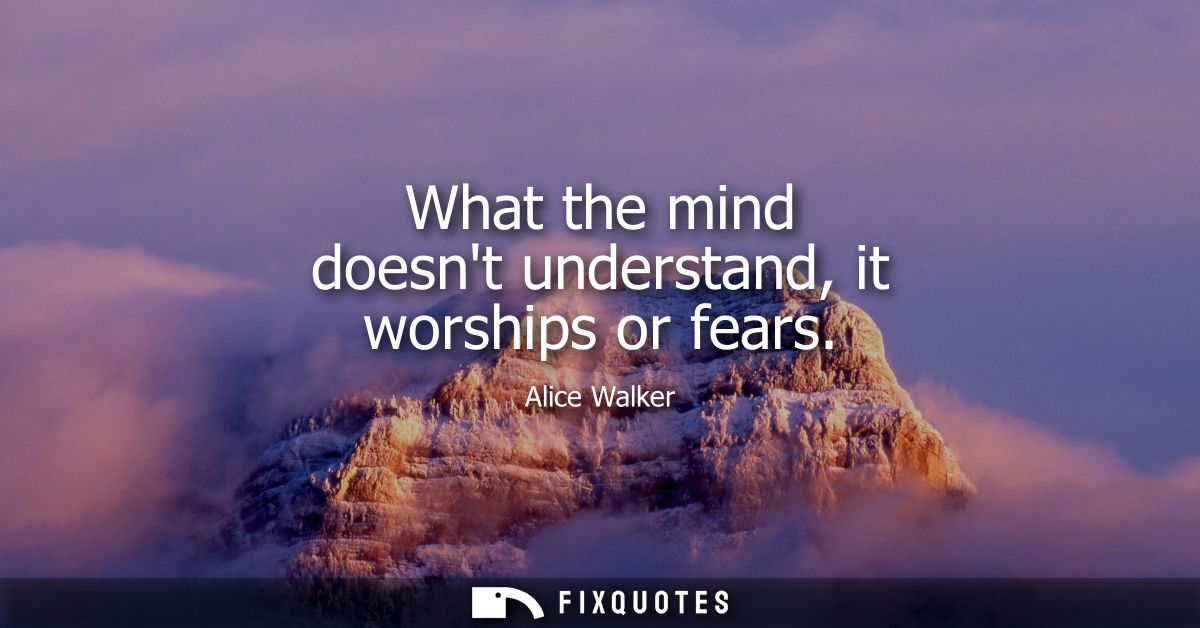
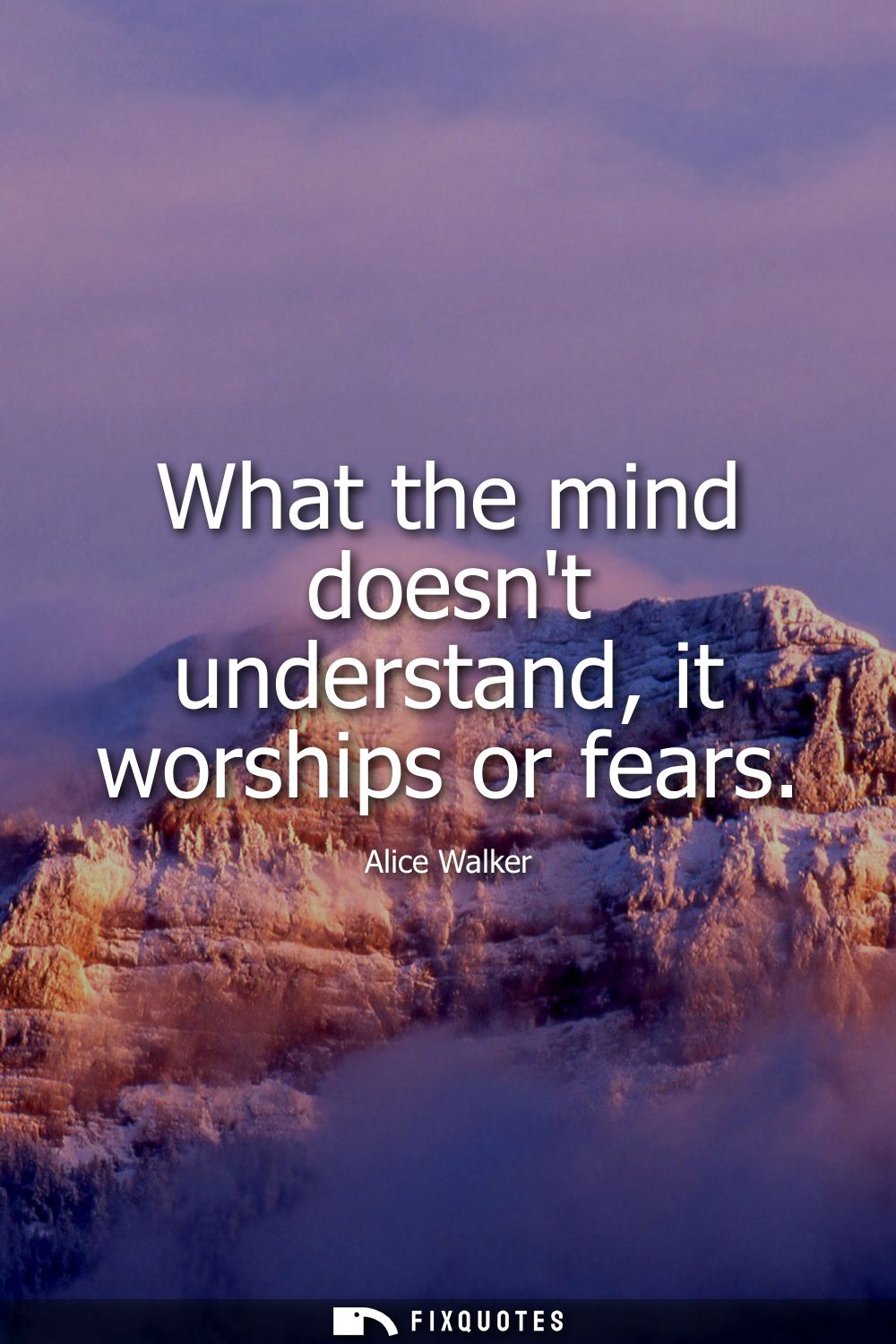
"What the mind doesn't understand, it worships or fears"
About this Quote
Mysticism and menace often begin at the same place: a gap in understanding. Alice Walker’s line cuts through the polite fiction that ignorance is neutral. When the mind can’t name a thing, it doesn’t merely shrug; it reaches for the two most socially powerful shortcuts available: reverence or dread. Worship turns the unknown into authority. Fear turns it into threat. Either way, the result is the same kind of surrender - a decision to stop thinking and start obeying.
Walker’s intent lands in the terrain she’s long mapped as a novelist and essayist: the everyday systems that survive by staying illegible. The subtext is political as much as psychological. “Mind” here isn’t just an individual brain; it’s a community’s shared sense-making. When cultures refuse to understand other people - their histories, bodies, religions, languages - they compensate by mythologizing them (exoticizing, sanctifying) or demonizing them (criminalizing, pathologizing). Both reactions feel emotionally satisfying because they protect the ego: if I worship you, I don’t have to meet you as an equal; if I fear you, I don’t have to examine my own power.
The sentence works because it’s clean and unsentimental, refusing the usual escape hatch of “misunderstanding.” Walker frames it as a pattern with consequences, not a miscommunication with a solution. In a world where propaganda thrives on confusion and certainty is marketed like comfort, the quote reads as both warning and dare: learn, or you’ll hand your agency to whatever story is loudest.
Walker’s intent lands in the terrain she’s long mapped as a novelist and essayist: the everyday systems that survive by staying illegible. The subtext is political as much as psychological. “Mind” here isn’t just an individual brain; it’s a community’s shared sense-making. When cultures refuse to understand other people - their histories, bodies, religions, languages - they compensate by mythologizing them (exoticizing, sanctifying) or demonizing them (criminalizing, pathologizing). Both reactions feel emotionally satisfying because they protect the ego: if I worship you, I don’t have to meet you as an equal; if I fear you, I don’t have to examine my own power.
The sentence works because it’s clean and unsentimental, refusing the usual escape hatch of “misunderstanding.” Walker frames it as a pattern with consequences, not a miscommunication with a solution. In a world where propaganda thrives on confusion and certainty is marketed like comfort, the quote reads as both warning and dare: learn, or you’ll hand your agency to whatever story is loudest.
Quote Details
| Topic | Wisdom |
|---|---|
| Source | Help us find the source |
| Cite |
Citation Formats
APA Style (7th ed.)
Walker, Alice. (2026, January 15). What the mind doesn't understand, it worships or fears. FixQuotes. https://fixquotes.com/quotes/what-the-mind-doesnt-understand-it-worships-or-37272/
Chicago Style
Walker, Alice. "What the mind doesn't understand, it worships or fears." FixQuotes. January 15, 2026. https://fixquotes.com/quotes/what-the-mind-doesnt-understand-it-worships-or-37272/.
MLA Style (9th ed.)
"What the mind doesn't understand, it worships or fears." FixQuotes, 15 Jan. 2026, https://fixquotes.com/quotes/what-the-mind-doesnt-understand-it-worships-or-37272/. Accessed 5 Mar. 2026.
More Quotes by Alice
Add to List