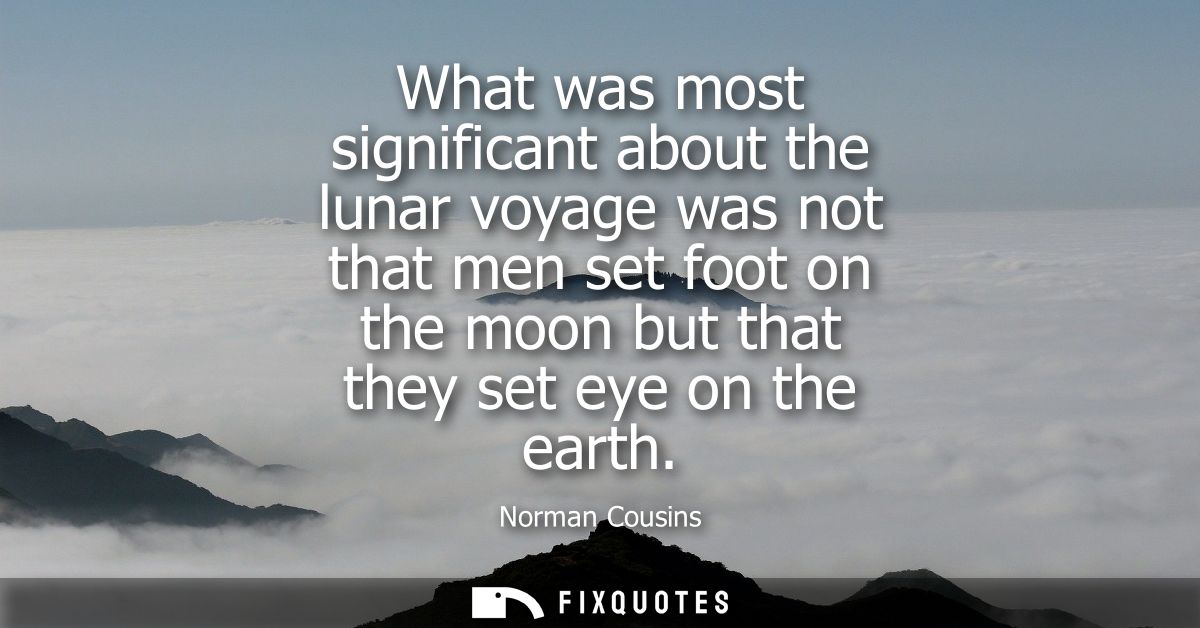
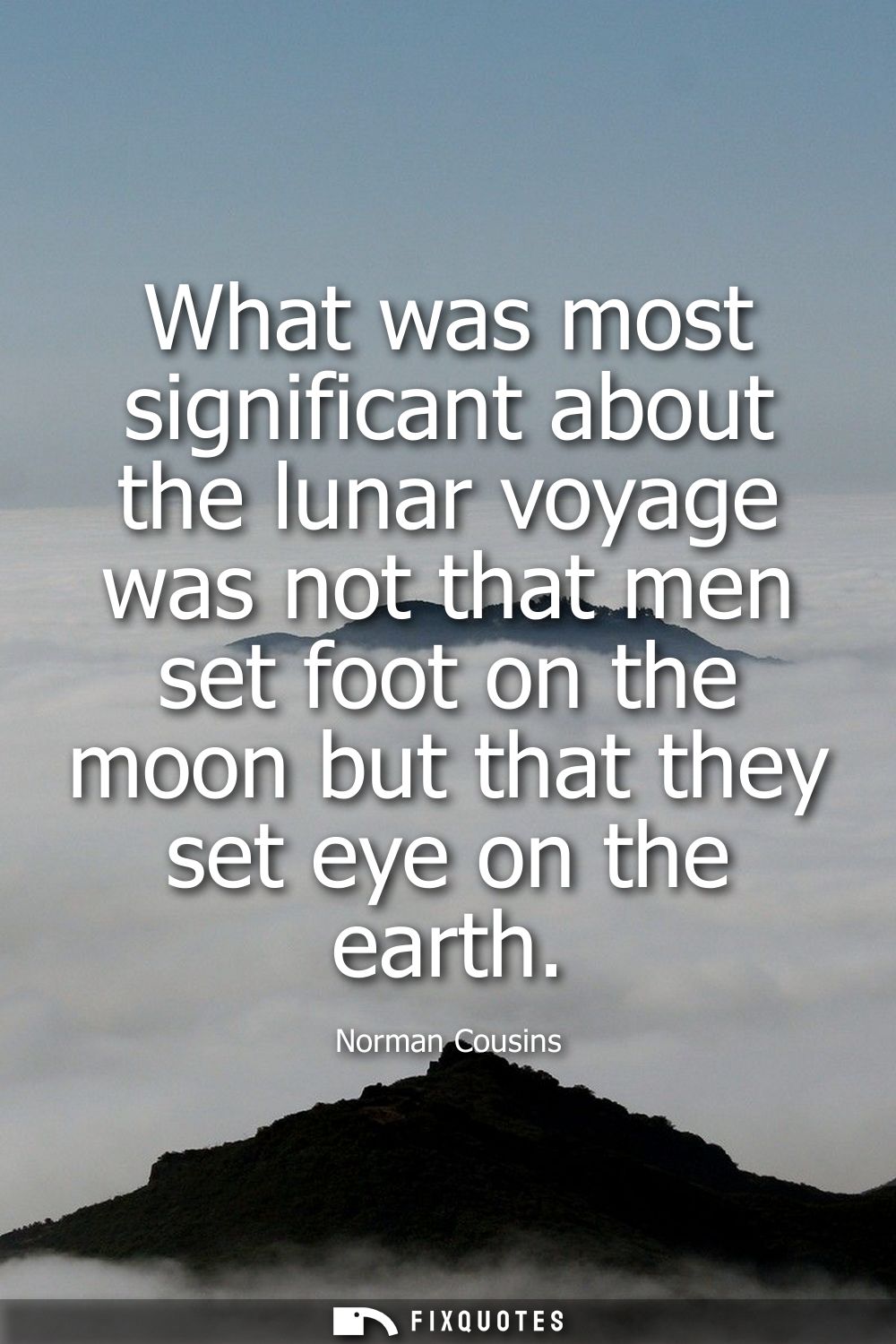
"What was most significant about the lunar voyage was not that men set foot on the moon, but that they set eye on the earth"
About this Quote
The phrasing is surgical. “Set foot” is muscular, colonial, almost transactional: conquest, territory, possession. “Set eye” is intimate and vulnerable, suggesting attention, recognition, even responsibility. Cousins reframes exploration as perception. What changes history isn’t the act of arriving somewhere new, but the shock of seeing home as a single object - finite, fragile, borderless. He’s pointing to the famous “Earthrise” effect without name-checking it: the image that compressed geopolitics into a small blue sphere and made nationalism look, at best, parochial.
Context matters here. Cousins was a prominent public intellectual in a century defined by technological triumphs paired with existential threats (nuclear arms, environmental degradation). Apollo’s spectacle risked being absorbed as propaganda or entertainment; Cousins insists it should be read as an ethical lesson. The subtext is almost accusatory: if we can cross the void and still fail to care for what we already have, the achievement is hollow.
It’s a humanist pivot disguised as a space quote: progress isn’t escape velocity, it’s expanded empathy.
Quote Details
| Topic | Wisdom |
|---|---|
| Source | Verified source: Rendezvous with Infinity (Norman Cousins, 1979)
Evidence: What was most significant about the first lunar voyage was not that men set foot on the moon, but that they set eye on earth. (Page 30). This wording appears in Norman Cousins’ own bylined piece, “Rendezvous with Infinity,” published in Cosmic Search, Volume 1 Number 1 (January 1979). Note the most-common secondary-quote variants differ slightly: (1) “lunar voyage” vs. “first lunar voyage,” (2) “the Earth” vs. “earth,” and (3) omission of the comma after “moon.” This Cosmic Search article is a primary source and is a verifiable, citable publication that contains the quote on the article’s starting page (page 30). I did not find reliable evidence (from Cousins’ own earlier publications) that this exact sentence was published or spoken earlier than January 1979; however, further confirmation would require checking Cousins’ earlier essays/speeches in print (e.g., Saturday Review-era columns) in archival databases. Other candidates (1) Dark Side of the Moon (Gerard DeGroot, 2010) compilation96.0% ... Norman Cousins once said that ” What was most significant about the lunar voyage was not that men set foot on the... |
| Cite |
Citation Formats
APA Style (7th ed.)
Cousins, Norman. (2026, February 23). What was most significant about the lunar voyage was not that men set foot on the moon, but that they set eye on the earth. FixQuotes. https://fixquotes.com/quotes/what-was-most-significant-about-the-lunar-voyage-92817/
Chicago Style
Cousins, Norman. "What was most significant about the lunar voyage was not that men set foot on the moon, but that they set eye on the earth." FixQuotes. February 23, 2026. https://fixquotes.com/quotes/what-was-most-significant-about-the-lunar-voyage-92817/.
MLA Style (9th ed.)
"What was most significant about the lunar voyage was not that men set foot on the moon, but that they set eye on the earth." FixQuotes, 23 Feb. 2026, https://fixquotes.com/quotes/what-was-most-significant-about-the-lunar-voyage-92817/. Accessed 28 Mar. 2026.