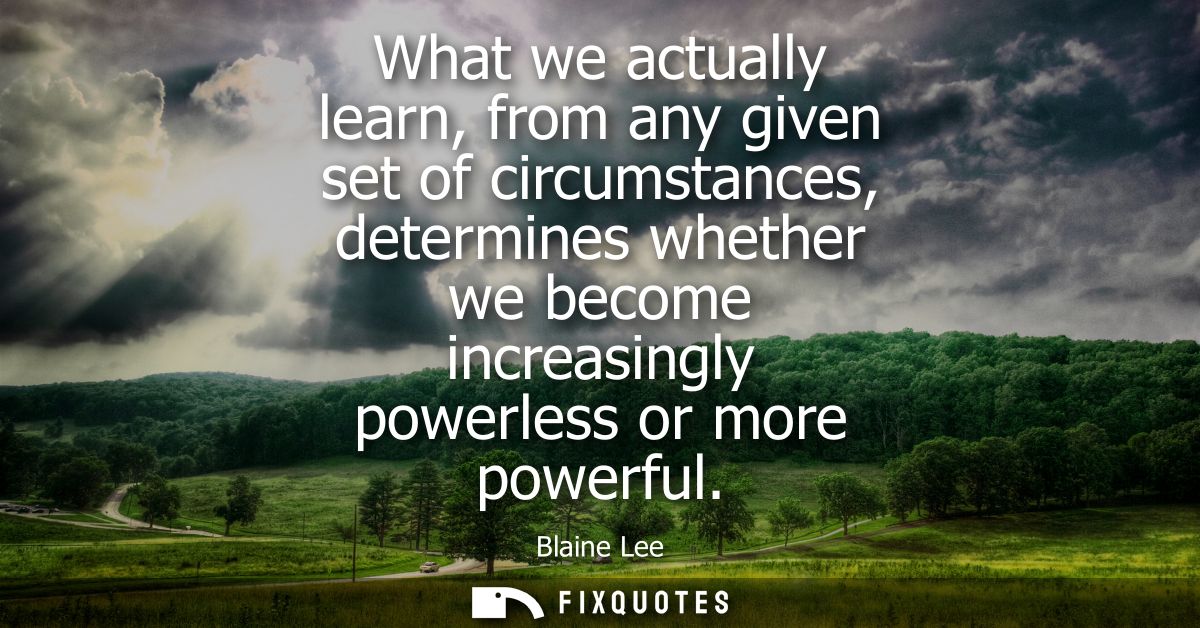
"What we actually learn, from any given set of circumstances, determines whether we become increasingly powerless or more powerful"
About this Quote
The key word is "actually". It implies a mismatch between what happens and what we take from it - and it quietly accuses us of getting the lesson wrong. That's the subtextual sting. We don't just endure circumstances; we author the story they become. If we learn helplessness (a familiar script in modern life: institutions fail, algorithms decide, bosses ghost), we become "increasingly powerless". If we learn patterns, boundaries, and leverage, we get "more powerful". Lee isn't promising control over events; he's insisting on control over meaning, which is often the only viable handle in a chaotic world.
The binary - powerless or powerful - is intentionally stark, almost moral in its pressure. It nudges the reader toward responsibility without saying "it's your fault". In the late-20th-century leadership and personal-development ecosystem where Lee wrote, this kind of sentence functions as a tool: a mantra meant to interrupt victimhood narratives and reframe setbacks as training data. It works because it doesn't deny pain; it argues pain can be processed into capacity.
Quote Details
| Topic | Learning from Mistakes |
|---|---|
| Source | Help us find the source |
| Cite |
Citation Formats
APA Style (7th ed.)
Lee, Blaine. (2026, January 15). What we actually learn, from any given set of circumstances, determines whether we become increasingly powerless or more powerful. FixQuotes. https://fixquotes.com/quotes/what-we-actually-learn-from-any-given-set-of-163356/
Chicago Style
Lee, Blaine. "What we actually learn, from any given set of circumstances, determines whether we become increasingly powerless or more powerful." FixQuotes. January 15, 2026. https://fixquotes.com/quotes/what-we-actually-learn-from-any-given-set-of-163356/.
MLA Style (9th ed.)
"What we actually learn, from any given set of circumstances, determines whether we become increasingly powerless or more powerful." FixQuotes, 15 Jan. 2026, https://fixquotes.com/quotes/what-we-actually-learn-from-any-given-set-of-163356/. Accessed 30 Mar. 2026.