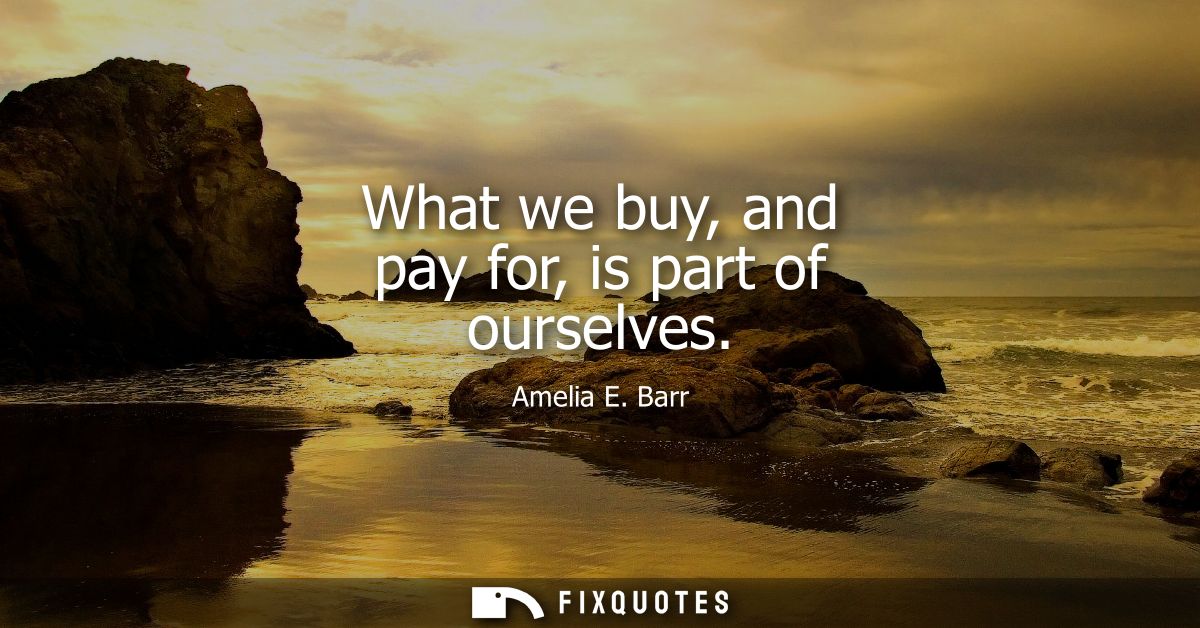
"What we buy, and pay for, is part of ourselves"
About this Quote
Consumption is never just a transaction in Barr's line; it's self-portraiture with a price tag. "What we buy, and pay for" sounds like a tidy ledger entry, then she swerves: the object becomes "part of ourselves". The phrasing is bluntly possessive, almost bodily. Paying isn't framed as a loss but as a kind of grafting - we attach the purchased thing to identity, memory, habit, status. Barr isn't romanticizing shopping; she's pointing to the quiet intimacy of ordinary choices, the way money turns values into visible evidence.
The intent lands harder in her era. Barr wrote in the long shadow of industrial capitalism's boom: mass production, department stores, expanding middle-class domestic life, and an increasingly moralized marketplace where thrift and respectability were policed, especially for women. In that context, buying isn't neutral. It signals class, discipline, aspiration, and belonging. Paying "for" something is also paying "with" something: time, labor, dependence, a husband's wage, a writer's royalties. The subtext is that every purchase is an ethical and social wager about who you are allowed to be.
The line also carries a warning: if purchases become "part of ourselves", they can colonize the self. Barr anticipates a modern discomfort - that identity is built through commodities - without the smugness of later critiques. She compresses an entire economy of desire into a single domestic truth: we don't merely own things; we are, in small accumulating ways, owned back by the choices we finance.
The intent lands harder in her era. Barr wrote in the long shadow of industrial capitalism's boom: mass production, department stores, expanding middle-class domestic life, and an increasingly moralized marketplace where thrift and respectability were policed, especially for women. In that context, buying isn't neutral. It signals class, discipline, aspiration, and belonging. Paying "for" something is also paying "with" something: time, labor, dependence, a husband's wage, a writer's royalties. The subtext is that every purchase is an ethical and social wager about who you are allowed to be.
The line also carries a warning: if purchases become "part of ourselves", they can colonize the self. Barr anticipates a modern discomfort - that identity is built through commodities - without the smugness of later critiques. She compresses an entire economy of desire into a single domestic truth: we don't merely own things; we are, in small accumulating ways, owned back by the choices we finance.
Quote Details
| Topic | Money |
|---|---|
| Source | Verified source: All the Days of My Life (Amelia E. Barr, 1913)
Evidence: Good! What we buy, and pay for, is part of ourselves. (Page 205). The quote appears in Amelia E. Barr's autobiography All the Days of My Life: An Autobiography. In the Project Gutenberg transcription, the line appears on the page image/transcription corresponding to page 205, in a passage about Barr establishing a home in Austin, Texas. This is a primary-source occurrence in Barr's own published writing. Search results from quote sites also point to this book, and the Gutenberg text directly verifies the wording. I did not find evidence of an earlier speech, interview, or article containing this exact line, so the earliest verified primary-source publication I could confirm is this 1913 book. Other candidates (1) All the Days of My Life: An Autobiography (Amelia E. Barr, 2022) compilation95.0% The Red Leaves of a Human Heart Amelia E. Barr. strong domestic. The walls were covered with the same material, and t... |
| Cite |
Citation Formats
APA Style (7th ed.)
Barr, Amelia E. (2026, March 7). What we buy, and pay for, is part of ourselves. FixQuotes. https://fixquotes.com/quotes/what-we-buy-and-pay-for-is-part-of-ourselves-161968/
Chicago Style
Barr, Amelia E. "What we buy, and pay for, is part of ourselves." FixQuotes. March 7, 2026. https://fixquotes.com/quotes/what-we-buy-and-pay-for-is-part-of-ourselves-161968/.
MLA Style (9th ed.)
"What we buy, and pay for, is part of ourselves." FixQuotes, 7 Mar. 2026, https://fixquotes.com/quotes/what-we-buy-and-pay-for-is-part-of-ourselves-161968/. Accessed 6 Apr. 2026.
More Quotes by Amelia
Add to List