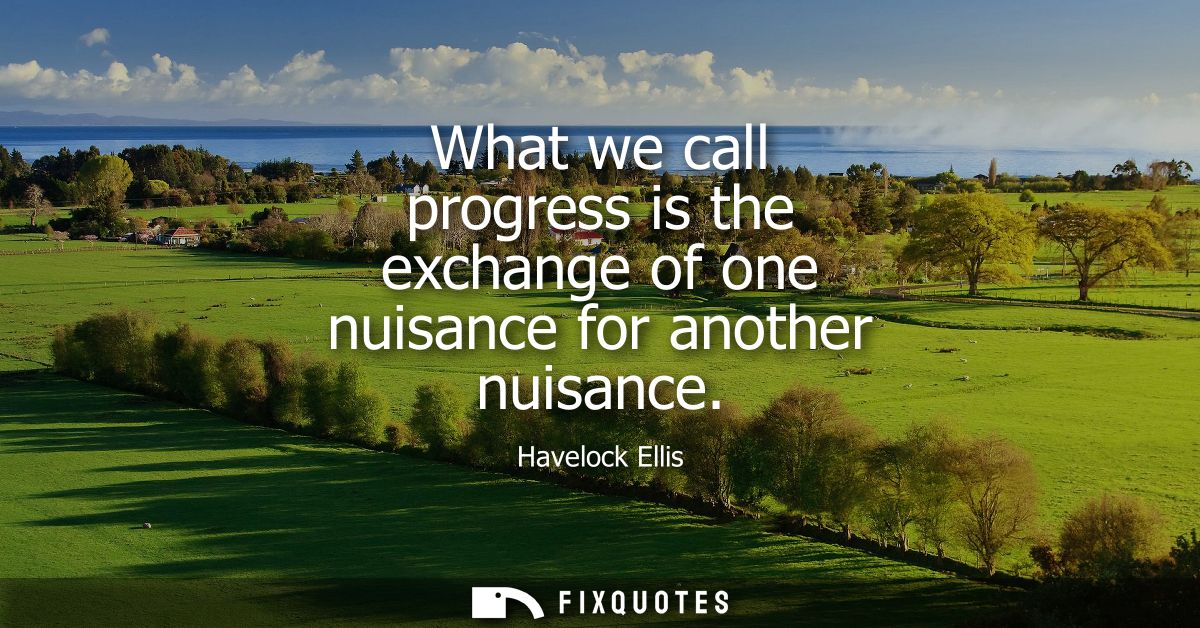
"What we call progress is the exchange of one nuisance for another nuisance"
About this Quote
Progress, Ellis suggests, is less a staircase than a revolving door: you exit one irritation only to meet the next one in the lobby. It lands because it punctures the Victorian-to-modern faith that history naturally “improves” us. By calling the result a “nuisance” either way, he strips innovation of its halo and brings it down to the daily, bodily scale where a psychologist like Ellis lived professionally: habits, anxieties, social friction, the quiet misery of norms that change faster than people do.
The intent isn’t to sneer at change so much as to demystify it. “Exchange” is doing the real work: progress becomes a transaction with hidden fees, not a moral triumph. Ellis’s subtext is that every solution reorganizes discomfort rather than abolishing it. New freedoms create new pressures; new knowledge creates new categories to be judged by; new technologies save time and then colonize it. Nuisance is not an accident of progress but part of its engine, the persistent grit that keeps societies moving and individuals adapting.
Context sharpens the edge. Ellis wrote in an era obsessed with modernization and “scientific” management of life, while he himself studied sexuality and social norms in ways that unsettled polite certainties. His line reads like a clinical warning against utopian promises: expect trade-offs, expect unintended consequences, and be wary of anyone selling a future without hassles. The cynicism is measured, almost therapeutic: if you anticipate nuisance, you can choose which one you’re willing to live with.
The intent isn’t to sneer at change so much as to demystify it. “Exchange” is doing the real work: progress becomes a transaction with hidden fees, not a moral triumph. Ellis’s subtext is that every solution reorganizes discomfort rather than abolishing it. New freedoms create new pressures; new knowledge creates new categories to be judged by; new technologies save time and then colonize it. Nuisance is not an accident of progress but part of its engine, the persistent grit that keeps societies moving and individuals adapting.
Context sharpens the edge. Ellis wrote in an era obsessed with modernization and “scientific” management of life, while he himself studied sexuality and social norms in ways that unsettled polite certainties. His line reads like a clinical warning against utopian promises: expect trade-offs, expect unintended consequences, and be wary of anyone selling a future without hassles. The cynicism is measured, almost therapeutic: if you anticipate nuisance, you can choose which one you’re willing to live with.
Quote Details
| Topic | Wisdom |
|---|---|
| Source | Help us find the source |
| Cite | Cite this Quote |
Citation Formats
APA Style (7th ed.)
Ellis, Havelock. (n.d.). What we call progress is the exchange of one nuisance for another nuisance. FixQuotes. https://fixquotes.com/quotes/what-we-call-progress-is-the-exchange-of-one-148535/
Chicago Style
Ellis, Havelock. "What we call progress is the exchange of one nuisance for another nuisance." FixQuotes. Accessed February 2, 2026. https://fixquotes.com/quotes/what-we-call-progress-is-the-exchange-of-one-148535/.
MLA Style (9th ed.)
"What we call progress is the exchange of one nuisance for another nuisance." FixQuotes, https://fixquotes.com/quotes/what-we-call-progress-is-the-exchange-of-one-148535/. Accessed 2 Feb. 2026.
More Quotes by Havelock
Add to List