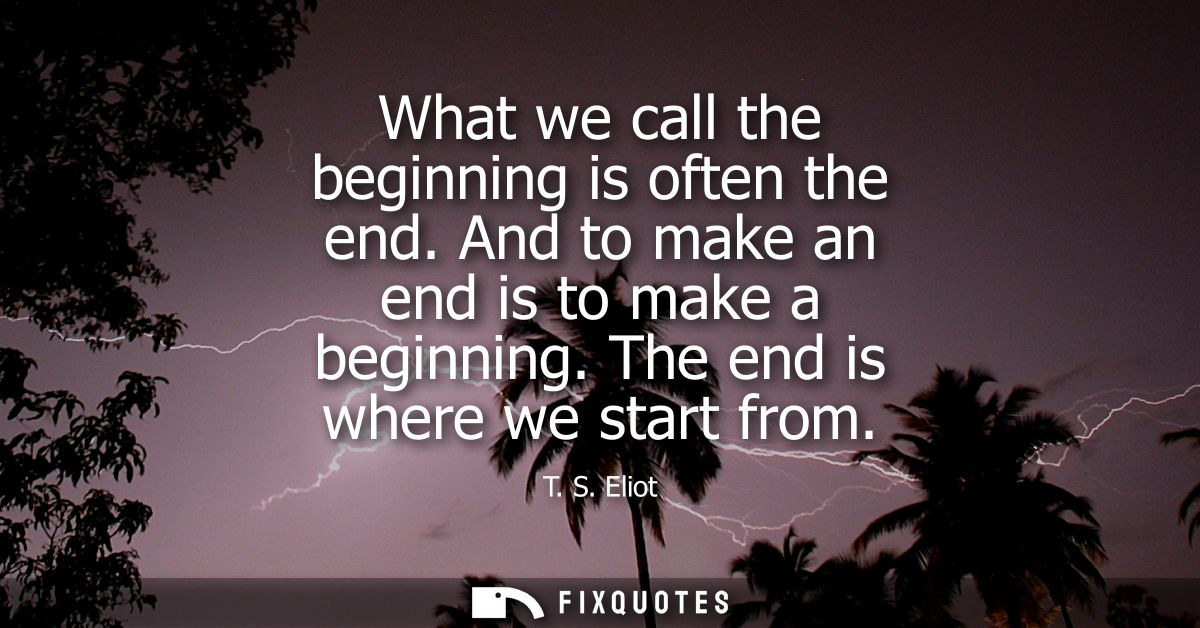
"What we call the beginning is often the end. And to make an end is to make a beginning. The end is where we start from"
About this Quote
Eliot makes a tidy paradox feel like a bruise you keep pressing: the line insists that our neat timelines are emotional fictions, not lived reality. The repetition of "beginning" and "end" works like a ritual chant, the kind you use when language has to carry what logic can’t. He’s not being cute. He’s staging a mind trying to survive change without lying to itself about what change costs.
Written into the grain of Four Quartets (from which this comes) is Eliot’s wartime sense of history as recurrence rather than progress. London is being bombed; Europe is watching old certainties collapse; modernity’s promise of forward motion looks shaky. In that context, "the end is where we start from" reads less like inspiration-poster wisdom and more like an anti-romantic admission: you don’t graduate out of fear, grief, faith, or doubt. You circle back, older, carrying different evidence.
The subtext is theological as much as psychological. Eliot, an Anglo-Catholic poet, is always testing whether time is a trap or a doorway. Endings become a kind of purgation: losing what you thought you were, so you can re-enter the world with fewer illusions. The syntax itself enacts the turn; each sentence reverses the previous one, like footsteps retracing a path and discovering it’s not the same path anymore. What “starts” us, Eliot implies, isn’t novelty. It’s reckoning.
Written into the grain of Four Quartets (from which this comes) is Eliot’s wartime sense of history as recurrence rather than progress. London is being bombed; Europe is watching old certainties collapse; modernity’s promise of forward motion looks shaky. In that context, "the end is where we start from" reads less like inspiration-poster wisdom and more like an anti-romantic admission: you don’t graduate out of fear, grief, faith, or doubt. You circle back, older, carrying different evidence.
The subtext is theological as much as psychological. Eliot, an Anglo-Catholic poet, is always testing whether time is a trap or a doorway. Endings become a kind of purgation: losing what you thought you were, so you can re-enter the world with fewer illusions. The syntax itself enacts the turn; each sentence reverses the previous one, like footsteps retracing a path and discovering it’s not the same path anymore. What “starts” us, Eliot implies, isn’t novelty. It’s reckoning.
Quote Details
| Topic | New Beginnings |
|---|
More Quotes by S. Eliot
Add to List