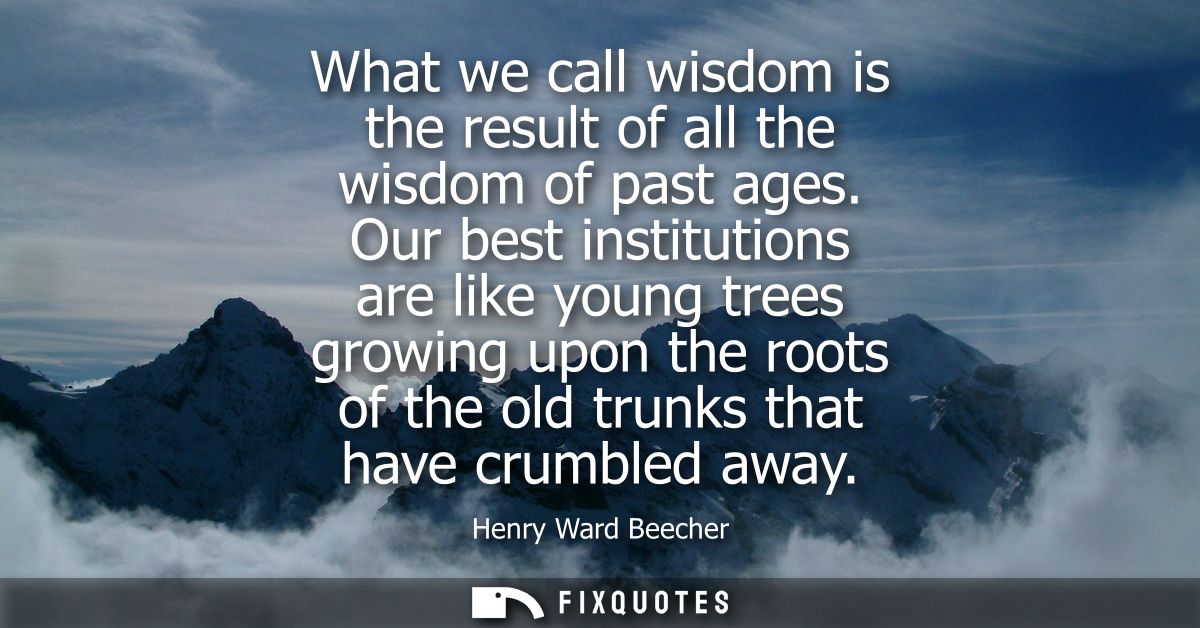
"What we call wisdom is the result of all the wisdom of past ages. Our best institutions are like young trees growing upon the roots of the old trunks that have crumbled away"
About this Quote
The tree image sharpens the argument and reveals Beecher’s intent. He’s not praising tradition as a museum piece; he’s defending it as organic compost. “Young trees” signals vitality and change, while “roots of the old trunks that have crumbled away” admits decay, failure, and obsolescence. Institutions endure not because the past was pure, but because the past was useful. The crumbling trunk is an unusually honest concession from a 19th-century clergyman in a nation obsessed with progress: history is not a pedestal, it’s mulch.
The subtext has a civic edge. Beecher lived through abolitionist conflict, civil war, and rapid industrialization - decades when Americans argued whether to break with inherited structures or sanctify them. His metaphor threads that needle: reform can be legitimate precisely because it grows from what came before. For a preacher, this is also theological messaging: faith, morals, and social order are cumulative, not improvised. The line is persuasive because it makes continuity feel natural rather than coercive, giving change permission while keeping the past on the payroll.
Quote Details
| Topic | Wisdom |
|---|---|
| Source | Help us find the source |
| Cite |
Citation Formats
APA Style (7th ed.)
Beecher, Henry Ward. (2026, January 17). What we call wisdom is the result of all the wisdom of past ages. Our best institutions are like young trees growing upon the roots of the old trunks that have crumbled away. FixQuotes. https://fixquotes.com/quotes/what-we-call-wisdom-is-the-result-of-all-the-37071/
Chicago Style
Beecher, Henry Ward. "What we call wisdom is the result of all the wisdom of past ages. Our best institutions are like young trees growing upon the roots of the old trunks that have crumbled away." FixQuotes. January 17, 2026. https://fixquotes.com/quotes/what-we-call-wisdom-is-the-result-of-all-the-37071/.
MLA Style (9th ed.)
"What we call wisdom is the result of all the wisdom of past ages. Our best institutions are like young trees growing upon the roots of the old trunks that have crumbled away." FixQuotes, 17 Jan. 2026, https://fixquotes.com/quotes/what-we-call-wisdom-is-the-result-of-all-the-37071/. Accessed 18 Feb. 2026.