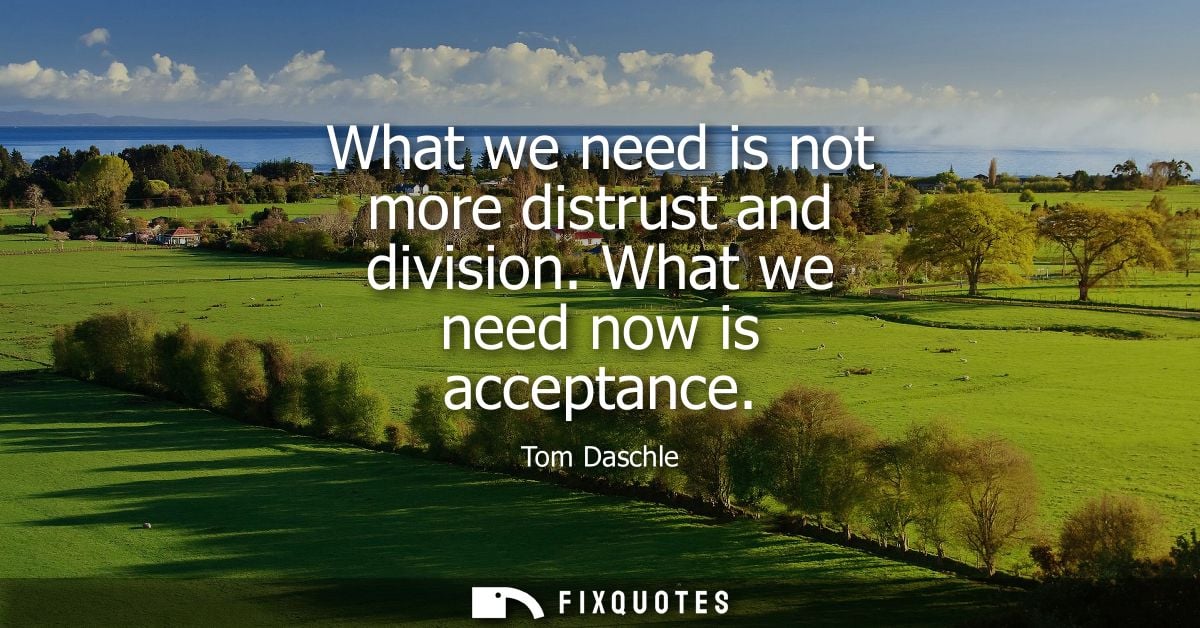
"What we need is not more distrust and division. What we need now is acceptance"
About this Quote
The rhetoric works by pairing negatives (“not more”) with a soft imperative (“what we need”), sliding from critique to comfort without naming a culprit. “Acceptance” is the key: it’s morally luminous and strategically ambiguous. Acceptance of what, exactly - policy compromise, election outcomes, demographic change, ideological pluralism? The vagueness is the point. It invites listeners to pour their own grievance into “division” and their own preferred settlement into “acceptance,” creating a coalition of interpretation rather than a coalition of specifics.
As a late-20th/early-21st century American politician, Daschle is speaking from inside an era when partisan identity hardened into lifestyle, cable news monetized outrage, and institutions became proxy battlefields. In that climate, “acceptance” functions as both plea and pressure. It asks citizens to lower the temperature, but it also nudges dissenters to accept the prevailing framework - the legitimacy of process, the necessity of coexistence, the idea that political opponents are still compatriots.
The subtext is a bet: that social repair begins not with winning an argument, but with re-legitimizing the other side’s presence. It’s less a policy prescription than a demand for civic adulthood.
Quote Details
| Topic | Peace |
|---|---|
| Source | Help us find the source |
| Cite |
Citation Formats
APA Style (7th ed.)
Daschle, Tom. (2026, January 15). What we need is not more distrust and division. What we need now is acceptance. FixQuotes. https://fixquotes.com/quotes/what-we-need-is-not-more-distrust-and-division-156925/
Chicago Style
Daschle, Tom. "What we need is not more distrust and division. What we need now is acceptance." FixQuotes. January 15, 2026. https://fixquotes.com/quotes/what-we-need-is-not-more-distrust-and-division-156925/.
MLA Style (9th ed.)
"What we need is not more distrust and division. What we need now is acceptance." FixQuotes, 15 Jan. 2026, https://fixquotes.com/quotes/what-we-need-is-not-more-distrust-and-division-156925/. Accessed 27 Mar. 2026.