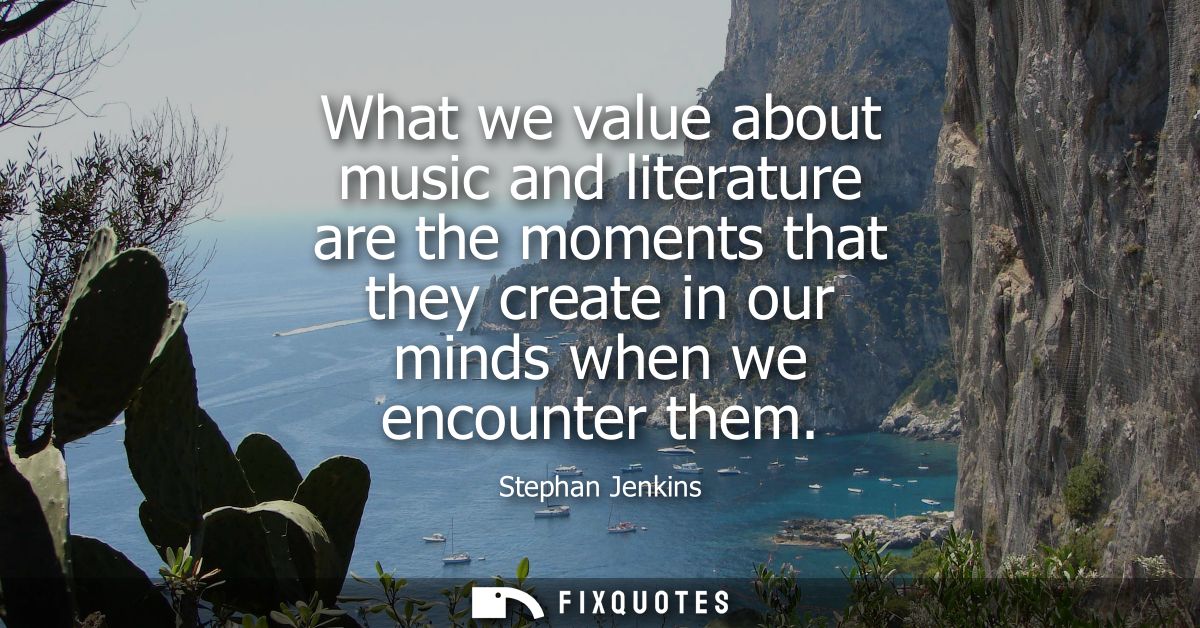
"What we value about music and literature are the moments that they create in our minds when we encounter them"
About this Quote
Stephan Jenkins is arguing for art as an event, not an object: the real “value” of music and literature isn’t lodged in technique, prestige, or even message, but in the private mental cinema they trigger. It’s a musician’s way of defending the intangible against the spreadsheet. In an era where songs are background noise and books are “content,” he’s insisting the payoff happens in a flash of interior life: a scene, a feeling, a remembered smell, a future you suddenly rehearse.
The phrasing matters. “Moments” is modest on purpose. Not enlightenment, not transformation, just the kind of quick, vivid psychic weather shift that only art can cause when it lands correctly. “Create in our minds” quietly relocates authorship. The artist supplies the spark; the listener or reader finishes the job. That’s both democratic and self-protective: if meaning is co-authored by the audience, then the critic’s demand for a single definitive interpretation starts to look beside the point.
There’s also a subtle swipe at cultural gatekeeping. By pairing music and literature, Jenkins collapses the high/low divide and argues they’re evaluated by the same metric: do they generate lived mental experience? It’s a statement shaped by late-20th/early-21st century media saturation, where abundance forces triage. The works that survive aren’t necessarily the “best” on paper; they’re the ones that keep producing replayable inner moments - the hook you can’t unhear, the sentence you can’t stop carrying around.
The phrasing matters. “Moments” is modest on purpose. Not enlightenment, not transformation, just the kind of quick, vivid psychic weather shift that only art can cause when it lands correctly. “Create in our minds” quietly relocates authorship. The artist supplies the spark; the listener or reader finishes the job. That’s both democratic and self-protective: if meaning is co-authored by the audience, then the critic’s demand for a single definitive interpretation starts to look beside the point.
There’s also a subtle swipe at cultural gatekeeping. By pairing music and literature, Jenkins collapses the high/low divide and argues they’re evaluated by the same metric: do they generate lived mental experience? It’s a statement shaped by late-20th/early-21st century media saturation, where abundance forces triage. The works that survive aren’t necessarily the “best” on paper; they’re the ones that keep producing replayable inner moments - the hook you can’t unhear, the sentence you can’t stop carrying around.
Quote Details
| Topic | Art |
|---|---|
| Source | Help us find the source |
More Quotes by Stephan
Add to List