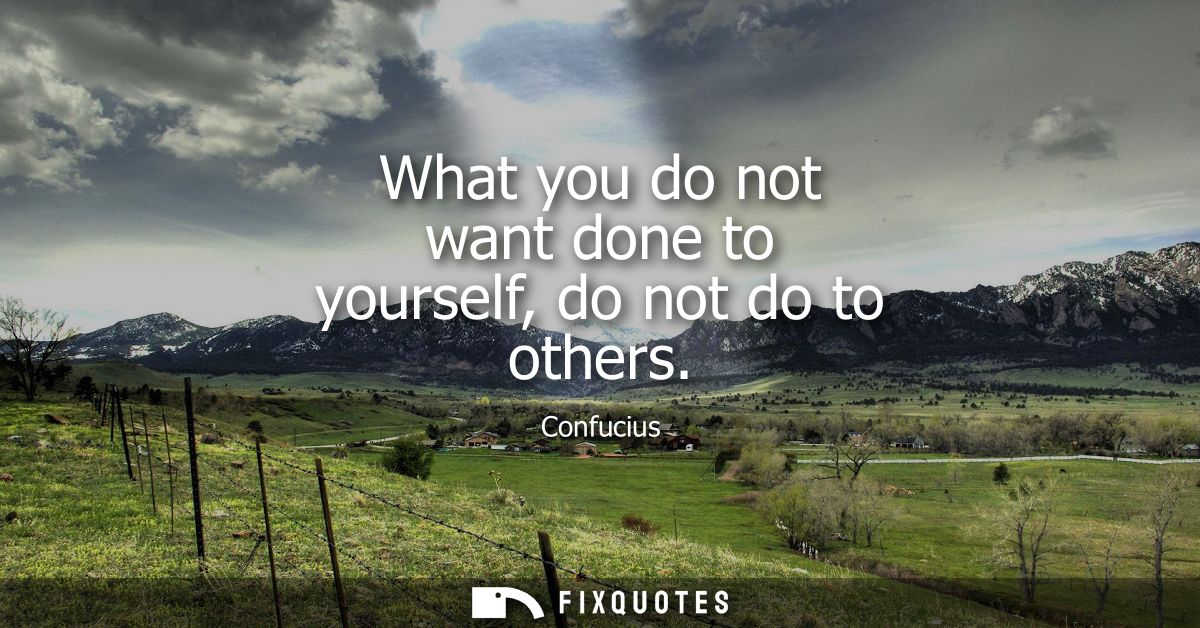
"What you do not want done to yourself, do not do to others"
About this Quote
A rule this spare doesn’t need poetry; it needs compliance. Confucius frames ethics as a discipline of restraint, not a theater of heroism. The line is the negative version of what later cultures call the Golden Rule, and that “do not” matters: it aims less at inspiring grand acts of kindness than at preventing everyday harm. In a society where status and ritual could easily rationalize cruelty, the simplest brake is empathy calibrated to self-interest. If you dislike humiliation, don’t traffic in it. If you dread arbitrary power, don’t wield it casually.
The subtext is political as much as personal. Confucius isn’t speaking as a mystic promising inner peace; he’s a civic repairman trying to stabilize a world of fraying hierarchies and constant conflict. His moral philosophy (ren, often translated as humaneness) depends on relationships functioning without constant coercion. This maxim is portable: it can be applied by rulers to subjects, parents to children, officials to rivals. Its genius is that it doesn’t require a shared theology, only a shared nervous system.
There’s also a deliberate modesty to the phrasing. It doesn’t claim you can fully know what others need; it asks you to start with what you know you can’t tolerate. That makes it harder to weaponize as “I’d like this, so you must,” and easier to use as a minimal standard of decency. Confucius offers ethics not as self-expression, but as social infrastructure.
The subtext is political as much as personal. Confucius isn’t speaking as a mystic promising inner peace; he’s a civic repairman trying to stabilize a world of fraying hierarchies and constant conflict. His moral philosophy (ren, often translated as humaneness) depends on relationships functioning without constant coercion. This maxim is portable: it can be applied by rulers to subjects, parents to children, officials to rivals. Its genius is that it doesn’t require a shared theology, only a shared nervous system.
There’s also a deliberate modesty to the phrasing. It doesn’t claim you can fully know what others need; it asks you to start with what you know you can’t tolerate. That makes it harder to weaponize as “I’d like this, so you must,” and easier to use as a minimal standard of decency. Confucius offers ethics not as self-expression, but as social infrastructure.
Quote Details
| Topic | Ethics & Morality |
|---|---|
| Source | Analects (Lunyu) — Chinese: “己所不欲,勿施于人” (commonly translated “Do not do to others what you do not want done to yourself”), traditionally attributed to Confucius (Analects). |
| Cite |
Citation Formats
APA Style (7th ed.)
Confucius. (2026, January 15). What you do not want done to yourself, do not do to others. FixQuotes. https://fixquotes.com/quotes/what-you-do-not-want-done-to-yourself-do-not-do-143/
Chicago Style
Confucius. "What you do not want done to yourself, do not do to others." FixQuotes. January 15, 2026. https://fixquotes.com/quotes/what-you-do-not-want-done-to-yourself-do-not-do-143/.
MLA Style (9th ed.)
"What you do not want done to yourself, do not do to others." FixQuotes, 15 Jan. 2026, https://fixquotes.com/quotes/what-you-do-not-want-done-to-yourself-do-not-do-143/. Accessed 25 Mar. 2026.
More Quotes by Confucius
Add to List