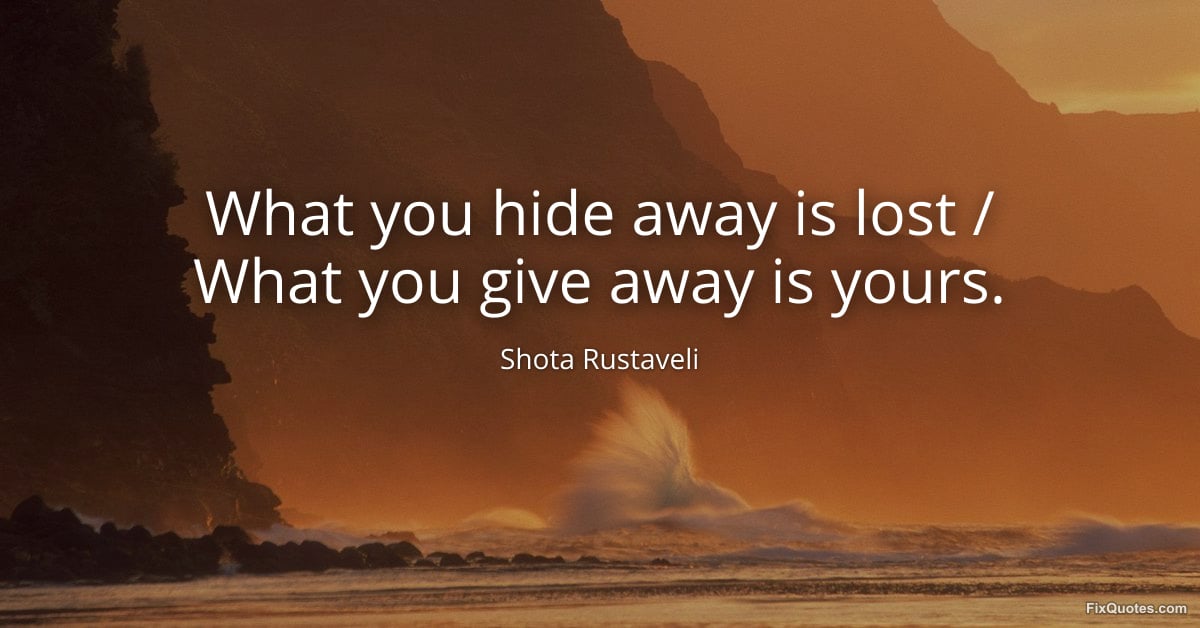
"What you hide away is lost / What you give away is yours"
About this Quote
Rustaveli’s couplet is a neat moral boomerang: the instinct to protect, hoard, and conceal doesn’t preserve value, it evaporates it. What’s kept “away” isn’t merely stored; it’s rendered inert, cut off from circulation, witness, and use. In a courtly world where status was performed through patronage and public generosity, hiding isn’t prudence, it’s a kind of social death. Loss here isn’t only material. It’s the loss of meaning.
The second line flips ownership into something almost paradoxical. “What you give away is yours” reframes possession as a legacy of action rather than a claim of control. The gift becomes yours because it binds others to you: through gratitude, story, reputation, obligation. In a culture where honor is communal and memory is currency, giving is an investment in permanence. Rustaveli suggests that the only durable property is what survives as relationship and narrative.
What makes the aphorism work is its stark accounting language applied to the soul. It reads like advice, but it’s also a quiet indictment of fear: the fear that generosity makes you smaller. Rustaveli argues the opposite. Hoarding shrinks the self into private darkness; giving enlarges it into the public record. The couplet doesn’t romanticize sacrifice; it gives it a hard, almost transactional logic. If you want something to remain yours, don’t lock it up. Let it live elsewhere, where it can’t be taken away by time in the same way.
The second line flips ownership into something almost paradoxical. “What you give away is yours” reframes possession as a legacy of action rather than a claim of control. The gift becomes yours because it binds others to you: through gratitude, story, reputation, obligation. In a culture where honor is communal and memory is currency, giving is an investment in permanence. Rustaveli suggests that the only durable property is what survives as relationship and narrative.
What makes the aphorism work is its stark accounting language applied to the soul. It reads like advice, but it’s also a quiet indictment of fear: the fear that generosity makes you smaller. Rustaveli argues the opposite. Hoarding shrinks the self into private darkness; giving enlarges it into the public record. The couplet doesn’t romanticize sacrifice; it gives it a hard, almost transactional logic. If you want something to remain yours, don’t lock it up. Let it live elsewhere, where it can’t be taken away by time in the same way.
Quote Details
| Topic | Kindness |
|---|---|
| Source | Cited as Rustaveli in New East Digital Archive article (15 June 2020) referencing his couplet (English translation as printed there). |
| Cite |
Citation Formats
APA Style (7th ed.)
Rustaveli, Shota. (2026, February 23). What you hide away is lost / What you give away is yours. FixQuotes. https://fixquotes.com/quotes/what-you-hide-away-is-lost-what-you-give-away-185654/
Chicago Style
Rustaveli, Shota. "What you hide away is lost / What you give away is yours." FixQuotes. February 23, 2026. https://fixquotes.com/quotes/what-you-hide-away-is-lost-what-you-give-away-185654/.
MLA Style (9th ed.)
"What you hide away is lost / What you give away is yours." FixQuotes, 23 Feb. 2026, https://fixquotes.com/quotes/what-you-hide-away-is-lost-what-you-give-away-185654/. Accessed 23 Feb. 2026.
More Quotes by Shota
Add to List