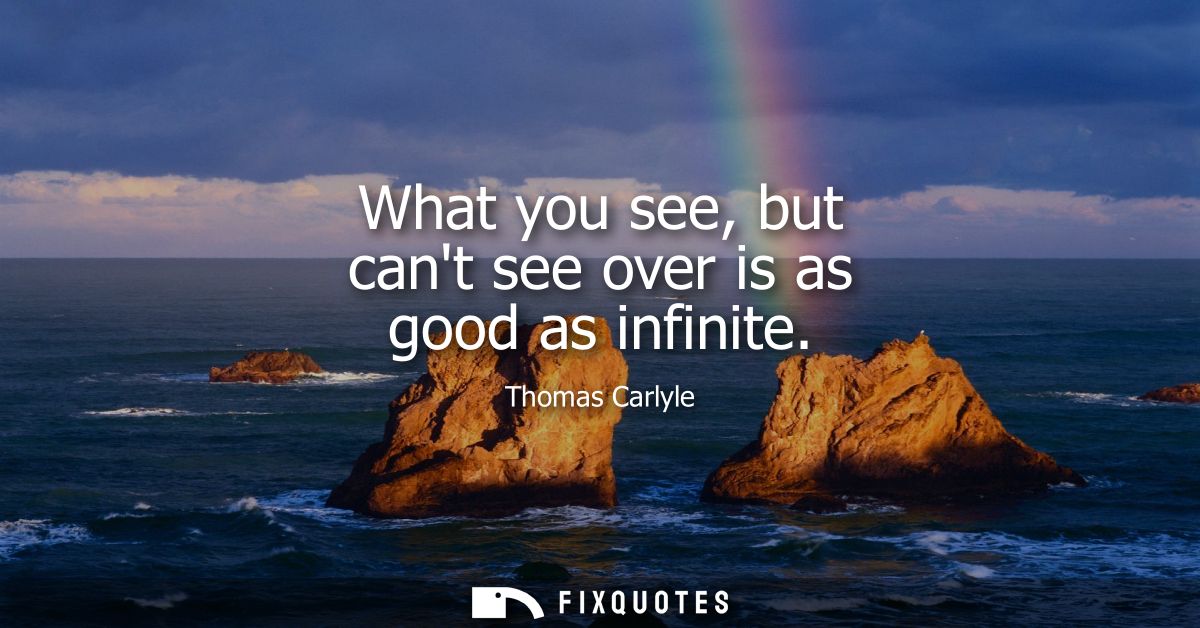
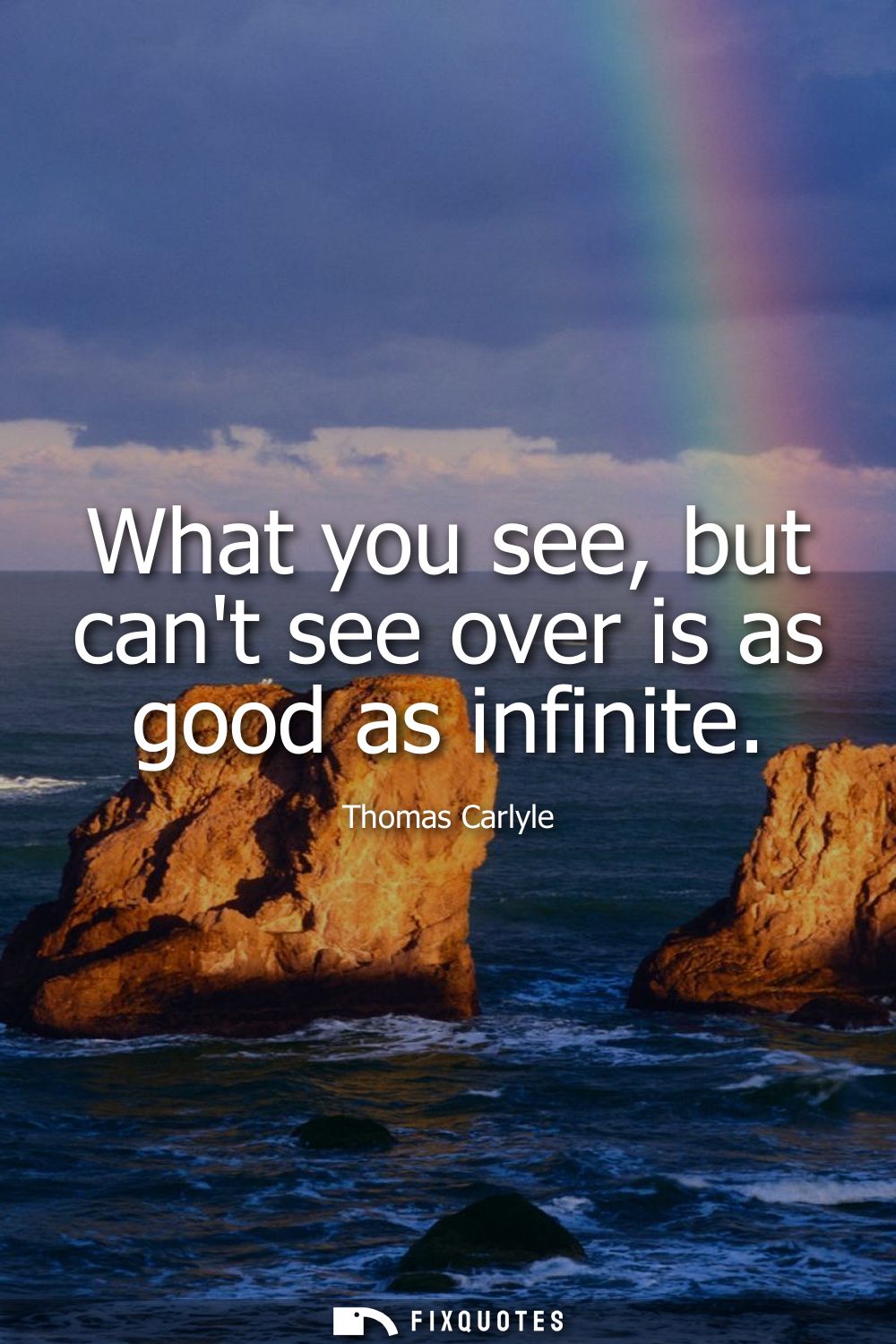
"What you see, but can't see over, is as good as infinite"
About this Quote
A horizon can be a prison as easily as it is a view, and Carlyle is needling that paradox. “What you see” is the familiar world: the facts at hand, the immediate landscape of work, worry, duty. “But can’t see over” is the crucial turn. The problem isn’t ignorance; it’s the limit you don’t recognize as a limit. When your line of sight stops, your imagination stops with it, and the finite begins to behave like the infinite. The little patch of reality you inhabit swells until it feels total, final, unquestionable.
That’s Carlyle’s intent: to expose how human perception inflates local circumstance into cosmic law. It’s a critique of the mind’s tyranny-by-proximity. Whatever looms closest - a crisis, a job, a social order, a set of “common sense” assumptions - can acquire the force of eternity simply because we lack the vantage point to relativize it. In that sense, the sentence is less mystical than diagnostic: the infinite isn’t always a grand metaphysical concept; it’s sometimes just your inability to see past the next ridge.
Context matters. Carlyle wrote in the pressure cooker of industrial modernity, when old certainties were collapsing and new systems (factories, markets, mass politics) were asserting themselves as inevitabilities. His line carries a warning shot: don’t confuse the dominant structures of your moment with the structure of reality itself. The subtext is moral as much as epistemic: if you accept your horizon as fate, you’ll live as if no other life were possible.
That’s Carlyle’s intent: to expose how human perception inflates local circumstance into cosmic law. It’s a critique of the mind’s tyranny-by-proximity. Whatever looms closest - a crisis, a job, a social order, a set of “common sense” assumptions - can acquire the force of eternity simply because we lack the vantage point to relativize it. In that sense, the sentence is less mystical than diagnostic: the infinite isn’t always a grand metaphysical concept; it’s sometimes just your inability to see past the next ridge.
Context matters. Carlyle wrote in the pressure cooker of industrial modernity, when old certainties were collapsing and new systems (factories, markets, mass politics) were asserting themselves as inevitabilities. His line carries a warning shot: don’t confuse the dominant structures of your moment with the structure of reality itself. The subtext is moral as much as epistemic: if you accept your horizon as fate, you’ll live as if no other life were possible.
Quote Details
| Topic | Wisdom |
|---|---|
| Source | Help us find the source |
| Cite |
Citation Formats
APA Style (7th ed.)
Carlyle, Thomas. (2026, February 19). What you see, but can't see over, is as good as infinite. FixQuotes. https://fixquotes.com/quotes/what-you-see-but-cant-see-over-is-as-good-as-33084/
Chicago Style
Carlyle, Thomas. "What you see, but can't see over, is as good as infinite." FixQuotes. February 19, 2026. https://fixquotes.com/quotes/what-you-see-but-cant-see-over-is-as-good-as-33084/.
MLA Style (9th ed.)
"What you see, but can't see over, is as good as infinite." FixQuotes, 19 Feb. 2026, https://fixquotes.com/quotes/what-you-see-but-cant-see-over-is-as-good-as-33084/. Accessed 5 Apr. 2026.
More Quotes by Thomas
Add to List