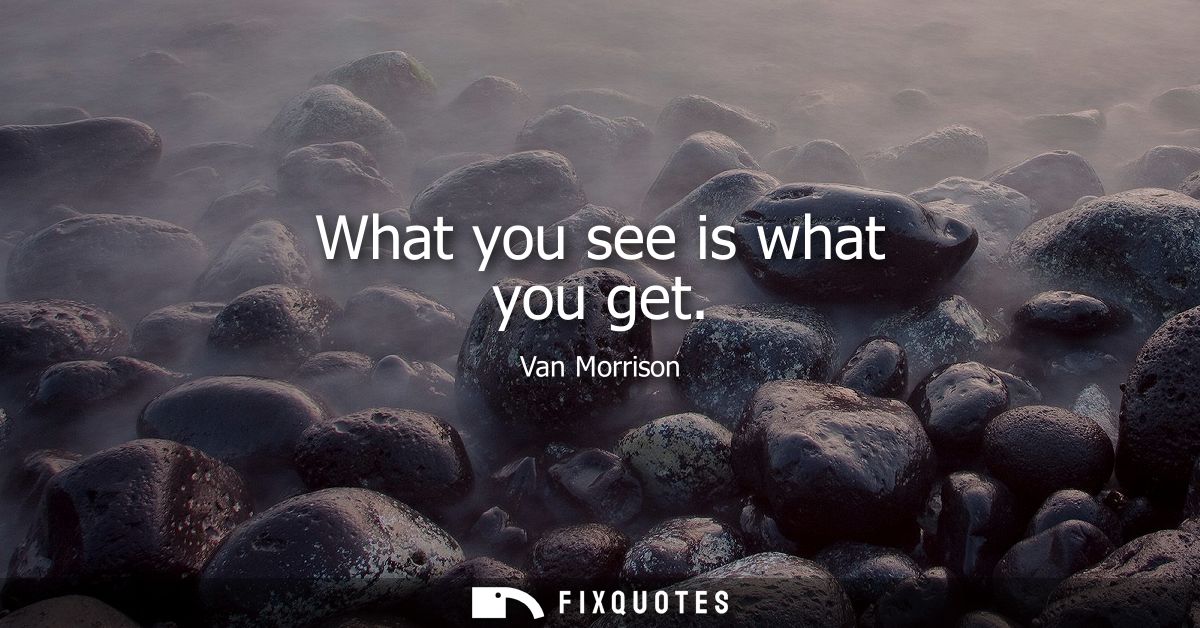
"What you see is what you get"
About this Quote
A phrase that sounds like honesty and feels like a dare. Coming from Van Morrison, "What you see is what you get" reads less like a friendly promise than a boundary line: don’t ask for an accessible version, don’t expect a curated persona, don’t confuse the public figure with a product designed to please you.
The intent is blunt self-definition. Morrison’s career has long been marked by a refusal to perform celebrity on command, whether that’s stonewalling interviewers, bristling at industry expectations, or letting the music do the talking. In that context, the line becomes a preemptive strike against interpretation and entitlement. It tells fans, critics, and gatekeepers alike: I’m not explaining myself; I’m not translating the work into palatable soundbites.
The subtext, though, is where it gets interesting. The phrase borrows the language of consumer transparency, the kind you’d see in advertising or retail: no hidden features, no surprises. But in an artist’s mouth, that plainness is almost ironic. Morrison’s songs are dense with mysticism, memory, and mood-swings; the inner life is the whole point, and it’s rarely straightforward. So "what you see" isn’t simple clarity, it’s what he’s willing to show at all.
Culturally, the line lands as an anti-brand brand: authenticity as posture, but also as protection. It’s a refusal to be flattened into a narrative, delivered in the kind of tough, economical language that makes argument feel pointless.
The intent is blunt self-definition. Morrison’s career has long been marked by a refusal to perform celebrity on command, whether that’s stonewalling interviewers, bristling at industry expectations, or letting the music do the talking. In that context, the line becomes a preemptive strike against interpretation and entitlement. It tells fans, critics, and gatekeepers alike: I’m not explaining myself; I’m not translating the work into palatable soundbites.
The subtext, though, is where it gets interesting. The phrase borrows the language of consumer transparency, the kind you’d see in advertising or retail: no hidden features, no surprises. But in an artist’s mouth, that plainness is almost ironic. Morrison’s songs are dense with mysticism, memory, and mood-swings; the inner life is the whole point, and it’s rarely straightforward. So "what you see" isn’t simple clarity, it’s what he’s willing to show at all.
Culturally, the line lands as an anti-brand brand: authenticity as posture, but also as protection. It’s a refusal to be flattened into a narrative, delivered in the kind of tough, economical language that makes argument feel pointless.
Quote Details
| Topic | Truth |
|---|---|
| Source | Help us find the source |
| Cite |
Citation Formats
APA Style (7th ed.)
Morrison, Van. (2026, January 16). What you see is what you get. FixQuotes. https://fixquotes.com/quotes/what-you-see-is-what-you-get-129470/
Chicago Style
Morrison, Van. "What you see is what you get." FixQuotes. January 16, 2026. https://fixquotes.com/quotes/what-you-see-is-what-you-get-129470/.
MLA Style (9th ed.)
"What you see is what you get." FixQuotes, 16 Jan. 2026, https://fixquotes.com/quotes/what-you-see-is-what-you-get-129470/. Accessed 1 Apr. 2026.
More Quotes by Van
Add to List