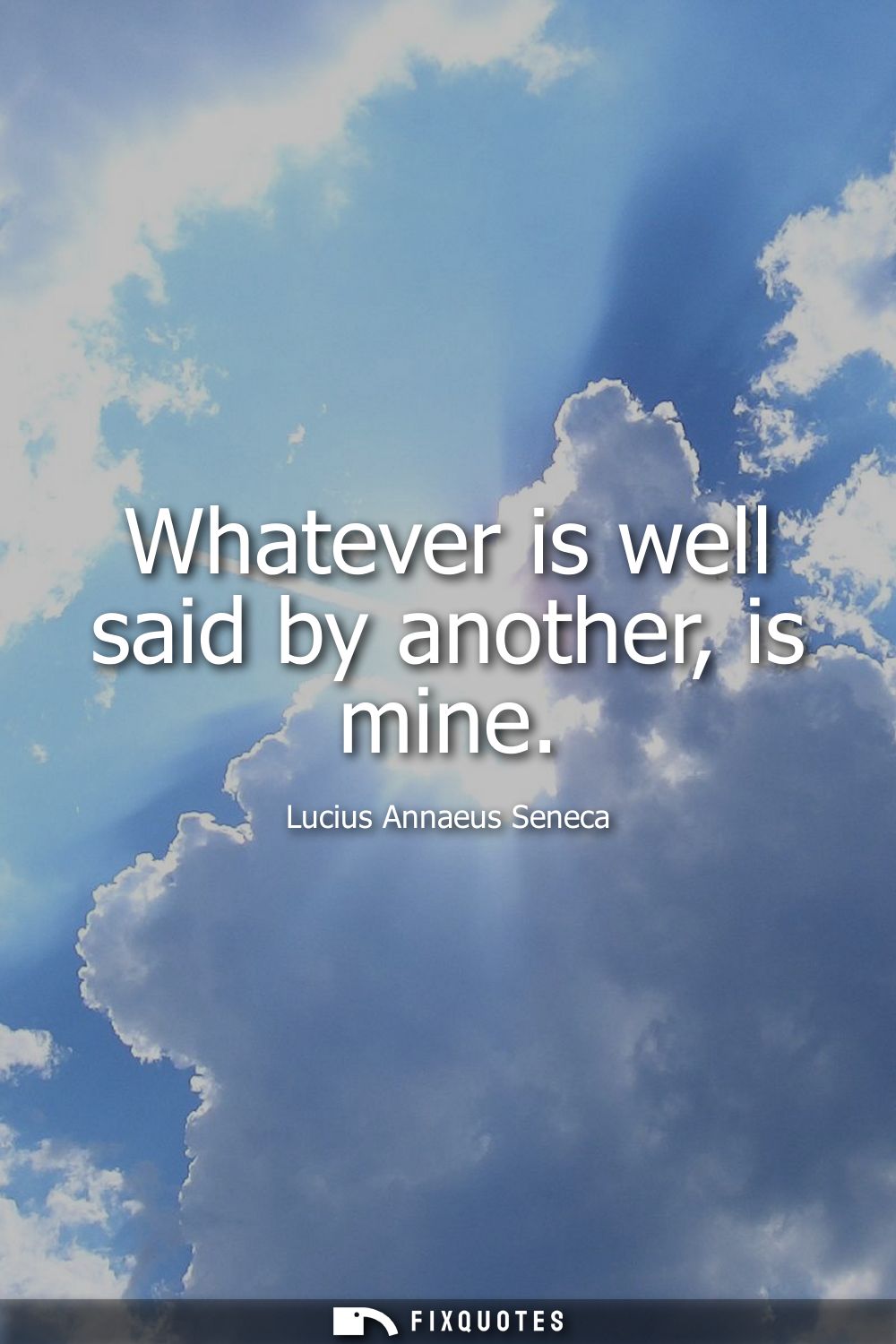
"Whatever is well said by another, is mine"
About this Quote
Seneca is staking a claim that sounds like theft until you hear the Stoic premise underneath it: wisdom isn’t property. In a Roman world obsessed with status, lineage, and the ownership of everything from land to people, he flips the script and treats a good idea as common currency. If truth is true, it doesn’t become less true because it arrived in someone else’s mouth first. The provocation is deliberate: he’s needling the vanity that equates originality with virtue.
The subtext is also defensive. Seneca was accused in his own time of borrowing too freely from Greek philosophers, especially the Stoics he popularized for Roman elites. “Whatever is well said by another, is mine” reads like an elegant rebuttal to the charge of being secondhand: he’s not plagiarizing, he’s practicing. For Seneca, philosophy is less a museum of citations than a regimen. You take what works, internalize it, and let it change your conduct.
There’s an ethical edge here, too. Seneca served as Nero’s adviser, navigating power with a mix of pragmatism and self-justification. Claiming the best lines as “mine” is an insistence that the self can be built from disciplined selection rather than inherited prestige or imperial proximity. It’s also a quiet reminder to his audience: stop hoarding authors, start hoarding insights. The Roman game was to collect names; Seneca wants you to collect principles.
The subtext is also defensive. Seneca was accused in his own time of borrowing too freely from Greek philosophers, especially the Stoics he popularized for Roman elites. “Whatever is well said by another, is mine” reads like an elegant rebuttal to the charge of being secondhand: he’s not plagiarizing, he’s practicing. For Seneca, philosophy is less a museum of citations than a regimen. You take what works, internalize it, and let it change your conduct.
There’s an ethical edge here, too. Seneca served as Nero’s adviser, navigating power with a mix of pragmatism and self-justification. Claiming the best lines as “mine” is an insistence that the self can be built from disciplined selection rather than inherited prestige or imperial proximity. It’s also a quiet reminder to his audience: stop hoarding authors, start hoarding insights. The Roman game was to collect names; Seneca wants you to collect principles.
Quote Details
| Topic | Wisdom |
|---|---|
| Source | Help us find the source |
| Cite |
Citation Formats
APA Style (7th ed.)
Younger, Seneca the. (2026, January 18). Whatever is well said by another, is mine. FixQuotes. https://fixquotes.com/quotes/whatever-is-well-said-by-another-is-mine-8582/
Chicago Style
Younger, Seneca the. "Whatever is well said by another, is mine." FixQuotes. January 18, 2026. https://fixquotes.com/quotes/whatever-is-well-said-by-another-is-mine-8582/.
MLA Style (9th ed.)
"Whatever is well said by another, is mine." FixQuotes, 18 Jan. 2026, https://fixquotes.com/quotes/whatever-is-well-said-by-another-is-mine-8582/. Accessed 17 Feb. 2026.
More Quotes by Seneca
Add to List