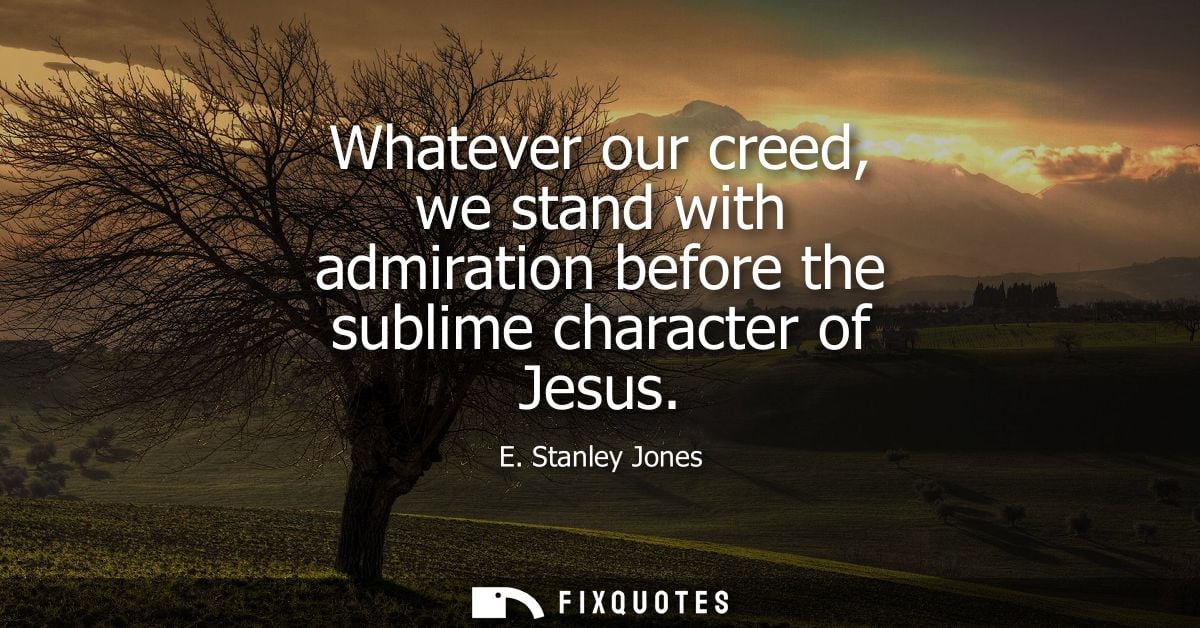
"Whatever our creed, we stand with admiration before the sublime character of Jesus"
About this Quote
The key lever is “sublime.” That’s not just praise; it’s elevation. Sublimity implies something that overwhelms ordinary categories and forces a kind of reverent pause. Jones is trying to convert admiration into openness: if you can be moved by Jesus as a moral and spiritual phenomenon, you’re already halfway toward the Christian claim, or at least toward taking it seriously. The sentence performs belief as an experience before it asks for assent.
Context matters. Jones was a Methodist missionary and a prominent voice in 20th-century Christian apologetics, working in an era when Christianity faced both global religious plurality and the pressure of modern skepticism. This line reads like interfaith diplomacy with a persuasive undertow: it grants room to Hindus, Muslims, humanists, even nominal Christians, while proposing a shared cultural baseline - Jesus as an unimpeachable figure. The subtext is confident: disagreement is permitted, but admiration is framed as inevitable, almost mandatory, which is precisely how the sentence exerts its soft power.
Quote Details
| Topic | Faith |
|---|---|
| Source | Help us find the source |
| Cite |
Citation Formats
APA Style (7th ed.)
Jones, E. Stanley. (2026, January 18). Whatever our creed, we stand with admiration before the sublime character of Jesus. FixQuotes. https://fixquotes.com/quotes/whatever-our-creed-we-stand-with-admiration-23026/
Chicago Style
Jones, E. Stanley. "Whatever our creed, we stand with admiration before the sublime character of Jesus." FixQuotes. January 18, 2026. https://fixquotes.com/quotes/whatever-our-creed-we-stand-with-admiration-23026/.
MLA Style (9th ed.)
"Whatever our creed, we stand with admiration before the sublime character of Jesus." FixQuotes, 18 Jan. 2026, https://fixquotes.com/quotes/whatever-our-creed-we-stand-with-admiration-23026/. Accessed 11 Mar. 2026.