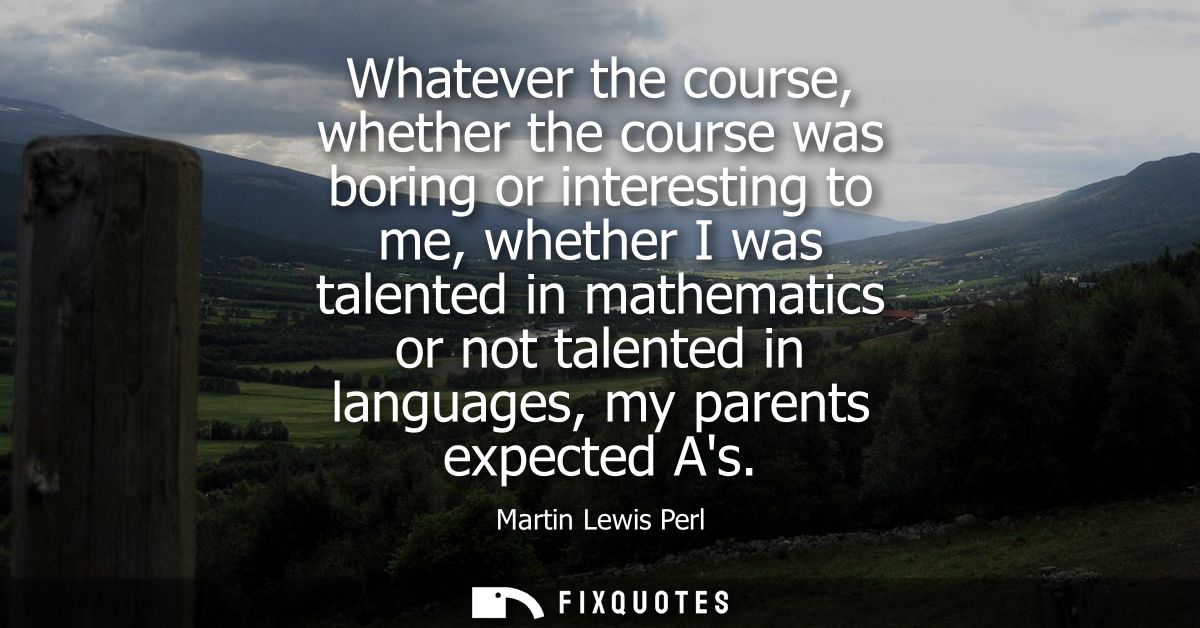
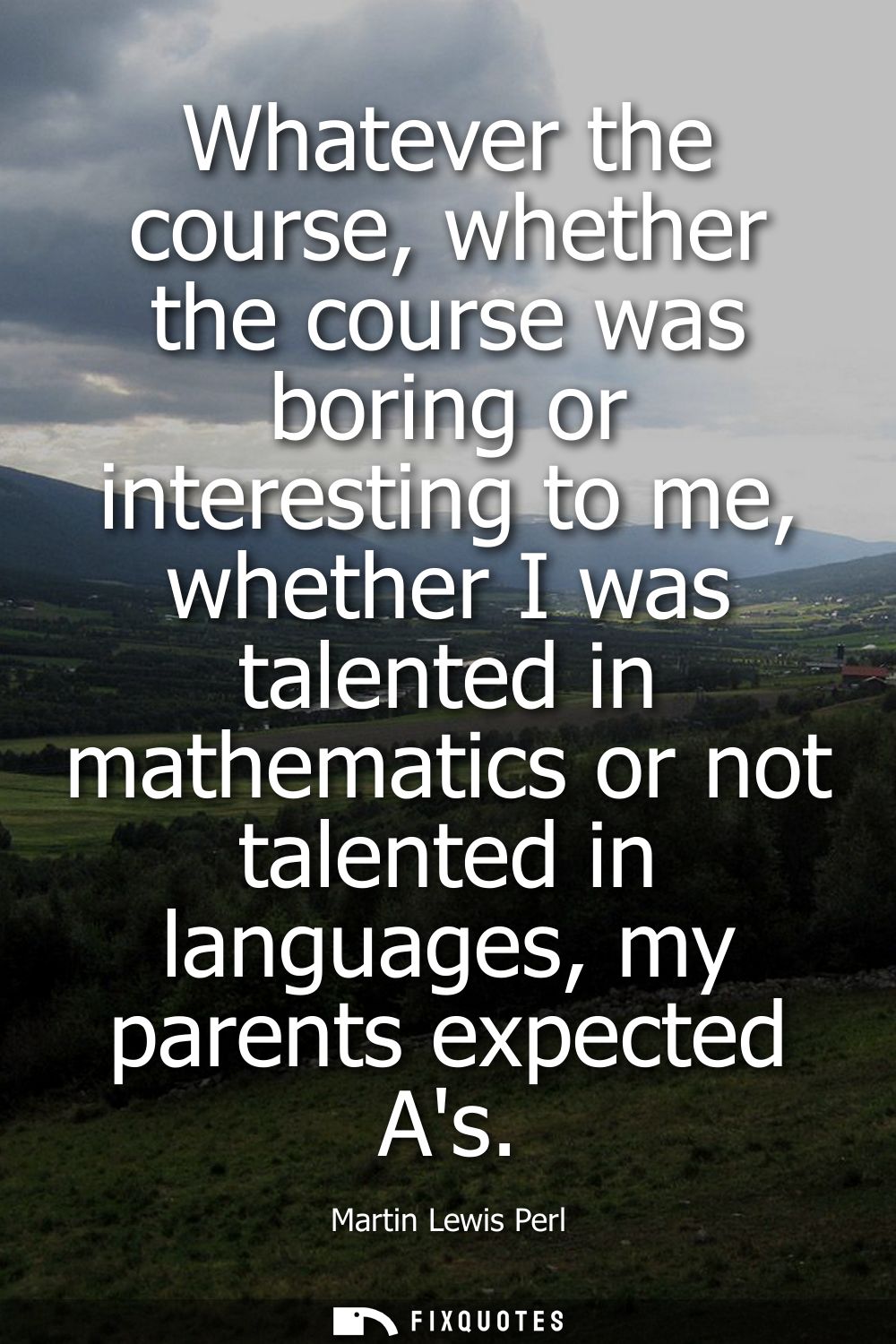
"Whatever the course, whether the course was boring or interesting to me, whether I was talented in mathematics or not talented in languages, my parents expected A's"
About this Quote
The subtext is both motivational and unsettling. On one hand, it’s a blueprint for the kind of disciplined competence that scientific careers quietly require. Physics isn’t a straight line of fascination; it’s long stretches of grind, ambiguity, and problem sets that don’t flatter your ego. Parents who normalize high expectations across subjects are, in effect, training a child to push past the seductive narrative of “I’m just not good at that.” That mindset can be the difference between someone who hits a wall in research and someone who keeps chiseling.
On the other hand, Perl’s even-handed “expected A’s” hints at a pressure system that doesn’t care about temperament. It’s meritocratic in tone but not necessarily in feel: love may not be conditional, yet approval can start to sound quantified. Read in context - a 20th-century scientist shaped before today’s therapeutic language about burnout - it captures an older American bargain: excellence buys mobility, and comfort is earned, not assumed.
Quote Details
| Topic | Parenting |
|---|---|
| Source | Help us find the source |
| Cite |
Citation Formats
APA Style (7th ed.)
Perl, Martin Lewis. (2026, January 17). Whatever the course, whether the course was boring or interesting to me, whether I was talented in mathematics or not talented in languages, my parents expected A's. FixQuotes. https://fixquotes.com/quotes/whatever-the-course-whether-the-course-was-boring-28031/
Chicago Style
Perl, Martin Lewis. "Whatever the course, whether the course was boring or interesting to me, whether I was talented in mathematics or not talented in languages, my parents expected A's." FixQuotes. January 17, 2026. https://fixquotes.com/quotes/whatever-the-course-whether-the-course-was-boring-28031/.
MLA Style (9th ed.)
"Whatever the course, whether the course was boring or interesting to me, whether I was talented in mathematics or not talented in languages, my parents expected A's." FixQuotes, 17 Jan. 2026, https://fixquotes.com/quotes/whatever-the-course-whether-the-course-was-boring-28031/. Accessed 25 Mar. 2026.