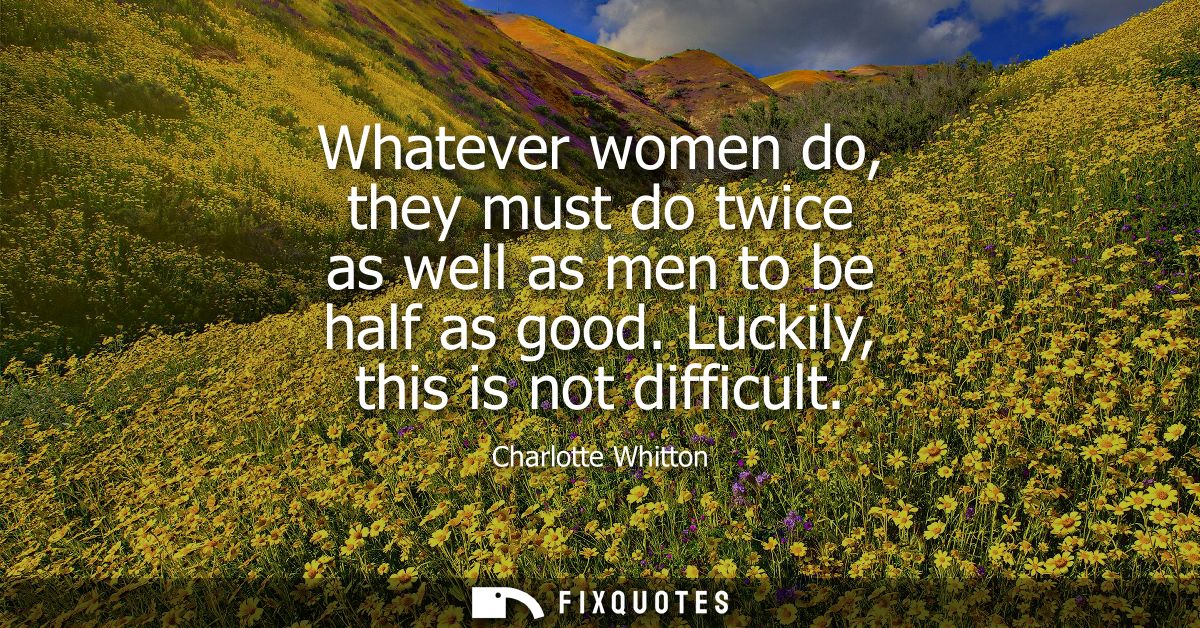
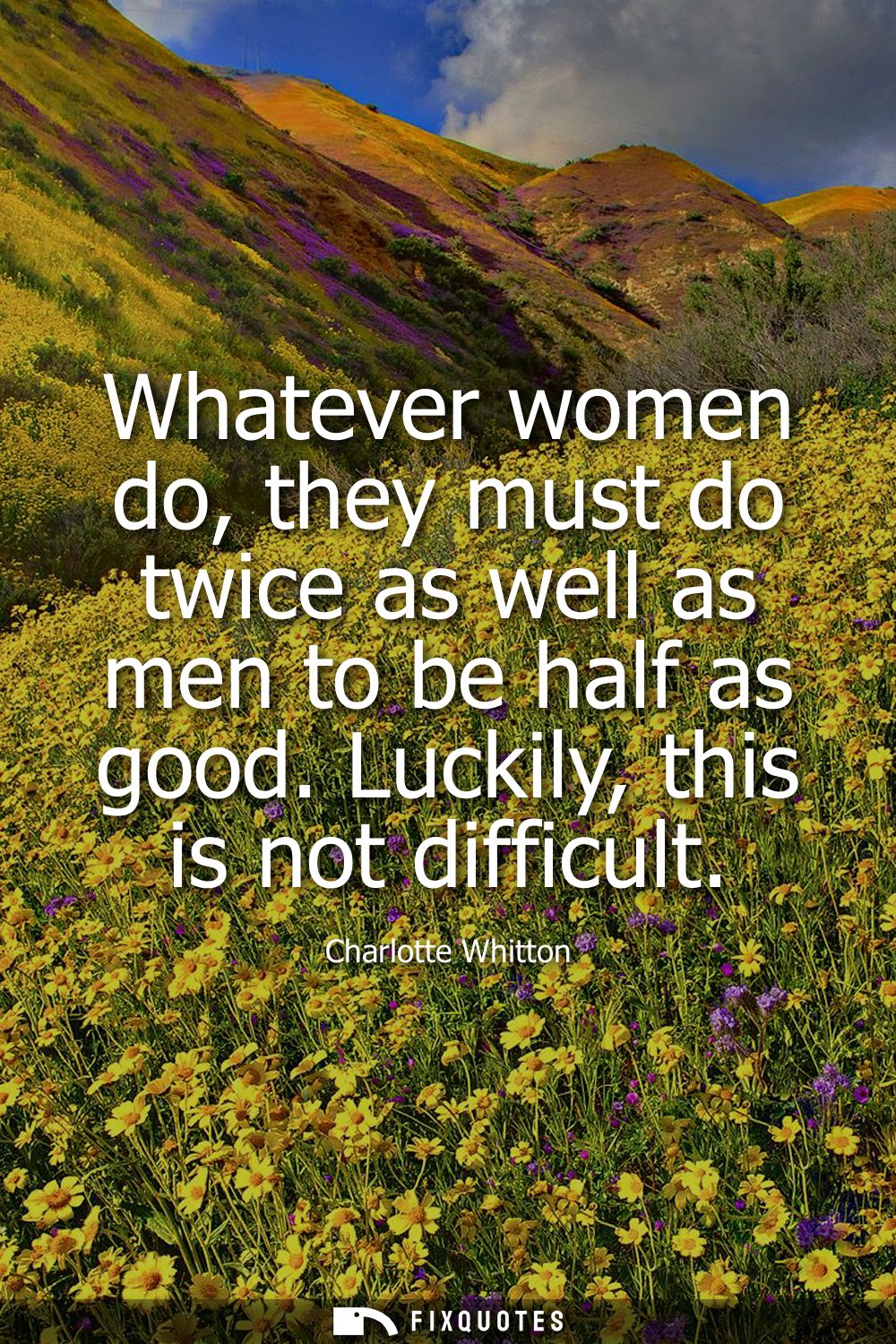
"Whatever women do, they must do twice as well as men to be half as good. Luckily, this is not difficult"
About this Quote
Then comes the kicker: “Luckily, this is not difficult.” That “luckily” is a politician’s knife twist. It reads like morale-boosting bravado, but the subtext is acid. If it’s “not difficult,” the men setting the standard are being indicted as mediocre beneficiaries of lowered expectations. She’s simultaneously flattering women’s competence and shaming a system that measures it with a warped ruler.
Context matters. Whitton wasn’t writing from the sidelines; she was a Canadian political figure who navigated institutions built to exclude her. The quip carries the cadence of someone who’s had to win rooms before she could win votes. It’s also a strategic sound bite: short enough to travel, sharp enough to recruit. In mid-century public life, women were often expected to be exceptional just to be tolerated, and Whitton turns that lived double standard into a punchline that stings precisely because it feels true.
Quote Details
| Topic | Equality |
|---|---|
| Source | Later attribution: Charlotte Whitton (Charlotte Whitton) modern compilation
Evidence:
quotes whatever women do they must do twice as well as men to be thought half as good luckily this is not difficult in canad |
| Cite |
Citation Formats
APA Style (7th ed.)
Whitton, Charlotte. (2026, March 16). Whatever women do, they must do twice as well as men to be half as good. Luckily, this is not difficult. FixQuotes. https://fixquotes.com/quotes/whatever-women-do-they-must-do-twice-as-well-as-117237/
Chicago Style
Whitton, Charlotte. "Whatever women do, they must do twice as well as men to be half as good. Luckily, this is not difficult." FixQuotes. March 16, 2026. https://fixquotes.com/quotes/whatever-women-do-they-must-do-twice-as-well-as-117237/.
MLA Style (9th ed.)
"Whatever women do, they must do twice as well as men to be half as good. Luckily, this is not difficult." FixQuotes, 16 Mar. 2026, https://fixquotes.com/quotes/whatever-women-do-they-must-do-twice-as-well-as-117237/. Accessed 3 Apr. 2026.