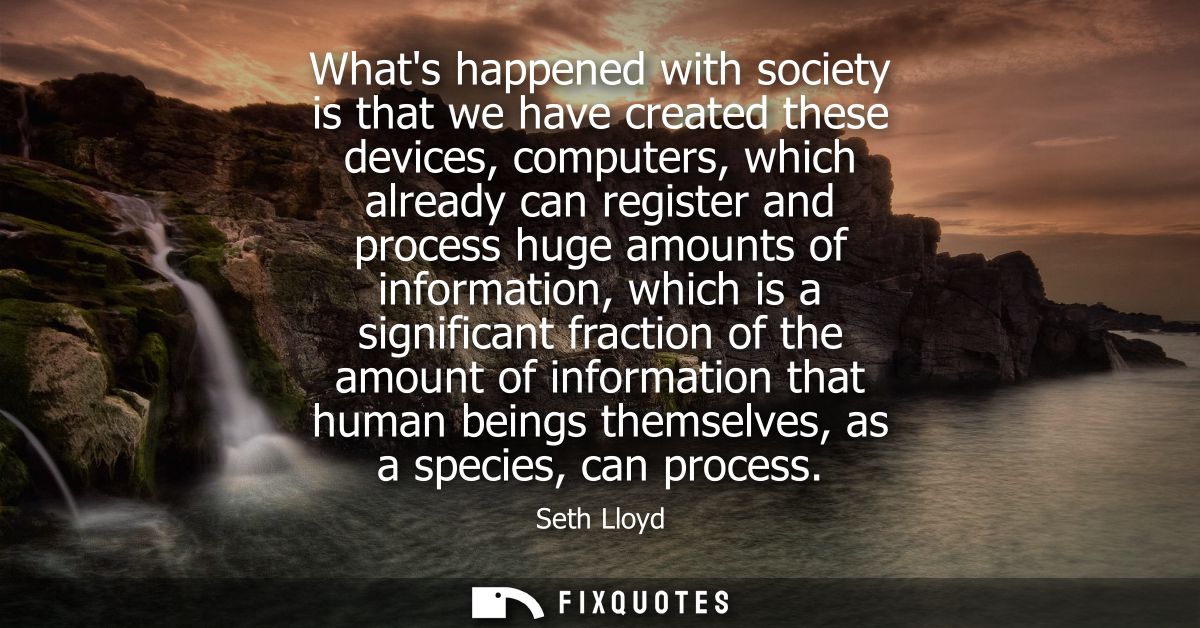
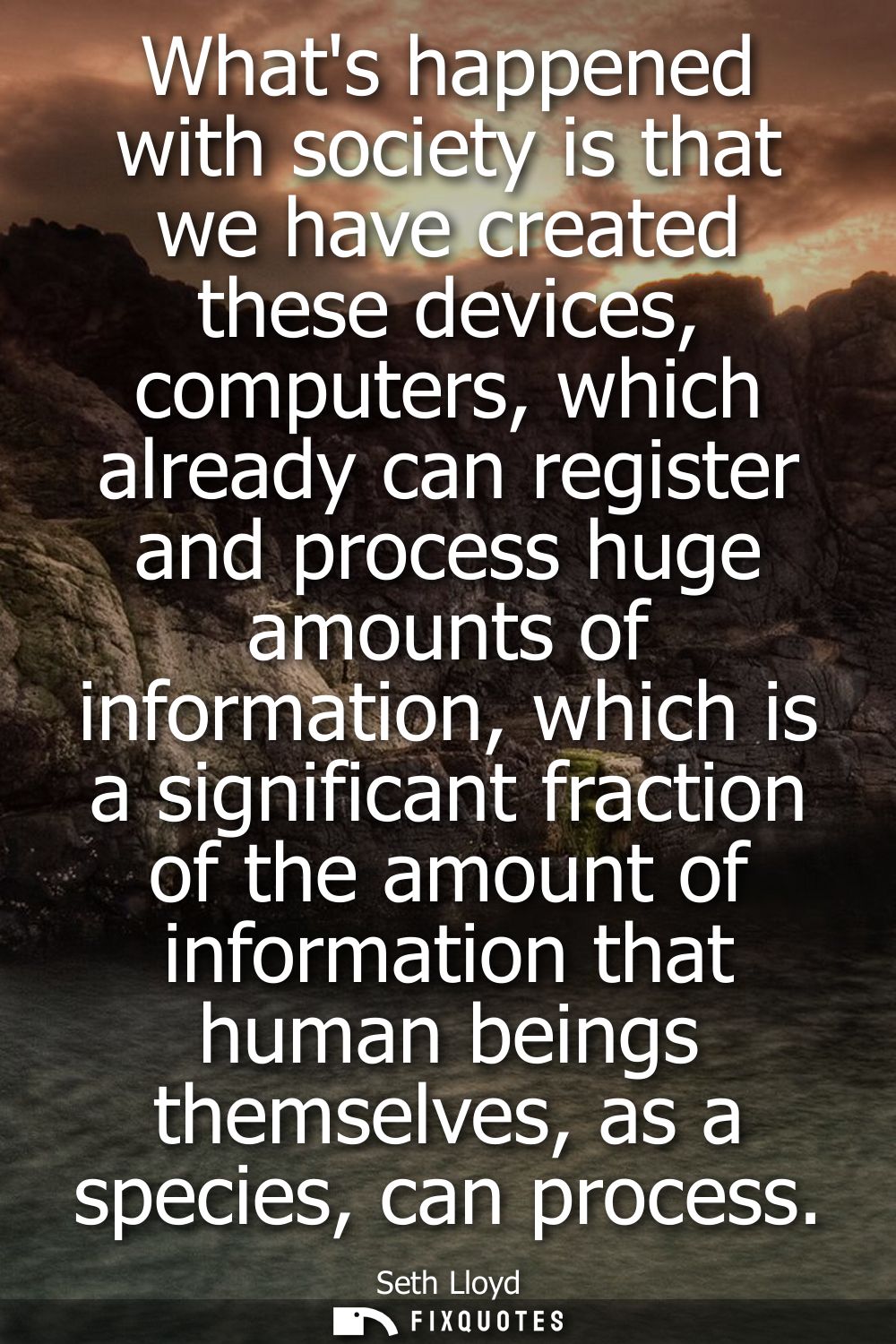
"What's happened with society is that we have created these devices, computers, which already can register and process huge amounts of information, which is a significant fraction of the amount of information that human beings themselves, as a species, can process"
About this Quote
The kicker is the quiet provocation in "a significant fraction". He doesn’t claim computers surpass us; he doesn’t need to. Fractional parity is enough to trigger the larger anxiety: if machines can process what we process, then the bottleneck in modern life may not be computation but meaning. Lloyd’s educator’s restraint reads as strategy. By avoiding flashy doom or hype, he makes the point feel inevitable, almost bureaucratic: the numbers are moving, the balance is changing, adjust accordingly.
Context matters. Lloyd comes out of quantum information science, a field that treats computation as physics, not metaphor. That background sharpens the subtext: information isn’t just what we know, it’s what the universe can carry and transform. In that light, "society" isn’t adopting gadgets; it’s reorganizing itself around new physical capabilities. The quote nudges listeners toward a sober question: when processing power becomes cheap and abundant, what human trait actually becomes scarce - attention, ethics, accountability, or agency?
Quote Details
| Topic | Artificial Intelligence |
|---|---|
| Source | Help us find the source |
| Cite |
Citation Formats
APA Style (7th ed.)
Lloyd, Seth. (2026, January 15). What's happened with society is that we have created these devices, computers, which already can register and process huge amounts of information, which is a significant fraction of the amount of information that human beings themselves, as a species, can process. FixQuotes. https://fixquotes.com/quotes/whats-happened-with-society-is-that-we-have-152270/
Chicago Style
Lloyd, Seth. "What's happened with society is that we have created these devices, computers, which already can register and process huge amounts of information, which is a significant fraction of the amount of information that human beings themselves, as a species, can process." FixQuotes. January 15, 2026. https://fixquotes.com/quotes/whats-happened-with-society-is-that-we-have-152270/.
MLA Style (9th ed.)
"What's happened with society is that we have created these devices, computers, which already can register and process huge amounts of information, which is a significant fraction of the amount of information that human beings themselves, as a species, can process." FixQuotes, 15 Jan. 2026, https://fixquotes.com/quotes/whats-happened-with-society-is-that-we-have-152270/. Accessed 18 Feb. 2026.