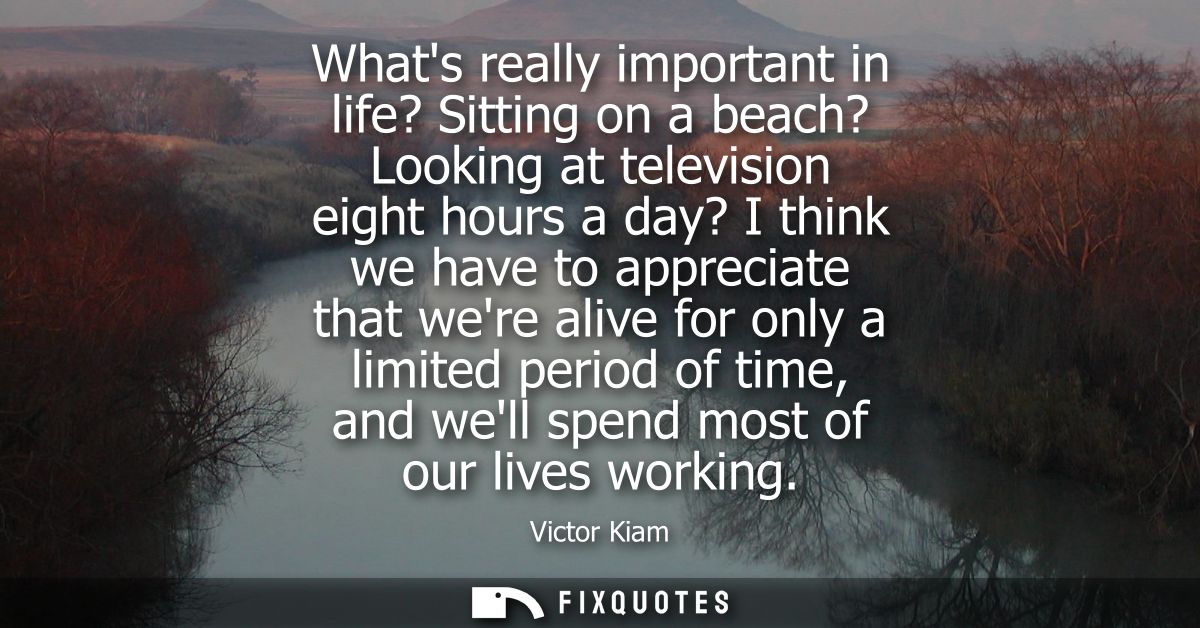
"What's really important in life? Sitting on a beach? Looking at television eight hours a day? I think we have to appreciate that we're alive for only a limited period of time, and we'll spend most of our lives working"
About this Quote
The pivot - “we have to appreciate that we’re alive for only a limited period of time” - borrows the language of existential wisdom, but the payoff is distinctly corporate: “we’ll spend most of our lives working.” That last clause is the tell. He’s not merely lamenting the modern workweek; he’s normalizing it as destiny and quietly asking you to make peace with it. The subtext is managerial and motivational at once: don’t build a life around escape, build a life that justifies the hours you’re about to sell.
Context matters because Kiam wasn’t a monk; he was a businessman famous for selling Remington products with swagger. In late-20th-century America, work stopped being only survival and became identity, a moral posture. His quote rides that cultural current: it turns mortality into a productivity argument, and it does so with the brisk impatience of someone who believes meaning is made, not found - preferably on the clock.
Quote Details
| Topic | Work-Life Balance |
|---|---|
| Source | Help us find the source |
| Cite |
Citation Formats
APA Style (7th ed.)
Kiam, Victor. (2026, January 15). What's really important in life? Sitting on a beach? Looking at television eight hours a day? I think we have to appreciate that we're alive for only a limited period of time, and we'll spend most of our lives working. FixQuotes. https://fixquotes.com/quotes/whats-really-important-in-life-sitting-on-a-beach-160908/
Chicago Style
Kiam, Victor. "What's really important in life? Sitting on a beach? Looking at television eight hours a day? I think we have to appreciate that we're alive for only a limited period of time, and we'll spend most of our lives working." FixQuotes. January 15, 2026. https://fixquotes.com/quotes/whats-really-important-in-life-sitting-on-a-beach-160908/.
MLA Style (9th ed.)
"What's really important in life? Sitting on a beach? Looking at television eight hours a day? I think we have to appreciate that we're alive for only a limited period of time, and we'll spend most of our lives working." FixQuotes, 15 Jan. 2026, https://fixquotes.com/quotes/whats-really-important-in-life-sitting-on-a-beach-160908/. Accessed 5 Apr. 2026.