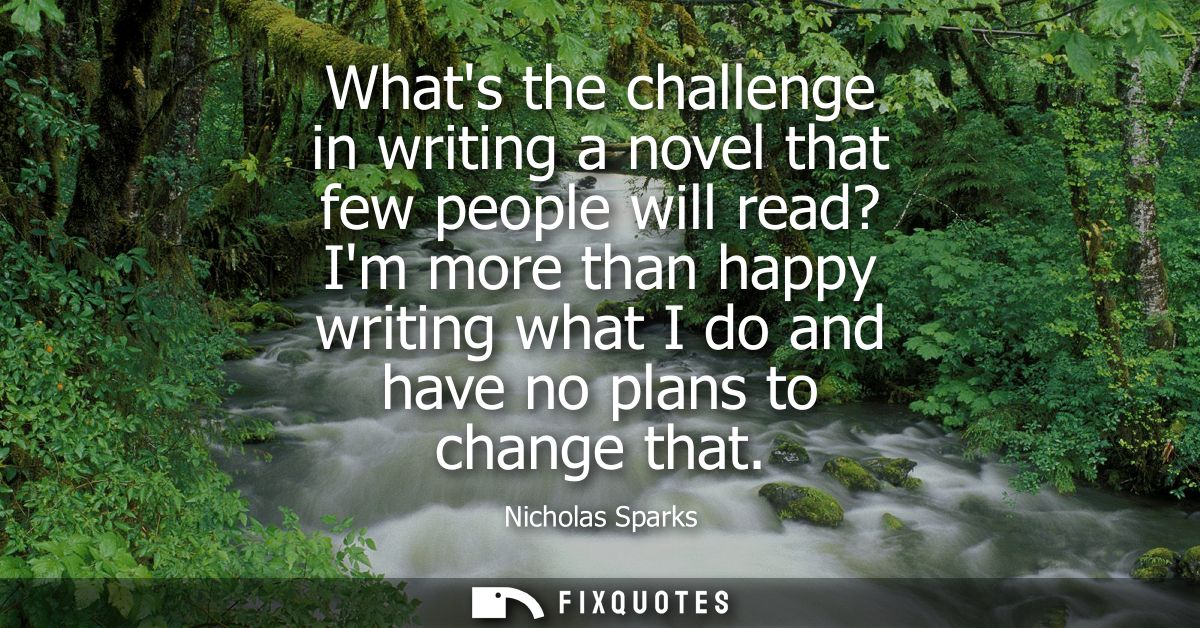
"What's the challenge in writing a novel that few people will read? I'm more than happy writing what I do and have no plans to change that"
About this Quote
There’s a sly inversion at work here: Nicholas Sparks, one of the most reliably read novelists alive, poses as the guy content to be ignored. The “challenge” he names isn’t craft so much as prestige. In contemporary literary culture, scarcity equals status; difficult books accrue cachet precisely because they repel the casual reader. Sparks needles that logic by pretending to covet the very thing he manifestly doesn’t need: the aura of the “serious” novelist whose audience is small but sanctified.
The subtext is defensive and strategic. Sparks has spent decades as a shorthand for mass-market sentimentality, a label that can function like a sneer in certain circles. By framing “few people will read” as a perverse artistic obstacle, he calls out how elitism often disguises itself as taste. It’s also a neat piece of self-protection: if the gatekeepers won’t grant him cultural capital, he’ll declare he never wanted it. The line “more than happy” is doing a lot of work, insisting on contentment while acknowledging the pressure to evolve, darken, experiment, or “grow up” into literary fiction.
Context matters: in an era where authors are expected to build personal brands, chase awards, and perform seriousness online, Sparks plants a flag in the unglamorous virtue of knowing your lane. It’s not anti-art; it’s pro-audience. He’s arguing that being widely read isn’t a guilty pleasure but a legitimate achievement, and that changing for approval is the real creative compromise.
The subtext is defensive and strategic. Sparks has spent decades as a shorthand for mass-market sentimentality, a label that can function like a sneer in certain circles. By framing “few people will read” as a perverse artistic obstacle, he calls out how elitism often disguises itself as taste. It’s also a neat piece of self-protection: if the gatekeepers won’t grant him cultural capital, he’ll declare he never wanted it. The line “more than happy” is doing a lot of work, insisting on contentment while acknowledging the pressure to evolve, darken, experiment, or “grow up” into literary fiction.
Context matters: in an era where authors are expected to build personal brands, chase awards, and perform seriousness online, Sparks plants a flag in the unglamorous virtue of knowing your lane. It’s not anti-art; it’s pro-audience. He’s arguing that being widely read isn’t a guilty pleasure but a legitimate achievement, and that changing for approval is the real creative compromise.
Quote Details
| Topic | Writing |
|---|
More Quotes by Nicholas
Add to List