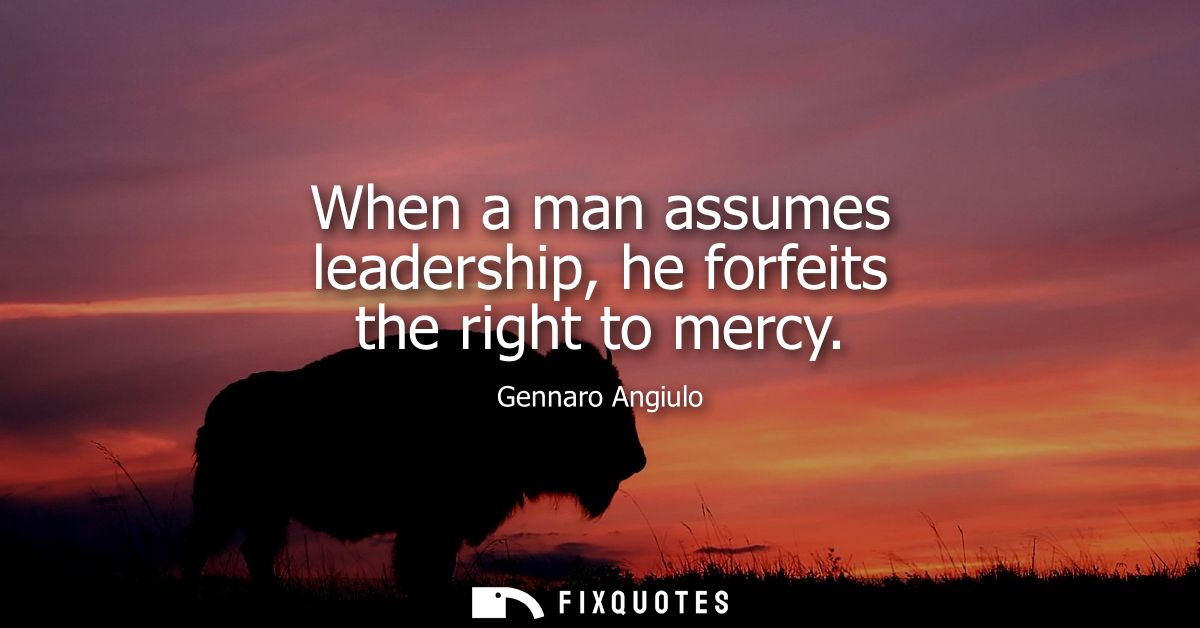
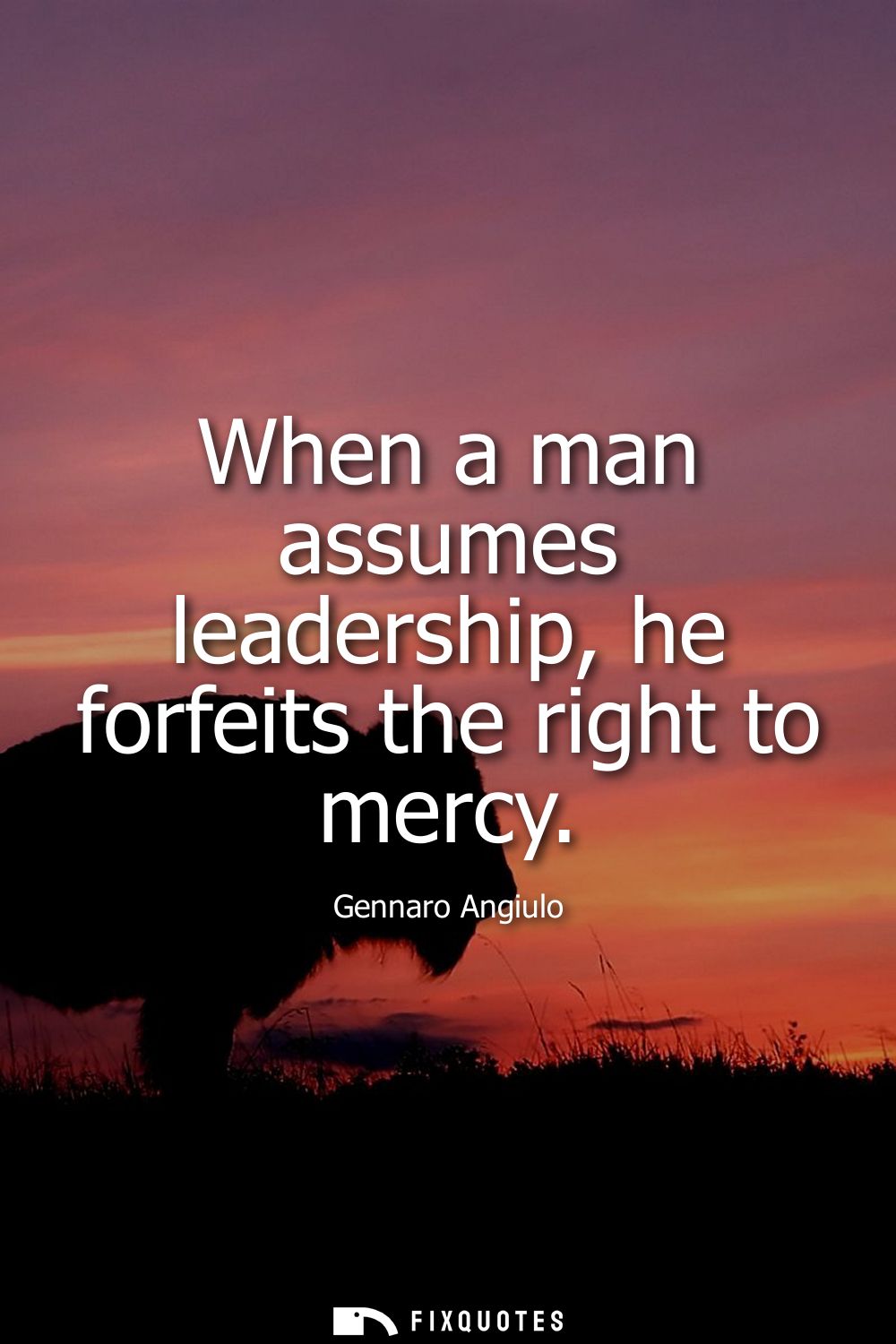
"When a man assumes leadership, he forfeits the right to mercy"
About this Quote
Leadership here isn’t framed as service; it’s framed as exposure. In one hard line, Gennaro Angiulo turns authority into a kind of self-issued death warrant: the moment you step out front, you’re no longer entitled to softness, second chances, or moral consideration. The phrasing is legalistic and brutal. “Assumes” suggests a deliberate act, almost ceremonial, while “forfeits” borrows the language of contracts and penalties. Mercy isn’t lost by accident; it’s surrendered as payment.
Coming from a criminal, the quote reads less like philosophy and more like a rule of the street dressed up as stoicism. It’s not about becoming tougher. It’s about accepting that leadership in a violent hierarchy invites constant testing and retaliation, and that your enemies - rivals, underlings, even allies - will treat compassion as weakness. The subtext is prophylactic: don’t ask for sympathy later, and don’t offer it now. If you’re the boss, you can’t afford to be seen pleading, wavering, or human.
It also works as a preemptive moral alibi. By declaring mercy off-limits, Angiulo reframes cruelty as duty: harsh decisions aren’t a choice, they’re the cost of command. That’s how power sustains itself in illicit systems where legitimacy can’t be claimed through law or elections. Authority must be performed, constantly, and the performance requires a public absence of mercy - even if privately, mercy is exactly what everyone wants.
Coming from a criminal, the quote reads less like philosophy and more like a rule of the street dressed up as stoicism. It’s not about becoming tougher. It’s about accepting that leadership in a violent hierarchy invites constant testing and retaliation, and that your enemies - rivals, underlings, even allies - will treat compassion as weakness. The subtext is prophylactic: don’t ask for sympathy later, and don’t offer it now. If you’re the boss, you can’t afford to be seen pleading, wavering, or human.
It also works as a preemptive moral alibi. By declaring mercy off-limits, Angiulo reframes cruelty as duty: harsh decisions aren’t a choice, they’re the cost of command. That’s how power sustains itself in illicit systems where legitimacy can’t be claimed through law or elections. Authority must be performed, constantly, and the performance requires a public absence of mercy - even if privately, mercy is exactly what everyone wants.
Quote Details
| Topic | Leadership |
|---|---|
| Source | Help us find the source |
| Cite |
Citation Formats
APA Style (7th ed.)
Angiulo, Gennaro. (2026, January 16). When a man assumes leadership, he forfeits the right to mercy. FixQuotes. https://fixquotes.com/quotes/when-a-man-assumes-leadership-he-forfeits-the-121644/
Chicago Style
Angiulo, Gennaro. "When a man assumes leadership, he forfeits the right to mercy." FixQuotes. January 16, 2026. https://fixquotes.com/quotes/when-a-man-assumes-leadership-he-forfeits-the-121644/.
MLA Style (9th ed.)
"When a man assumes leadership, he forfeits the right to mercy." FixQuotes, 16 Jan. 2026, https://fixquotes.com/quotes/when-a-man-assumes-leadership-he-forfeits-the-121644/. Accessed 6 Apr. 2026.
More Quotes by Gennaro
Add to List