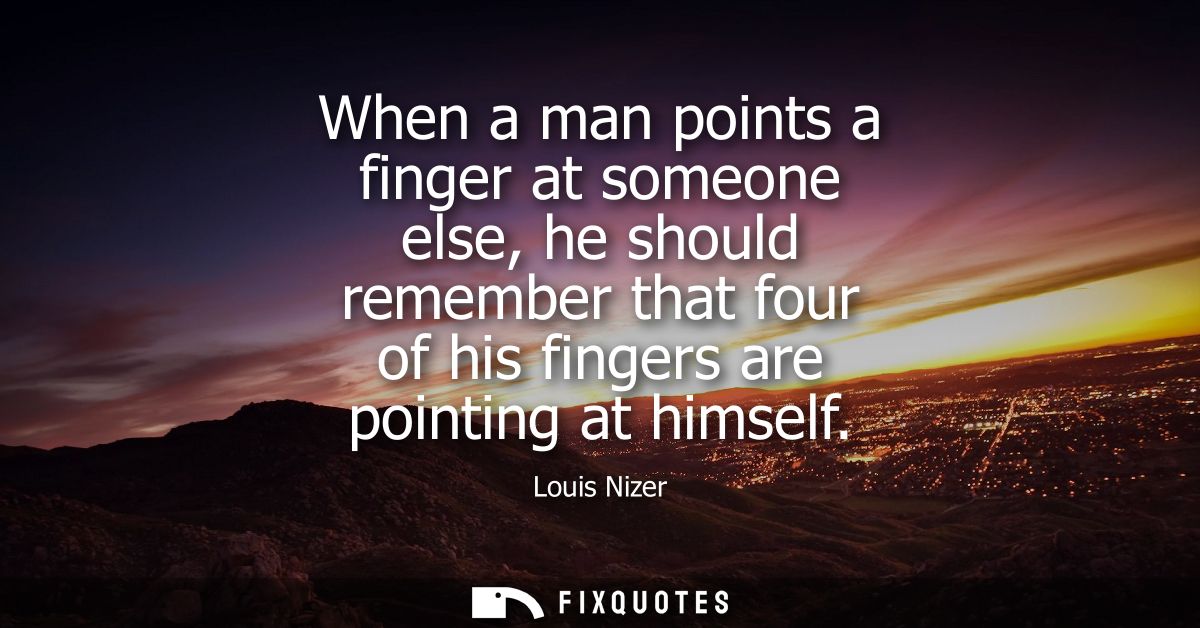
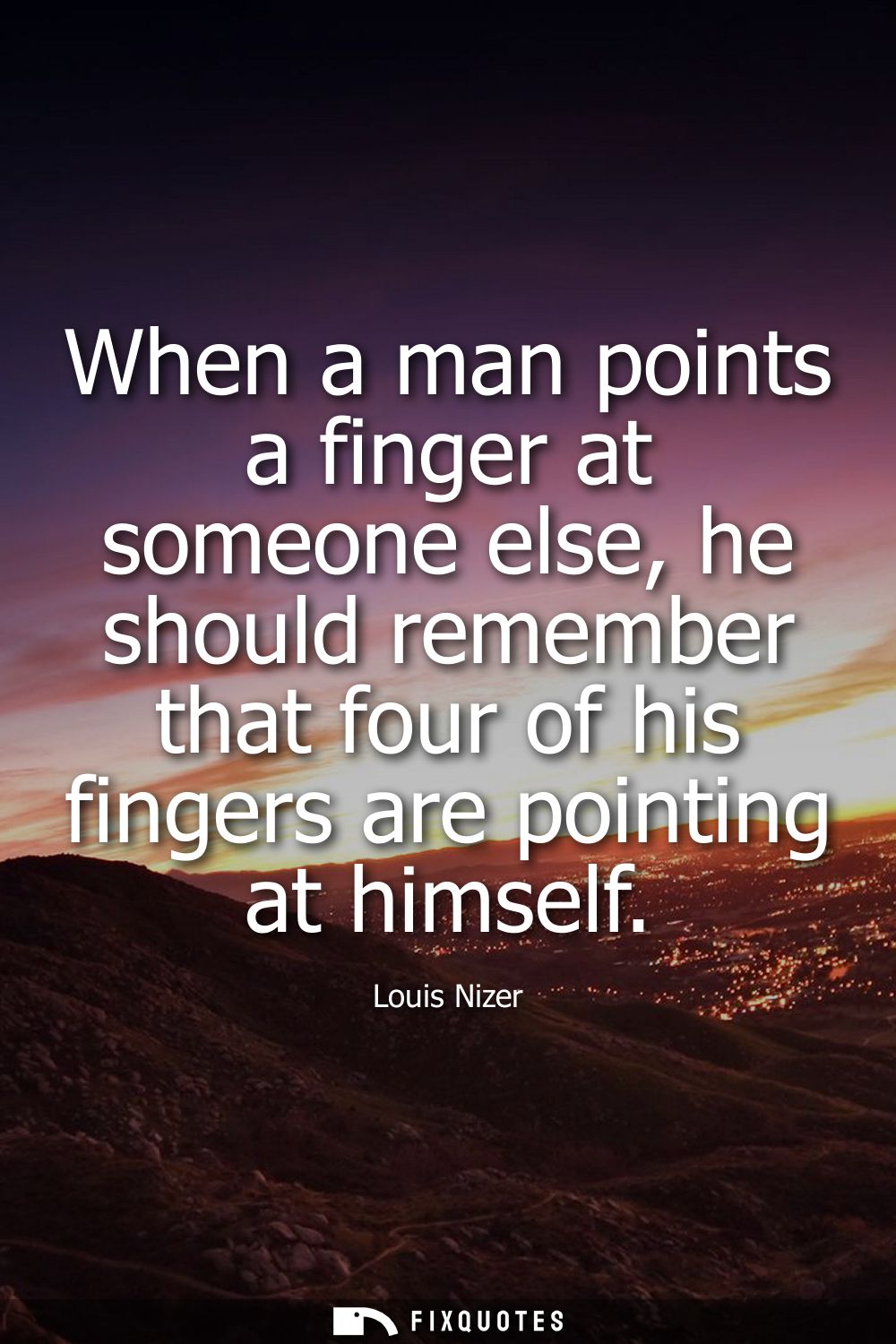
"When a man points a finger at someone else, he should remember that four of his fingers are pointing at himself"
About this Quote
As a lawyer, Nizer isn't offering a saintly plea for kindness. He's warning about tactics. Pointing is a performance: it assigns roles (villain, victim, judge) and tries to lock the room into a story where the speaker is clean. Nizer punctures that story by reminding you that blame has recoil. The subtext is less "be humble" than "don't be naive about your own interest". Accusation often functions as camouflage for complicity, projection, or at minimum the speaker's desire to escape scrutiny. Four fingers back at you is an image of cross-examination: the moment the questions swing around.
The context matters: Nizer built a public reputation during an era when the courtroom and the press fed each other, and reputations could be annihilated by insinuation. In that world, moral certainty is a strategy and a liability. The line anticipates modern call-out culture with unnerving clarity: the pleasure of naming someone else's failure is always tethered to the risk of being measured by the same standard. It's a compact reminder that judgment isn't a one-way broadcast; it's a mirror with a microphone.
Quote Details
| Topic | Humility |
|---|---|
| Source | Verified source: My Life in Court (Louis Nizer, 1961)
Evidence:
When a man points a finger at someone else, he should remember that four of his fingers are pointing to himself. (Page 115). The earliest PRIMARY source located for this wording is Nizer’s own memoir My Life in Court (Doubleday, 1961). Wikiquote attributes the line specifically to p. 115 of that book. I was able to verify bibliographic details (title, publisher, year) via library-catalog sources, but I could not access a scan/preview of the 1961 text itself to independently confirm the exact wording on p. 115; the quote is commonly reprinted with minor variants ("at" vs "to" himself). If you need courtroom-grade verification, the next step is to check page 115 in a physical first edition or a controlled digital facsimile (e.g., HeinOnline/Legal Classics Library) and capture an image or transcription directly from that page. Supporting references for bibliographic details include WorldCat cataloging for the 1961 Doubleday edition; for the page-cited quotation attribution, see Wikiquote. |
| Cite |
Citation Formats
APA Style (7th ed.)
Nizer, Louis. (2026, February 8). When a man points a finger at someone else, he should remember that four of his fingers are pointing at himself. FixQuotes. https://fixquotes.com/quotes/when-a-man-points-a-finger-at-someone-else-he-87302/
Chicago Style
Nizer, Louis. "When a man points a finger at someone else, he should remember that four of his fingers are pointing at himself." FixQuotes. February 8, 2026. https://fixquotes.com/quotes/when-a-man-points-a-finger-at-someone-else-he-87302/.
MLA Style (9th ed.)
"When a man points a finger at someone else, he should remember that four of his fingers are pointing at himself." FixQuotes, 8 Feb. 2026, https://fixquotes.com/quotes/when-a-man-points-a-finger-at-someone-else-he-87302/. Accessed 12 Feb. 2026.