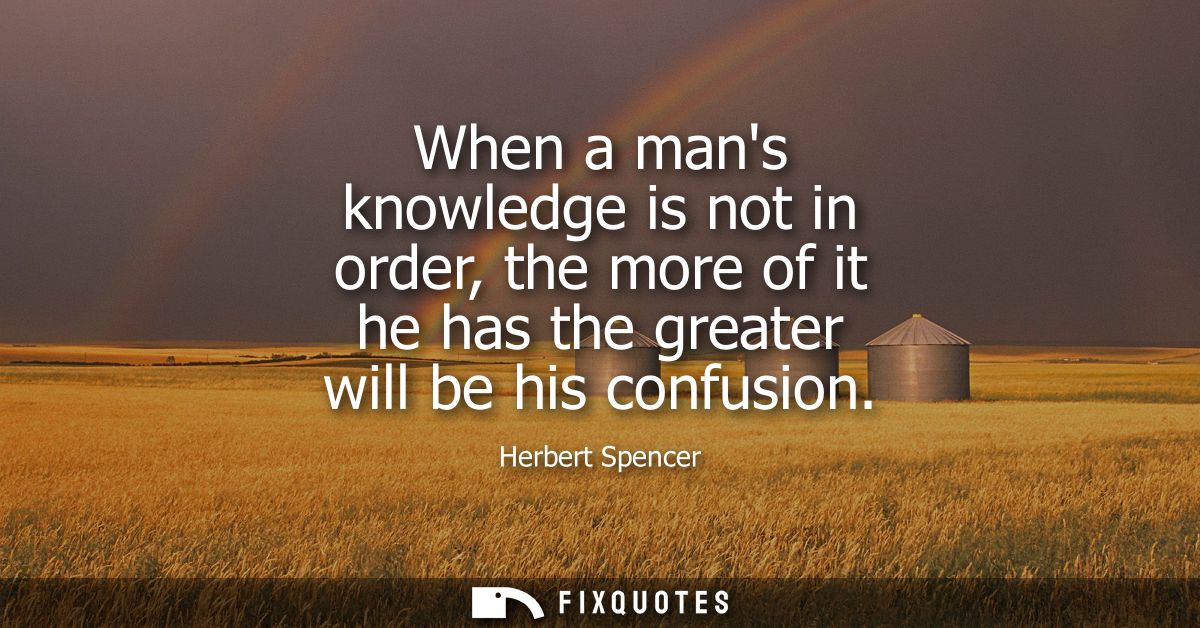
"When a man's knowledge is not in order, the more of it he has the greater will be his confusion"
About this Quote
The line lands because it flips a comforting Victorian faith in “more education” into a harsher, almost mechanical principle: knowledge is only useful when structured. Spencer’s phrasing borrows the language of systems - “in order” suggests taxonomy, hierarchy, and integration, not mere possession. He’s also making a moral point under the guise of epistemology. Disorder here implies laziness, vanity, or intellectual undiscipline: the refusal to do the unglamorous work of synthesis.
Context matters. Spencer writes in a 19th-century world intoxicated by expanding science, libraries, and specialization. The modern mind is suddenly faced with too much to know, and Spencer is effectively offering an early diagnosis of information overload. The subtext is a critique of the encyclopedic pose: the kind of learnedness that looks impressive socially but collapses under pressure because it lacks first principles. It’s a call to build frameworks before building archives.
Quote Details
| Topic | Knowledge |
|---|---|
| Source | Help us find the source |
| Cite |
Citation Formats
APA Style (7th ed.)
Spencer, Herbert. (2026, January 18). When a man's knowledge is not in order, the more of it he has the greater will be his confusion. FixQuotes. https://fixquotes.com/quotes/when-a-mans-knowledge-is-not-in-order-the-more-of-11349/
Chicago Style
Spencer, Herbert. "When a man's knowledge is not in order, the more of it he has the greater will be his confusion." FixQuotes. January 18, 2026. https://fixquotes.com/quotes/when-a-mans-knowledge-is-not-in-order-the-more-of-11349/.
MLA Style (9th ed.)
"When a man's knowledge is not in order, the more of it he has the greater will be his confusion." FixQuotes, 18 Jan. 2026, https://fixquotes.com/quotes/when-a-mans-knowledge-is-not-in-order-the-more-of-11349/. Accessed 12 Feb. 2026.