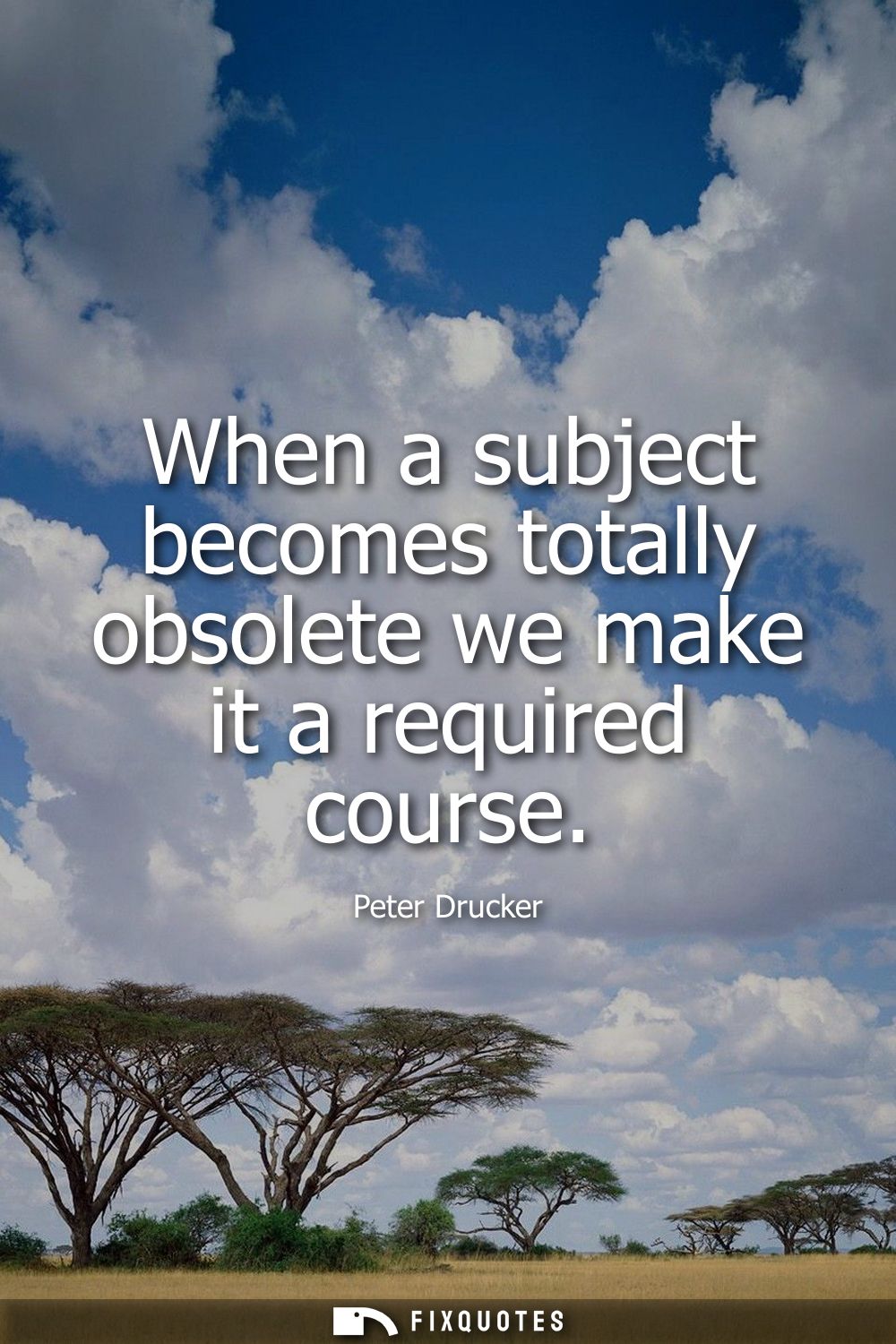
"When a subject becomes totally obsolete, we make it a required course"
About this Quote
The line also carries Drucker’s signature suspicion of complacent management. In business, obsolescence is a death sentence. In academia and credentialing systems, it can be a promotion. That inversion is the joke, and it’s why it stings: universities and professional bodies often respond to a changing world not by subtracting dead weight, but by adding more prerequisites, more compliance, more “core.” Students absorb the cost in time and debt; employers inherit graduates trained to navigate checklists rather than ambiguity.
Context matters. Drucker lived through the rise of the knowledge worker, the postwar expansion of universities, and the mid-century boom in managerial “science.” He watched organizations professionalize and standardize, then confuse standardization with relevance. The subtext is a warning about cultural lag: the world moves, institutions fossilize. By calling out “required” status, he’s naming how obsolescence hides in plain sight when it’s wrapped in tradition and stamped with authority. The punchline is an indictment of inertia masquerading as rigor.
Quote Details
| Topic | Teaching |
|---|---|
| Source | Help us find the source |
| Cite |
Citation Formats
APA Style (7th ed.)
Drucker, Peter. (2026, February 16). When a subject becomes totally obsolete, we make it a required course. FixQuotes. https://fixquotes.com/quotes/when-a-subject-becomes-totally-obsolete-we-make-29418/
Chicago Style
Drucker, Peter. "When a subject becomes totally obsolete, we make it a required course." FixQuotes. February 16, 2026. https://fixquotes.com/quotes/when-a-subject-becomes-totally-obsolete-we-make-29418/.
MLA Style (9th ed.)
"When a subject becomes totally obsolete, we make it a required course." FixQuotes, 16 Feb. 2026, https://fixquotes.com/quotes/when-a-subject-becomes-totally-obsolete-we-make-29418/. Accessed 28 Mar. 2026.