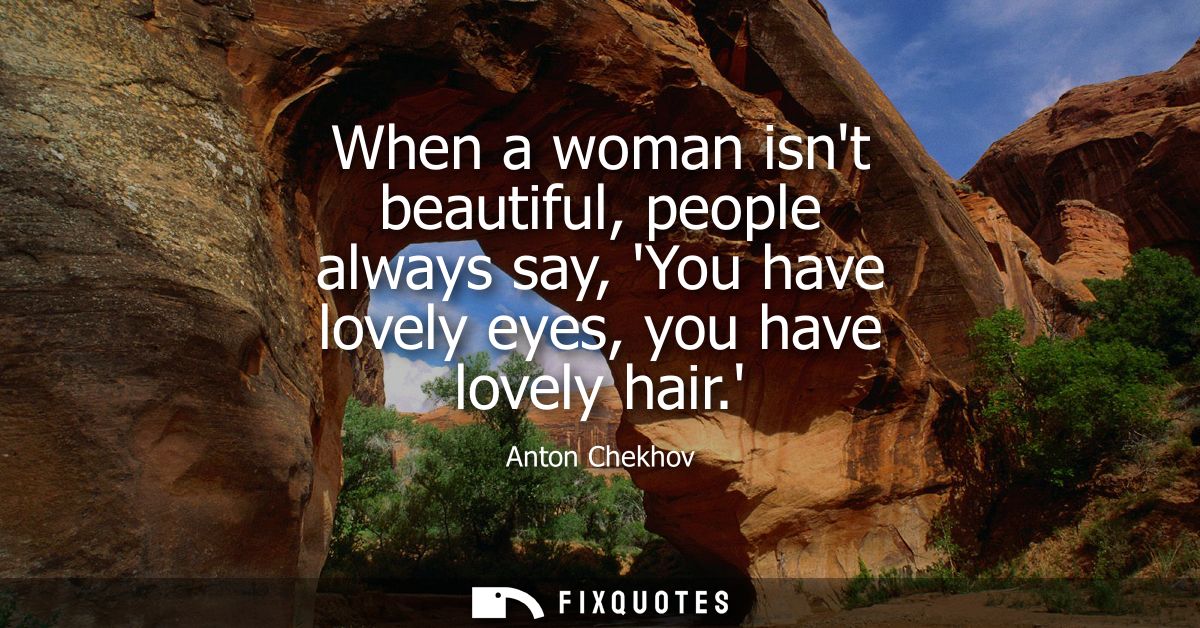
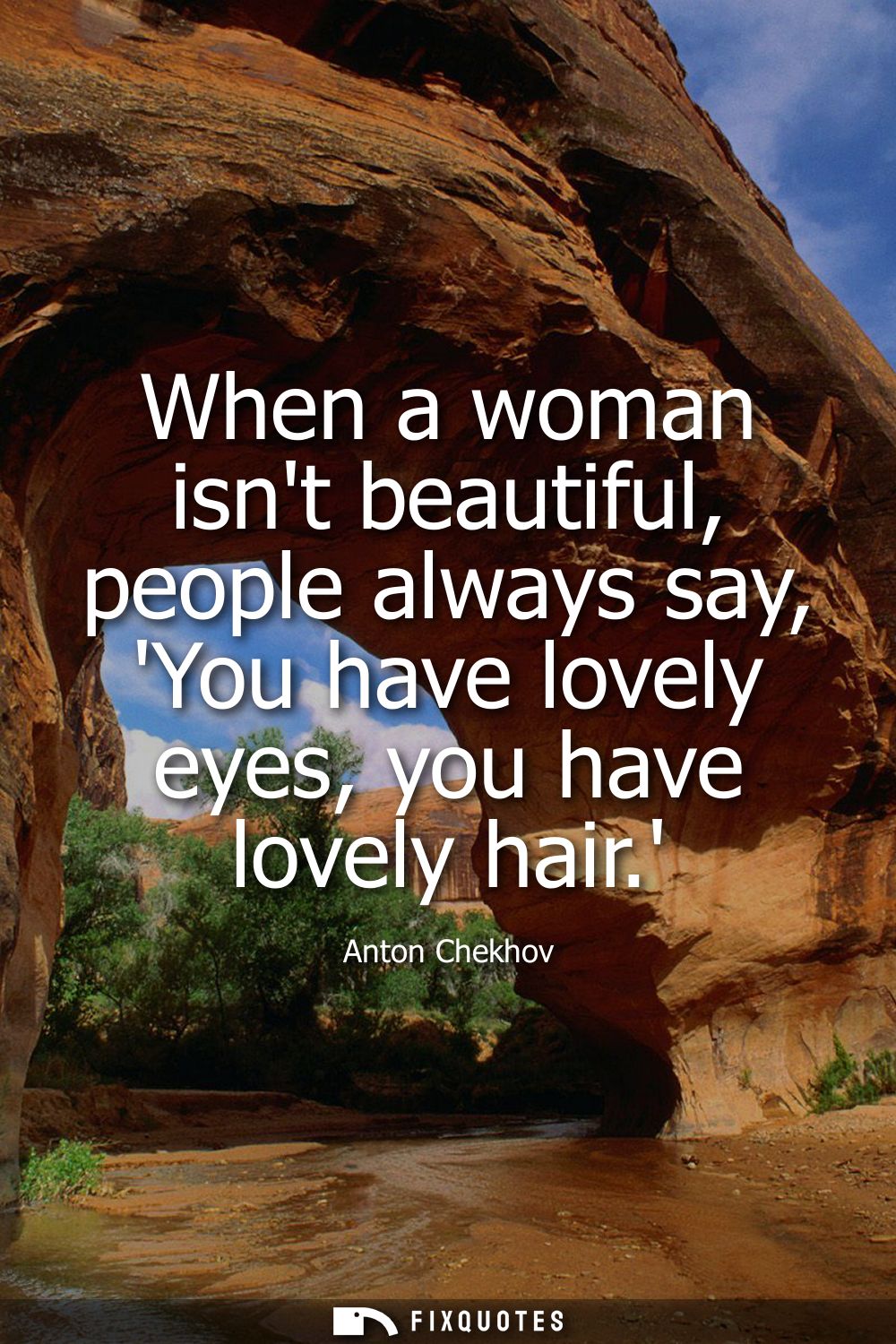
"When a woman isn't beautiful, people always say, 'You have lovely eyes, you have lovely hair.'"
About this Quote
The intent is less cruelty than exposure. Chekhov, the physician of social hypocrisies, diagnoses how quickly empathy becomes performance when beauty is treated as a woman's primary credential. The specificity matters: eyes and hair are detachable fragments, easy to compliment without engaging the whole person. It's praise that narrows rather than expands, turning a human being into a set of acceptable features. That reduction mirrors the larger market logic of Chekhov's era (and ours): women's value gets priced first on appearance, then softly discounted with "but" compliments when the product doesn't match the ideal.
The subtext is even darker: these consolations are offered for the comfort of the speaker, not the recipient. They allow people to feel humane while maintaining the hierarchy untouched. Chekhov's dramatist craft shows in the quoted dialogue - it's realistic, almost banal, which is why it stings. The line isn't trying to win an argument; it's letting everyday speech convict itself.
Quote Details
| Topic | Witty One-Liners |
|---|---|
| Source | Verified source: Uncle Vanya: Scenes from Country Life in Four Acts (Anton Chekhov, 1897)
Evidence: No, when a woman is ugly they always say she has beautiful hair or eyes. (Act III (no fixed page in this HTML edition)). The wording commonly circulated online (“When a woman isn't beautiful, people always say, 'You have lovely eyes, you have lovely hair.'”) is a paraphrase/reshaping of Chekhov’s line from Act III of the play. In the Gutenberg English translation, Sonya says this immediately after Helena tells her, “You have lovely hair.” This is a translated line; Chekhov’s original was written in Russian and first published as the play «Дядя Ваня» (Uncle Vanya), generally dated to 1897 publication. Other candidates (1) Humorous Wit (Djamel Ouis, 2020) compilation95.0% ... When a woman isn't beautiful , people always say , " You have lovely eyes , you have lovely hair . " Anton Chekho... |
| Cite |
Citation Formats
APA Style (7th ed.)
Chekhov, Anton. (2026, February 22). When a woman isn't beautiful, people always say, 'You have lovely eyes, you have lovely hair.'. FixQuotes. https://fixquotes.com/quotes/when-a-woman-isnt-beautiful-people-always-say-you-110844/
Chicago Style
Chekhov, Anton. "When a woman isn't beautiful, people always say, 'You have lovely eyes, you have lovely hair.'." FixQuotes. February 22, 2026. https://fixquotes.com/quotes/when-a-woman-isnt-beautiful-people-always-say-you-110844/.
MLA Style (9th ed.)
"When a woman isn't beautiful, people always say, 'You have lovely eyes, you have lovely hair.'." FixQuotes, 22 Feb. 2026, https://fixquotes.com/quotes/when-a-woman-isnt-beautiful-people-always-say-you-110844/. Accessed 4 Apr. 2026.