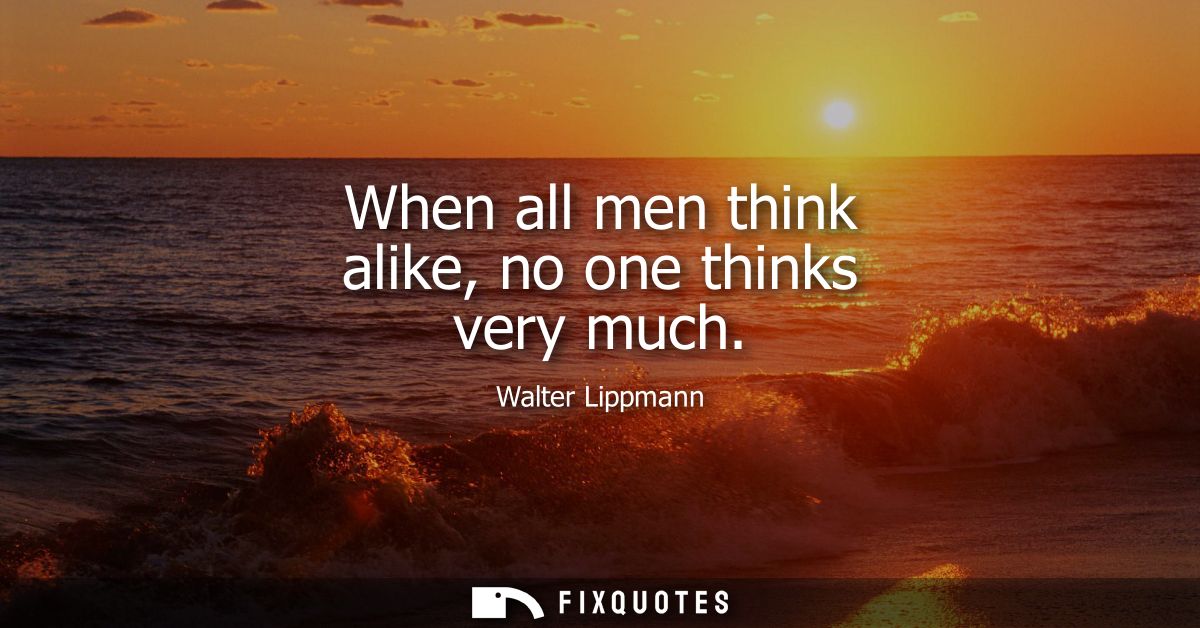
"When all men think alike, no one thinks very much"
About this Quote
Consensus is often sold as sanity, but Lippmann treats it as a warning label. "When all men think alike, no one thinks very much" lands because it turns a civic virtue on its head: agreement doesn’t signal clarity; it can signal compliance. The line is built on a sly paradox. "All men" implies a democratic totality, the comforting image of a public finally on the same page. Lippmann punctures that comfort by redefining "think" as labor, not posture. If everyone arrives at the same conclusion, he suggests, someone did the thinking for them.
The subtext is classic Lippmann: mass opinion is not a neutral reflection of reality but a manufactured product. In Public Opinion (1922), he argued that citizens navigate politics through "pictures in our heads" shaped by media, elites, and simplified narratives. So the real target here isn’t harmony; it’s the machinery that produces uniformity - slogans, party lines, moral panics, even the newsroom’s temptation to launder assumptions into "common sense."
Context matters. Lippmann wrote in the age of propaganda’s modern birth: World War I messaging, the rise of public relations, expanding mass media. His suspicion isn’t anti-democratic so much as anti-naive. He’s pointing at a structural problem: large publics can’t verify everything, so they outsource judgment, and outsourcing turns into mimicry.
What makes the sentence endure is its sting. It flatters the reader into dissent - not as contrarian cosplay, but as a duty. Thinking, in Lippmann’s framing, begins exactly where unanimity feels most comfortable.
The subtext is classic Lippmann: mass opinion is not a neutral reflection of reality but a manufactured product. In Public Opinion (1922), he argued that citizens navigate politics through "pictures in our heads" shaped by media, elites, and simplified narratives. So the real target here isn’t harmony; it’s the machinery that produces uniformity - slogans, party lines, moral panics, even the newsroom’s temptation to launder assumptions into "common sense."
Context matters. Lippmann wrote in the age of propaganda’s modern birth: World War I messaging, the rise of public relations, expanding mass media. His suspicion isn’t anti-democratic so much as anti-naive. He’s pointing at a structural problem: large publics can’t verify everything, so they outsource judgment, and outsourcing turns into mimicry.
What makes the sentence endure is its sting. It flatters the reader into dissent - not as contrarian cosplay, but as a duty. Thinking, in Lippmann’s framing, begins exactly where unanimity feels most comfortable.
Quote Details
| Topic | Reason & Logic |
|---|---|
| Source | Evidence:
... Walter Lippmann: "When all men think alike, no one thinks very much." (The Phantom Public, 1925) 6. Herbert Tingsten: "Elections decide who is to rule, and. |
| Cite |
Citation Formats
APA Style (7th ed.)
Lippmann, Walter. (2026, February 23). When all men think alike, no one thinks very much. FixQuotes. https://fixquotes.com/quotes/when-all-men-think-alike-no-one-thinks-very-much-78893/
Chicago Style
Lippmann, Walter. "When all men think alike, no one thinks very much." FixQuotes. February 23, 2026. https://fixquotes.com/quotes/when-all-men-think-alike-no-one-thinks-very-much-78893/.
MLA Style (9th ed.)
"When all men think alike, no one thinks very much." FixQuotes, 23 Feb. 2026, https://fixquotes.com/quotes/when-all-men-think-alike-no-one-thinks-very-much-78893/. Accessed 30 Mar. 2026.
More Quotes by Walter
Add to List