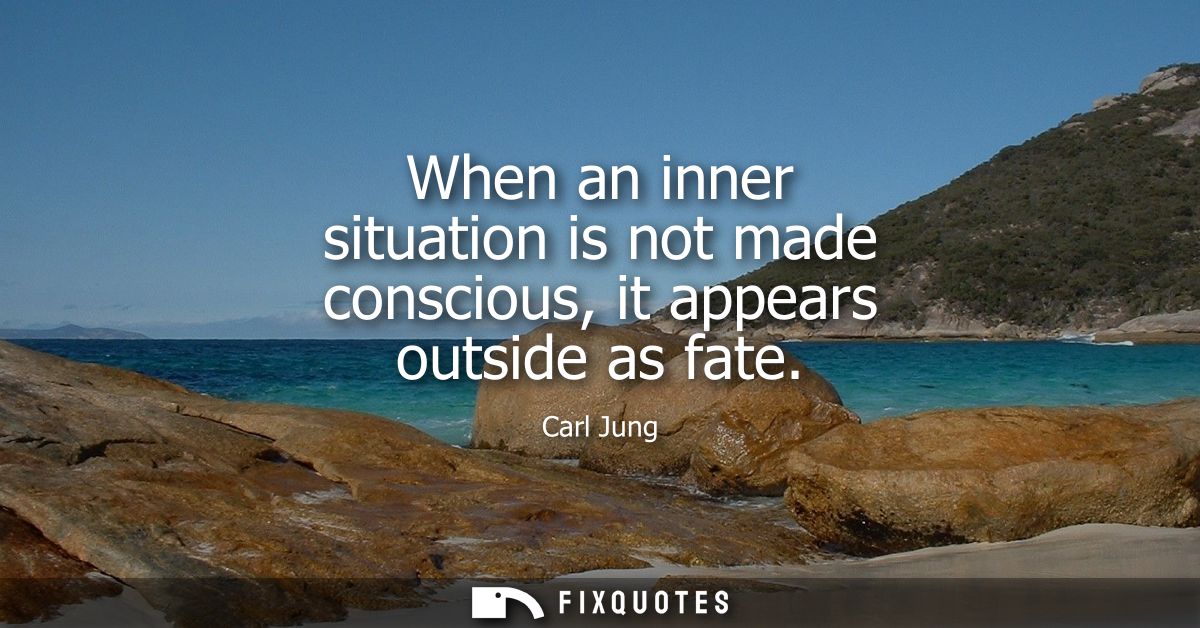
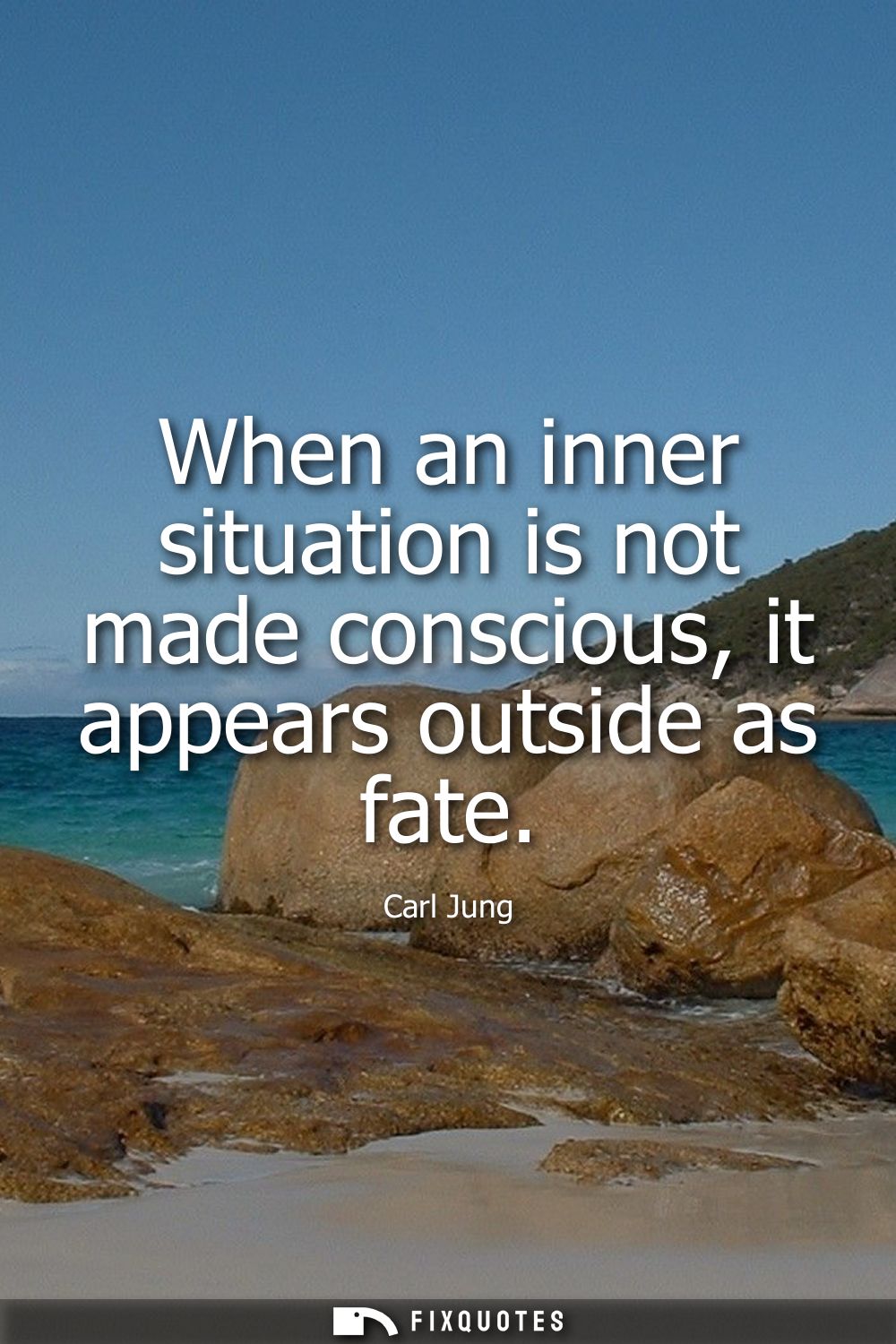
"When an inner situation is not made conscious, it appears outside as fate"
About this Quote
The key phrase is “not made conscious.” Jung isn’t urging navel-gazing for its own sake; he’s pointing to a practical liability. What you refuse to recognize in yourself doesn’t disappear. It returns as pattern: the same kind of boss, the same kind of relationship, the same kind of self-sabotage. By the time it shows up “outside,” it feels objective, inevitable, even ordained. That’s the subtextual sting: people often prefer the story of fate because it absolves them of authorship.
Context matters. Jung’s work on the unconscious and the “shadow” grows out of early 20th-century Europe, where modernity was breaking old certainties and psychology was competing with religion for explanatory authority. His framing preserves the drama of older moral language while offering a new culprit: psychic blindness. The sentence is also rhetorically strategic. It doesn’t deny that life is contingent or unfair; it insists that some portion of what we call destiny is repetition compulsion with better PR. Jung is selling responsibility without sounding like a scold, turning introspection into a form of agency.
Quote Details
| Topic | Free Will & Fate |
|---|---|
| Source | Help us find the source |
| Cite |
Citation Formats
APA Style (7th ed.)
Jung, Carl. (2026, January 17). When an inner situation is not made conscious, it appears outside as fate. FixQuotes. https://fixquotes.com/quotes/when-an-inner-situation-is-not-made-conscious-it-35158/
Chicago Style
Jung, Carl. "When an inner situation is not made conscious, it appears outside as fate." FixQuotes. January 17, 2026. https://fixquotes.com/quotes/when-an-inner-situation-is-not-made-conscious-it-35158/.
MLA Style (9th ed.)
"When an inner situation is not made conscious, it appears outside as fate." FixQuotes, 17 Jan. 2026, https://fixquotes.com/quotes/when-an-inner-situation-is-not-made-conscious-it-35158/. Accessed 12 Feb. 2026.