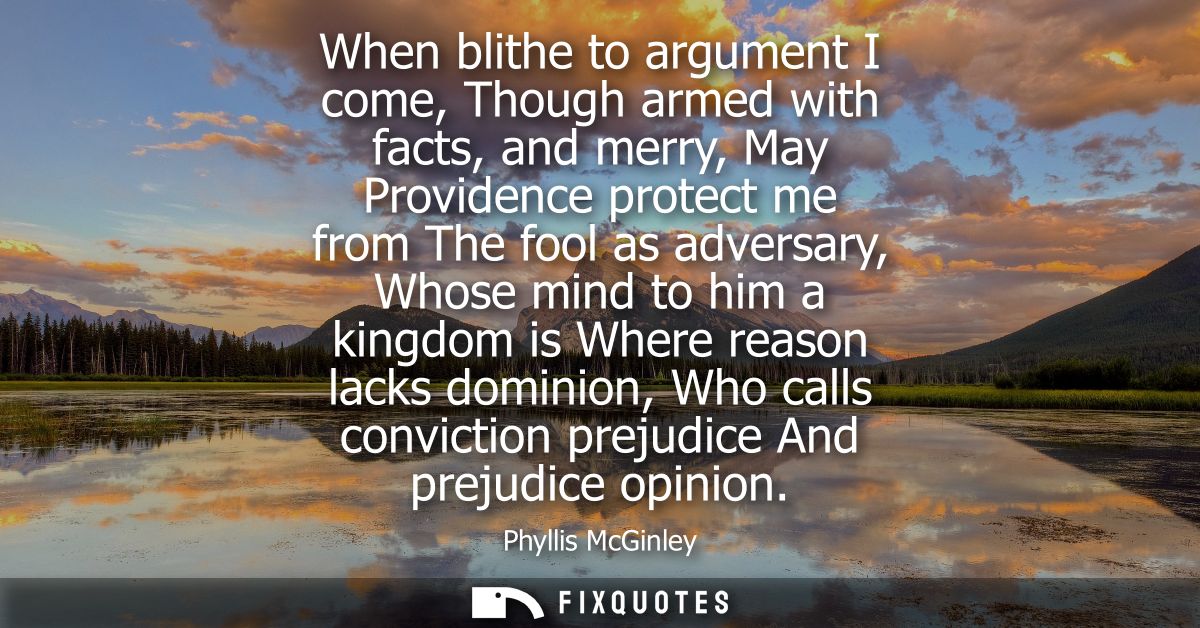
"When blithe to argument I come, Though armed with facts, and merry, May Providence protect me from The fool as adversary, Whose mind to him a kingdom is Where reason lacks dominion, Who calls conviction prejudice And prejudice opinion"
About this Quote
A cheerful debater, armed with facts and goodwill, asks for protection from the one opponent facts cannot touch: the fool. The plea is playful on its surface, almost jaunty, but it sketches a serious dilemma in public discourse. Against someone who treats his own mind as a private kingdom where reason holds no sway, evidence has no passport. He will recast your carefully reasoned conviction as mere prejudice, and then upgrade his own prejudice to the neutral-sounding status of opinion. The result is a rigged exchange in which criteria shift and language softens what should be condemned while hardening what should persuade.
The poem turns on that witty, pointed inversion. Conviction traditionally suggests a view anchored in reasons and principles, tested by argument and open to refinement. Prejudice, by contrast, is unearned certainty, pre-judgment that resists evidence. Opinion sits between them, something provisional. The fool collapses these distinctions to avoid accountability: the other side is biased; his bias is just a viewpoint. Once that shell game is in play, rational engagement stalls.
The line about a mind as a kingdom echoes a Renaissance lyric that praised inner sovereignty. McGinley tweaks the trope to expose a darker version of self-rule: mental autocracy without the check of reason. It is a neat illustration of her broader art. Known for light verse that sparkles with social observation, she uses bounce and rhyme to deliver trenchant truths about manners, civility, and the hazards of modern chatter.
The piece feels eerily contemporary. In an era when debates often reward performance over proof and platforms amplify certainty over curiosity, the merry disputant needs more than data. She needs luck, patience, and perhaps the wisdom to decline contests where terms are unfixed and good faith is absent. The prayer to Providence is half jest, half strategy: a recognition that some arguments are not arguments at all, only stalemates camouflaged by talk.
The poem turns on that witty, pointed inversion. Conviction traditionally suggests a view anchored in reasons and principles, tested by argument and open to refinement. Prejudice, by contrast, is unearned certainty, pre-judgment that resists evidence. Opinion sits between them, something provisional. The fool collapses these distinctions to avoid accountability: the other side is biased; his bias is just a viewpoint. Once that shell game is in play, rational engagement stalls.
The line about a mind as a kingdom echoes a Renaissance lyric that praised inner sovereignty. McGinley tweaks the trope to expose a darker version of self-rule: mental autocracy without the check of reason. It is a neat illustration of her broader art. Known for light verse that sparkles with social observation, she uses bounce and rhyme to deliver trenchant truths about manners, civility, and the hazards of modern chatter.
The piece feels eerily contemporary. In an era when debates often reward performance over proof and platforms amplify certainty over curiosity, the merry disputant needs more than data. She needs luck, patience, and perhaps the wisdom to decline contests where terms are unfixed and good faith is absent. The prayer to Providence is half jest, half strategy: a recognition that some arguments are not arguments at all, only stalemates camouflaged by talk.
Quote Details
| Topic | Reason & Logic |
|---|
More Quotes by Phyllis
Add to List