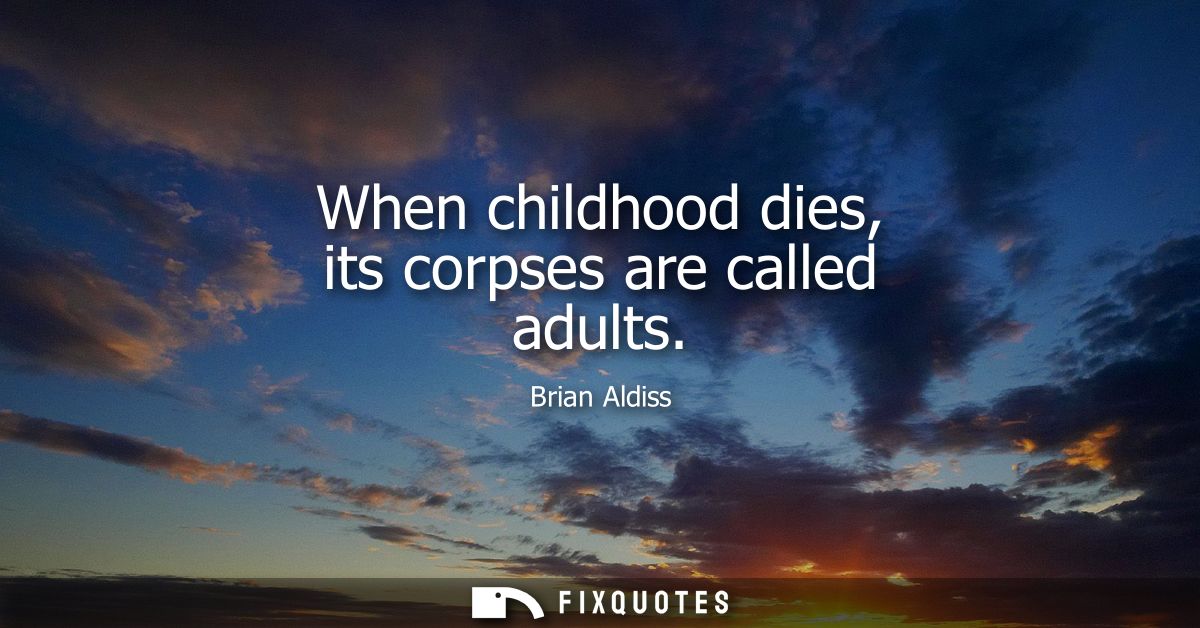
"When childhood dies, its corpses are called adults"
About this Quote
Aldiss lands the line like a coroner with a punchline: adulthood as a body bag for something vital we let expire. The shock isn’t just in the word “corpses,” it’s in the grammatical sleight of hand. Childhood “dies” as if it’s a natural event, but the aftermath is social labeling: we don’t mourn, we rename. “Adults” becomes a euphemism that tidies up the scene, suggesting a culture that treats imagination, vulnerability, and play as expendable once they stop being useful.
As a science fiction writer who spent decades interrogating “progress,” Aldiss is allergic to tidy narratives of maturation. His intent feels less like nostalgia and more like indictment. Modernity loves the story of linear improvement - the child becomes the competent grown-up - but Aldiss flips that arc into a conversion of life into compliance. If childhood is the part of us most capable of wonder and radical perception, then calling its remains “adults” hints that society’s version of maturity can be a kind of domestication: the imaginative mind embalmed in responsibility, productivity, and acceptable emotions.
The subtext is also self-aimed. Writers traffic in preserving childhood’s cognitive freedom, the ability to see the world untrained. Aldiss isn’t arguing against growing up; he’s warning that growing older is not the same thing as staying alive inside. The line works because it refuses comfort: it makes “adult” sound less like a destination than a diagnosis.
As a science fiction writer who spent decades interrogating “progress,” Aldiss is allergic to tidy narratives of maturation. His intent feels less like nostalgia and more like indictment. Modernity loves the story of linear improvement - the child becomes the competent grown-up - but Aldiss flips that arc into a conversion of life into compliance. If childhood is the part of us most capable of wonder and radical perception, then calling its remains “adults” hints that society’s version of maturity can be a kind of domestication: the imaginative mind embalmed in responsibility, productivity, and acceptable emotions.
The subtext is also self-aimed. Writers traffic in preserving childhood’s cognitive freedom, the ability to see the world untrained. Aldiss isn’t arguing against growing up; he’s warning that growing older is not the same thing as staying alive inside. The line works because it refuses comfort: it makes “adult” sound less like a destination than a diagnosis.
Quote Details
| Topic | Aging |
|---|---|
| Source | Help us find the source |
| Cite |
Citation Formats
APA Style (7th ed.)
Aldiss, Brian. (2026, January 15). When childhood dies, its corpses are called adults. FixQuotes. https://fixquotes.com/quotes/when-childhood-dies-its-corpses-are-called-adults-142037/
Chicago Style
Aldiss, Brian. "When childhood dies, its corpses are called adults." FixQuotes. January 15, 2026. https://fixquotes.com/quotes/when-childhood-dies-its-corpses-are-called-adults-142037/.
MLA Style (9th ed.)
"When childhood dies, its corpses are called adults." FixQuotes, 15 Jan. 2026, https://fixquotes.com/quotes/when-childhood-dies-its-corpses-are-called-adults-142037/. Accessed 4 Apr. 2026.
More Quotes by Brian
Add to List