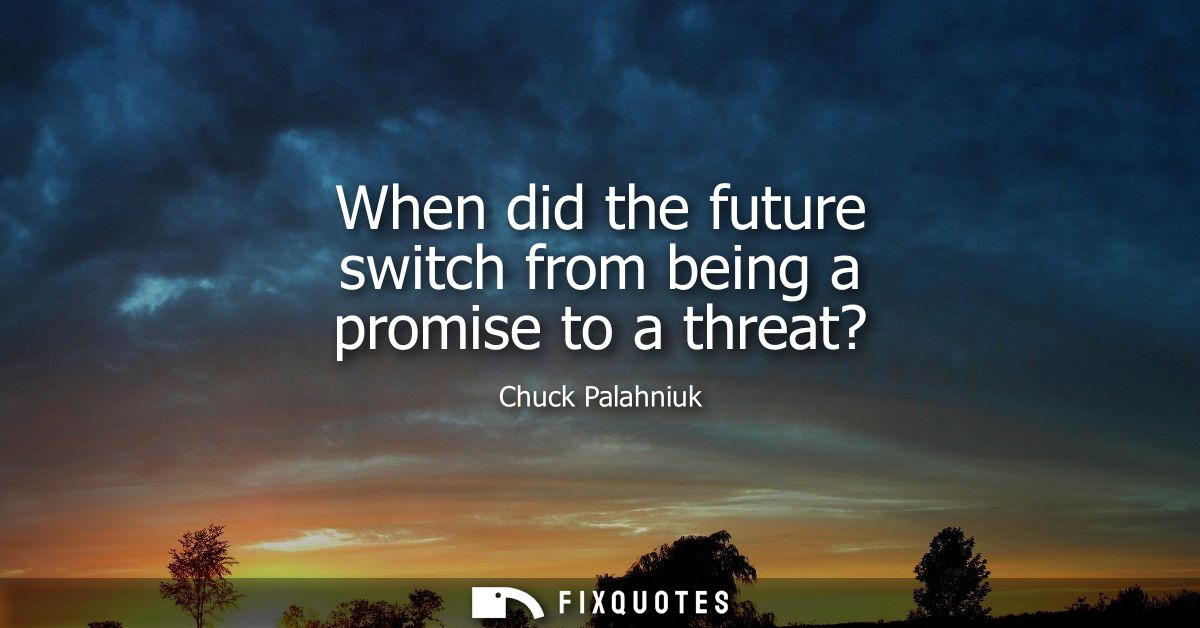
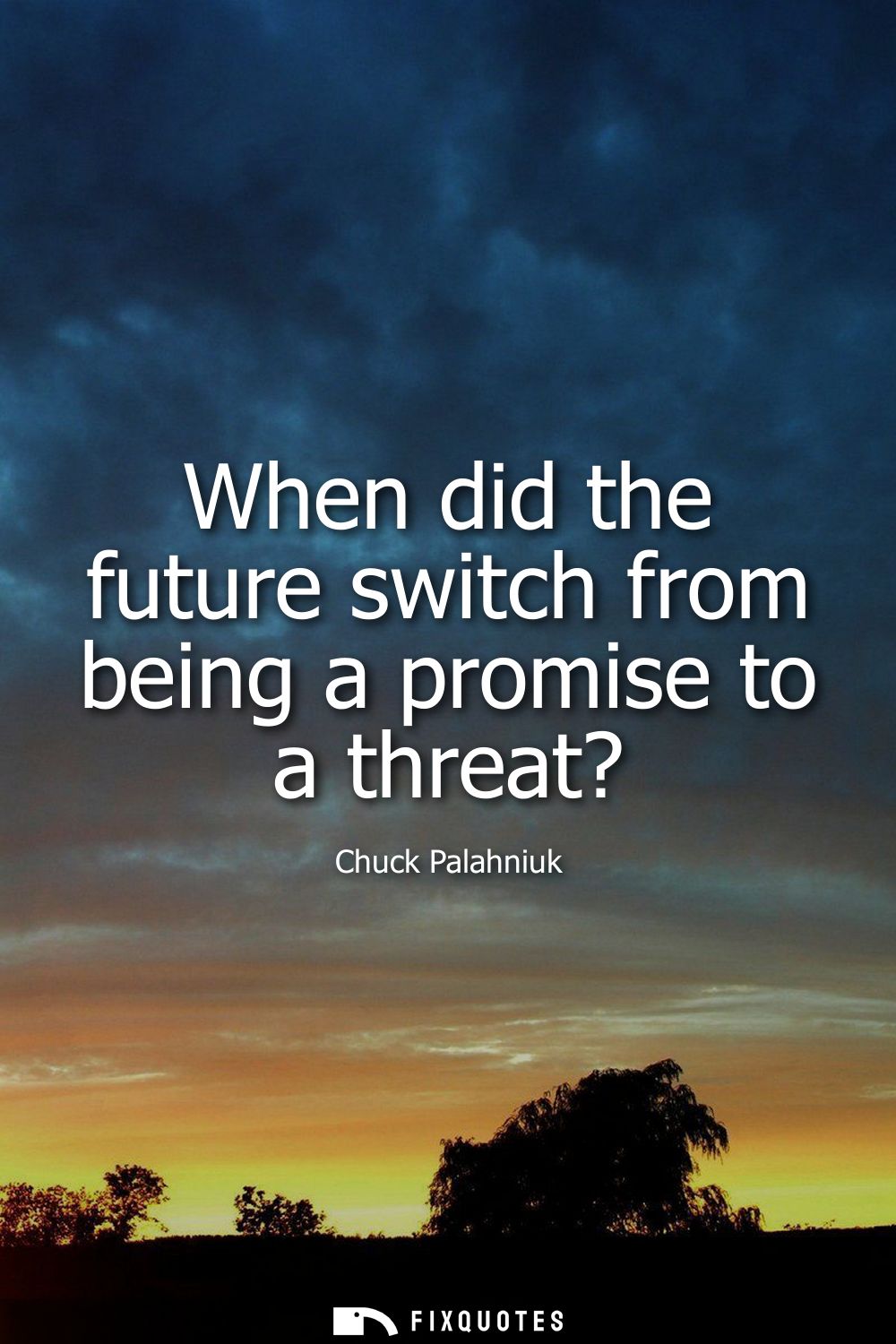
"When did the future switch from being a promise to a threat?"
About this Quote
The question lands like a cold hand on the spine: we were raised on a cultural script where “the future” meant jetpacks, upward mobility, and a cleaner version of ourselves. Palahniuk flips that inheritance into an accusation. Not “why are things bad,” but “when did we agree to be afraid?” The genius is in the verb switch. A promise is something you’re owed; a threat is something you’re warned about. Same object, opposite posture. His line captures the moment optimism stopped feeling naive and started feeling complicit.
Palahniuk’s work has always treated modern life as a self-improvement cult that secretly hates its members. Here, the future becomes the ultimate product launch: endlessly hyped, perpetually delayed, and then delivered as a crisis. The subtext is less sci-fi than economic and psychological. Precarious work, environmental collapse, surveillance, algorithmic drift, political whiplash: the future isn’t an open horizon so much as a pending notification. You don’t plan it, you brace for it.
The rhetorical move is also slyly collective. “Switch” implies someone changed the channel while we weren’t looking - institutions, markets, media, even our own appetites for catastrophe. It’s a pop-culture distillation of late-capitalist dread: the sense that progress is still happening, just not for you, and possibly not for humans at all.
Palahniuk doesn’t offer solace; he offers recognition. The line works because it names a quiet grief: not merely fear of what’s coming, but nostalgia for when “tomorrow” used to sound like a gift.
Palahniuk’s work has always treated modern life as a self-improvement cult that secretly hates its members. Here, the future becomes the ultimate product launch: endlessly hyped, perpetually delayed, and then delivered as a crisis. The subtext is less sci-fi than economic and psychological. Precarious work, environmental collapse, surveillance, algorithmic drift, political whiplash: the future isn’t an open horizon so much as a pending notification. You don’t plan it, you brace for it.
The rhetorical move is also slyly collective. “Switch” implies someone changed the channel while we weren’t looking - institutions, markets, media, even our own appetites for catastrophe. It’s a pop-culture distillation of late-capitalist dread: the sense that progress is still happening, just not for you, and possibly not for humans at all.
Palahniuk doesn’t offer solace; he offers recognition. The line works because it names a quiet grief: not merely fear of what’s coming, but nostalgia for when “tomorrow” used to sound like a gift.
Quote Details
| Topic | Anxiety |
|---|---|
| Source | Verified source: Invisible Monsters (Chuck Palahniuk, 1999)
Evidence: When did the future switch from being a promise to being a threat? (null). Primary-source attribution consensus is that this line originates in Chuck Palahniuk’s novel Invisible Monsters, first published in 1999. Many secondary sites repeat the quote and often cite different later editions (e.g., some cite a 2011/"Remix" edition and specific page numbers), but those are edition-dependent and not reliable for establishing first appearance. I could not access a verifiable scan/page image of the 1999 first edition text in this search session to confirm an exact page/chapter location; therefore page/chapter is left null and confidence is set to medium rather than high. Other candidates (1) Inside the Mind of Chuck Palahniuk (Frank Johnson, 2014) compilation95.0% ... When did the future switch from being a promise to a threat ? " " Minimalism seems closest to the sophisticated s... |
| Cite |
Citation Formats
APA Style (7th ed.)
Palahniuk, Chuck. (2026, February 16). When did the future switch from being a promise to a threat? FixQuotes. https://fixquotes.com/quotes/when-did-the-future-switch-from-being-a-promise-23093/
Chicago Style
Palahniuk, Chuck. "When did the future switch from being a promise to a threat?" FixQuotes. February 16, 2026. https://fixquotes.com/quotes/when-did-the-future-switch-from-being-a-promise-23093/.
MLA Style (9th ed.)
"When did the future switch from being a promise to a threat?" FixQuotes, 16 Feb. 2026, https://fixquotes.com/quotes/when-did-the-future-switch-from-being-a-promise-23093/. Accessed 2 Apr. 2026.
More Quotes by Chuck
Add to List