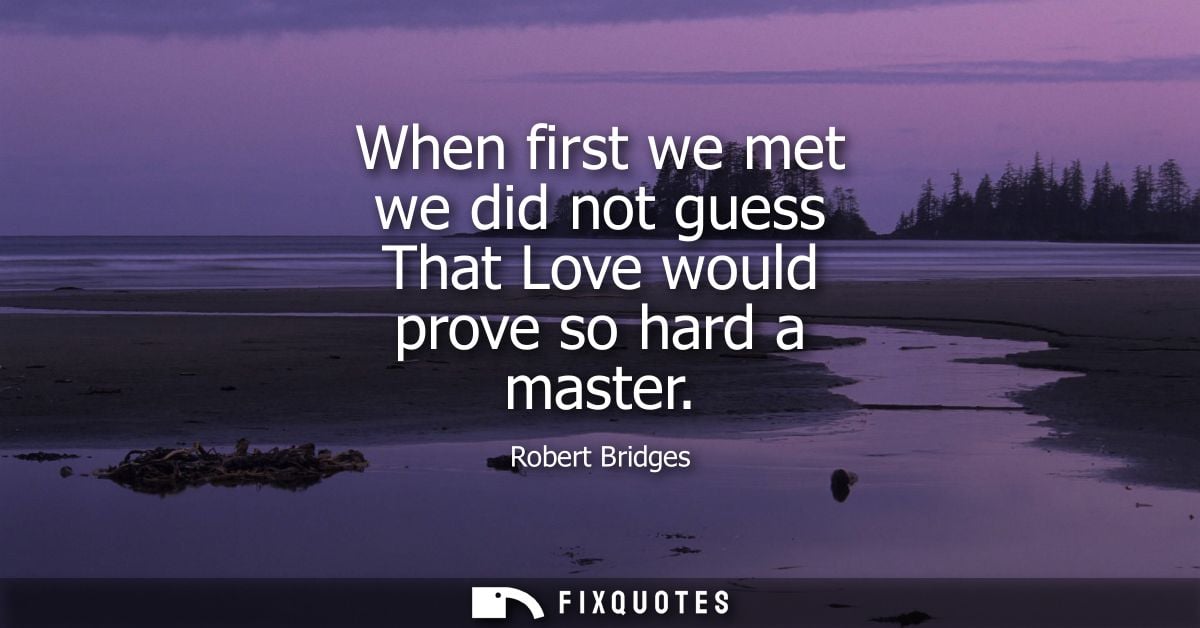
"When first we met we did not guess That Love would prove so hard a master"
About this Quote
Calling Love "a master" tilts the emotional balance of power. It's not a partner, not a muse, not even an affliction, but an authority. The word carries a double weight: the master of a craft (demanding discipline) and the master over a servant (demanding submission). That ambiguity is the poem's subtext: love can refine you and also reduce you, ask for your best and take more than you meant to give. "Hard" sharpens the point. This isn't the melodrama of heartsickness; it's the slow grind of responsibility, compromise, and the way devotion reorganizes your life around someone else's needs.
Bridges, writing in late Victorian/early modern England, sits in a cultural moment where feeling is increasingly scrutinized but still socially policed. The line reflects a reserved sensibility that nonetheless refuses to sentimentalize. Its intent is not to dismiss love, but to strip it of its marketing: the first meeting sells freedom; the lived relationship reveals governance. The couplet works because it compresses a whole adult education into two plain, almost conversational lines.
Quote Details
| Topic | Heartbreak |
|---|---|
| Source | Help us find the source |
| Cite |
Citation Formats
APA Style (7th ed.)
Bridges, Robert. (2026, January 16). When first we met we did not guess That Love would prove so hard a master. FixQuotes. https://fixquotes.com/quotes/when-first-we-met-we-did-not-guess-that-love-88586/
Chicago Style
Bridges, Robert. "When first we met we did not guess That Love would prove so hard a master." FixQuotes. January 16, 2026. https://fixquotes.com/quotes/when-first-we-met-we-did-not-guess-that-love-88586/.
MLA Style (9th ed.)
"When first we met we did not guess That Love would prove so hard a master." FixQuotes, 16 Jan. 2026, https://fixquotes.com/quotes/when-first-we-met-we-did-not-guess-that-love-88586/. Accessed 7 Apr. 2026.