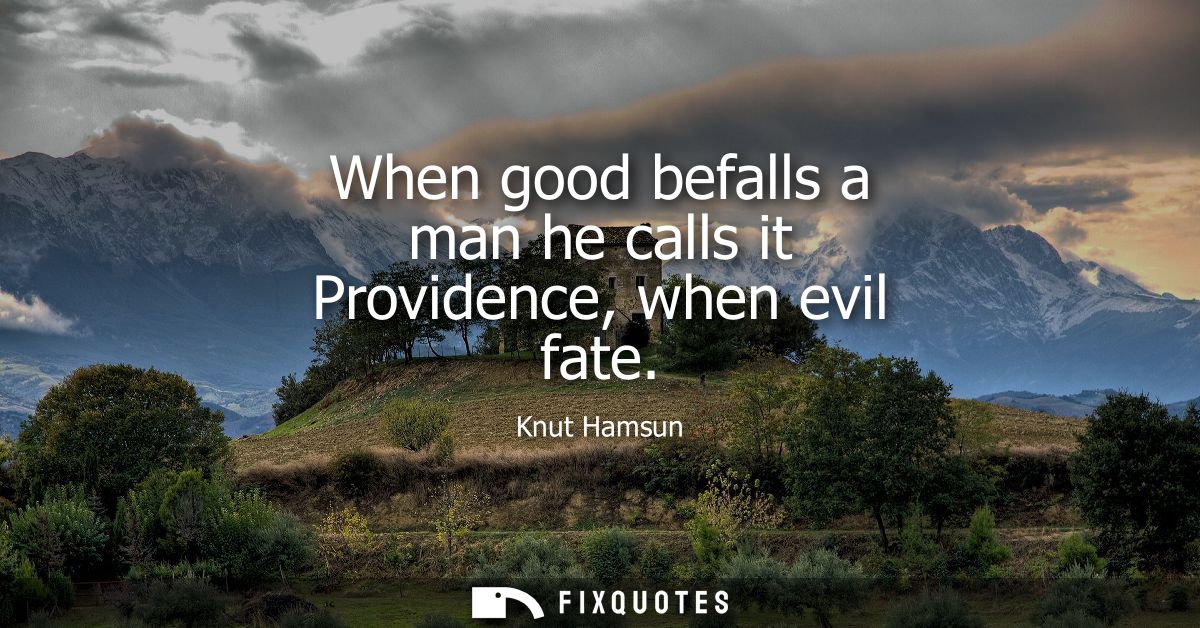
"When good befalls a man he calls it Providence, when evil fate"
About this Quote
A clean little scalpel of a sentence: Hamsun slices into the self-serving theology people use to keep their self-image intact. Good luck becomes “Providence” because it flatters the ego and suggests a world that endorses you. Bad luck gets outsourced to “fate” because it preserves the same ego from blame. The pairing isn’t accidental. Providence implies a personal, benevolent plan; fate implies a cold mechanism. One is intimacy, the other is machinery. Hamsun is pointing at the mental switch we flip depending on whether reality is handing us gifts or bills.
The quote’s real bite is that it isn’t arguing about whether God exists or whether fate is real. It’s arguing about how language gets recruited as moral PR. People don’t just interpret events; they curate a narrative in which they are either chosen or wronged. That’s why the line lands: it captures a familiar hypocrisy without sermonizing, letting the reader recognize the dodge in themselves.
Context matters with Hamsun because he’s a novelist obsessed with irrational motives, status hunger, and the stories people tell to survive their own contradictions. His characters often hover between mysticism and resentment, and this aphorism distills that psychology into a single pivot: when life smiles, we metaphysically take credit; when it snarls, we metaphysically appeal. The sentence is unfinished in your excerpt, but the intent is already complete: belief as convenience, metaphysics as alibi.
The quote’s real bite is that it isn’t arguing about whether God exists or whether fate is real. It’s arguing about how language gets recruited as moral PR. People don’t just interpret events; they curate a narrative in which they are either chosen or wronged. That’s why the line lands: it captures a familiar hypocrisy without sermonizing, letting the reader recognize the dodge in themselves.
Context matters with Hamsun because he’s a novelist obsessed with irrational motives, status hunger, and the stories people tell to survive their own contradictions. His characters often hover between mysticism and resentment, and this aphorism distills that psychology into a single pivot: when life smiles, we metaphysically take credit; when it snarls, we metaphysically appeal. The sentence is unfinished in your excerpt, but the intent is already complete: belief as convenience, metaphysics as alibi.
Quote Details
| Topic | Free Will & Fate |
|---|---|
| Source | Help us find the source |
| Cite |
Citation Formats
APA Style (7th ed.)
Hamsun, Knut. (2026, January 15). When good befalls a man he calls it Providence, when evil fate. FixQuotes. https://fixquotes.com/quotes/when-good-befalls-a-man-he-calls-it-providence-32653/
Chicago Style
Hamsun, Knut. "When good befalls a man he calls it Providence, when evil fate." FixQuotes. January 15, 2026. https://fixquotes.com/quotes/when-good-befalls-a-man-he-calls-it-providence-32653/.
MLA Style (9th ed.)
"When good befalls a man he calls it Providence, when evil fate." FixQuotes, 15 Jan. 2026, https://fixquotes.com/quotes/when-good-befalls-a-man-he-calls-it-providence-32653/. Accessed 12 Feb. 2026.
More Quotes by Knut
Add to List