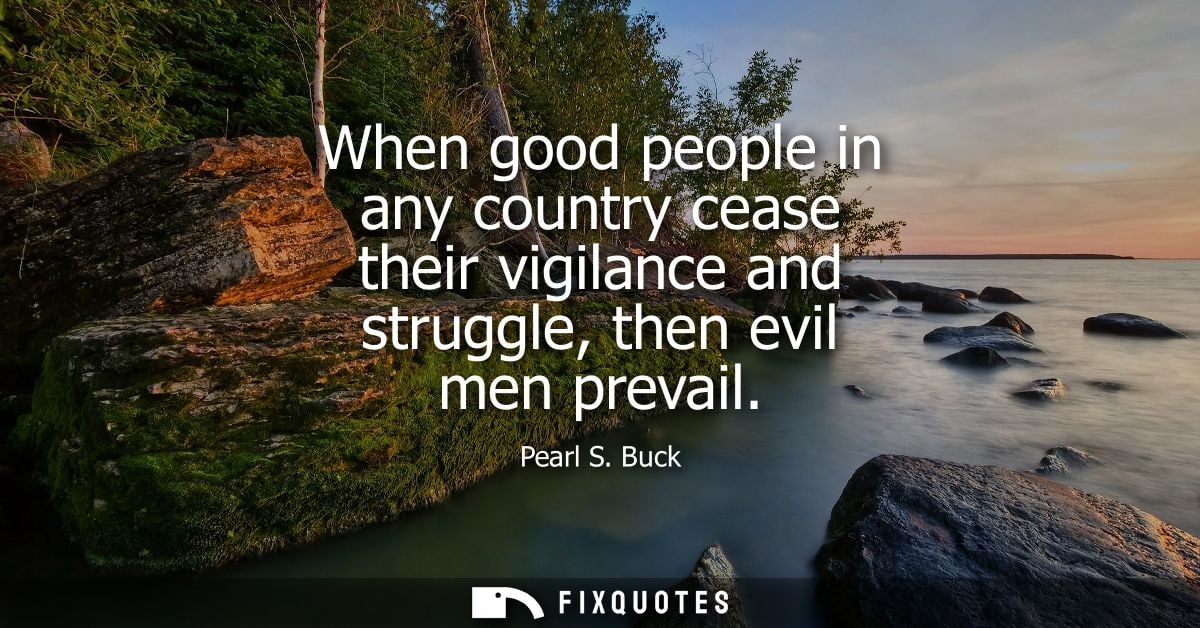
"When good people in any country cease their vigilance and struggle, then evil men prevail"
About this Quote
Buck’s phrasing is strategically unsentimental. “Good people” are not heroic; they’re merely competent stewards of the civic baseline. “Evil men,” meanwhile, aren’t described as brilliant or numerous. They simply “prevail,” a verb that implies advantage taken, momentum gained, doors left unlocked. The subtext is a warning against the comforting myth that history bends toward justice on its own. It doesn’t bend; it’s pushed, or it snaps back.
Context matters: Buck lived through upheavals that made complacency feel lethal - the rise of militarism in Asia, global war, ideological purges, the churn of propaganda. As a novelist shaped by cross-cultural experience, she’s also puncturing national self-flattery. “Any country” widens the indictment: no exceptionalism clause, no safe harbor for democracies that assume they’re immune to backsliding.
The intent isn’t to romanticize struggle but to normalize it. Buck suggests that civic life has a price of admission, paid in attention, participation, and the willingness to be inconvenient. When that payment stops, the bill doesn’t disappear; it’s handed to everyone.
Quote Details
| Topic | Justice |
|---|---|
| Source | Later attribution: Master Writing for the SAT (Margaret Moran, 2008) modern compilationISBN: 9780768927252 · ID: pcH9eGIRGBkC
Evidence:
... When good people in any country cease their vigilance and struggle, then evil men prevail. —Pearl S. Buck Assignment: What is your opinion of Buck's viewpoint that good people must always strive against evil? Plan and write an essay ... |
| Cite |
Citation Formats
APA Style (7th ed.)
Buck, Pearl S. (2026, March 7). When good people in any country cease their vigilance and struggle, then evil men prevail. FixQuotes. https://fixquotes.com/quotes/when-good-people-in-any-country-cease-their-160721/
Chicago Style
Buck, Pearl S. "When good people in any country cease their vigilance and struggle, then evil men prevail." FixQuotes. March 7, 2026. https://fixquotes.com/quotes/when-good-people-in-any-country-cease-their-160721/.
MLA Style (9th ed.)
"When good people in any country cease their vigilance and struggle, then evil men prevail." FixQuotes, 7 Mar. 2026, https://fixquotes.com/quotes/when-good-people-in-any-country-cease-their-160721/. Accessed 29 Mar. 2026.