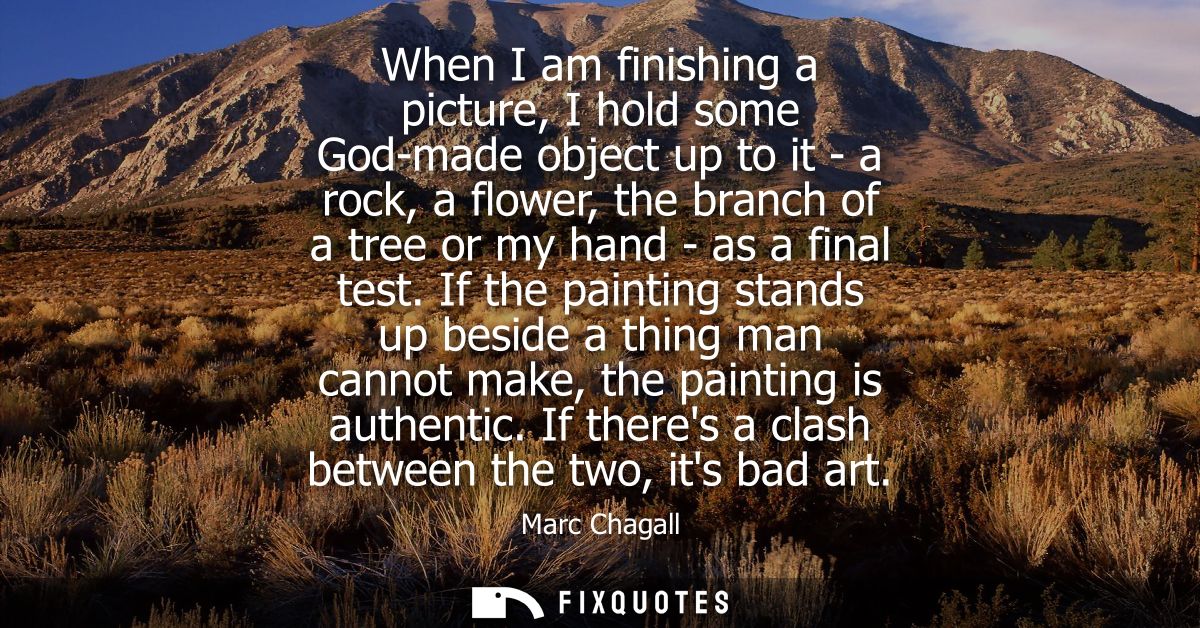
"When I am finishing a picture, I hold some God-made object up to it - a rock, a flower, the branch of a tree or my hand - as a final test. If the painting stands up beside a thing man cannot make, the painting is authentic. If there's a clash between the two, it's bad art"
About this Quote
The intent is practical, not mystical. Chagall is describing a studio ritual that short-circuits self-deception. A rock doesn’t care about your symbolism; a flower exposes your color lies; the branch judges your line with brutal impartiality. Even “my hand” matters here: the body as a real, flawed, living form, not an academic ideal. His test insists that art has to hold its own beside reality’s weird specificity, not replace it with cleverness.
The subtext takes a swipe at art that flatters human control. “A thing man cannot make” frames authenticity as humility: the artist as someone measuring himself against creation rather than competing for dominance. In Chagall’s context - an era of manifestos, abstraction, and the increasing commodification of avant-garde novelty - this reads like a refusal to let criticism, ideology, or the market be the final arbiter. He’s not arguing against invention; he’s arguing that invention without contact becomes decor, and decor becomes dead.
Quote Details
| Topic | Art |
|---|---|
| Source | Help us find the source |
| Cite |
Citation Formats
APA Style (7th ed.)
Chagall, Marc. (2026, January 16). When I am finishing a picture, I hold some God-made object up to it - a rock, a flower, the branch of a tree or my hand - as a final test. If the painting stands up beside a thing man cannot make, the painting is authentic. If there's a clash between the two, it's bad art. FixQuotes. https://fixquotes.com/quotes/when-i-am-finishing-a-picture-i-hold-some-93075/
Chicago Style
Chagall, Marc. "When I am finishing a picture, I hold some God-made object up to it - a rock, a flower, the branch of a tree or my hand - as a final test. If the painting stands up beside a thing man cannot make, the painting is authentic. If there's a clash between the two, it's bad art." FixQuotes. January 16, 2026. https://fixquotes.com/quotes/when-i-am-finishing-a-picture-i-hold-some-93075/.
MLA Style (9th ed.)
"When I am finishing a picture, I hold some God-made object up to it - a rock, a flower, the branch of a tree or my hand - as a final test. If the painting stands up beside a thing man cannot make, the painting is authentic. If there's a clash between the two, it's bad art." FixQuotes, 16 Jan. 2026, https://fixquotes.com/quotes/when-i-am-finishing-a-picture-i-hold-some-93075/. Accessed 9 Mar. 2026.