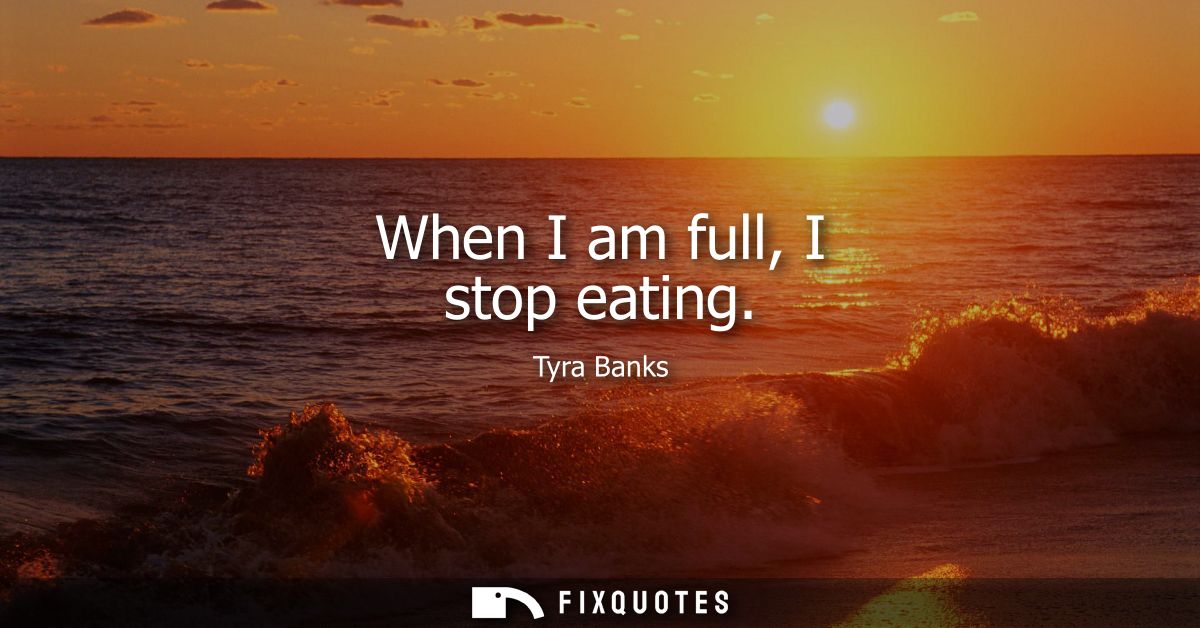
"When I am full, I stop eating"
About this Quote
A line this blunt from Tyra Banks lands like a mic drop because it weaponizes the obvious. "When I am full, I stop eating" reads like the simplest self-help rule imaginable, but its real target is an industry built on making hunger feel like a job requirement. Coming from a supermodel-turned-TV impresario, it’s less a nutritional tip than a refusal to participate in the glamourization of deprivation.
The intent is practical on the surface: trust your body, not a spreadsheet of calories or a punitive diet plan. The subtext is sharper: so much of modern beauty culture trains women to distrust internal signals, to treat fullness as failure and discipline as moral virtue. Banks flips that script by framing stopping as the default, not an achievement. No confession, no apology, no performance of suffering. Just a boundary.
Context matters. Banks rose in the era when "heroin chic" aesthetics and tabloid body surveillance made eating publicly feel politically loaded. She also built a second act on television that sold transformation while occasionally critiquing the cruelty behind it. That tension makes the quote work: it’s coming from someone who knows both the machine and the audience’s exhaustion with it.
Its power is its deadpan simplicity. It doesn’t argue with diet culture; it sidesteps it, implying the radical move isn’t to optimize your body, but to reclaim basic, unsexy self-trust.
The intent is practical on the surface: trust your body, not a spreadsheet of calories or a punitive diet plan. The subtext is sharper: so much of modern beauty culture trains women to distrust internal signals, to treat fullness as failure and discipline as moral virtue. Banks flips that script by framing stopping as the default, not an achievement. No confession, no apology, no performance of suffering. Just a boundary.
Context matters. Banks rose in the era when "heroin chic" aesthetics and tabloid body surveillance made eating publicly feel politically loaded. She also built a second act on television that sold transformation while occasionally critiquing the cruelty behind it. That tension makes the quote work: it’s coming from someone who knows both the machine and the audience’s exhaustion with it.
Its power is its deadpan simplicity. It doesn’t argue with diet culture; it sidesteps it, implying the radical move isn’t to optimize your body, but to reclaim basic, unsexy self-trust.
Quote Details
| Topic | Witty One-Liners |
|---|---|
| Source | Help us find the source |
| Cite |
Citation Formats
APA Style (7th ed.)
Banks, Tyra. (2026, January 16). When I am full, I stop eating. FixQuotes. https://fixquotes.com/quotes/when-i-am-full-i-stop-eating-122060/
Chicago Style
Banks, Tyra. "When I am full, I stop eating." FixQuotes. January 16, 2026. https://fixquotes.com/quotes/when-i-am-full-i-stop-eating-122060/.
MLA Style (9th ed.)
"When I am full, I stop eating." FixQuotes, 16 Jan. 2026, https://fixquotes.com/quotes/when-i-am-full-i-stop-eating-122060/. Accessed 5 Mar. 2026.
More Quotes by Tyra
Add to List