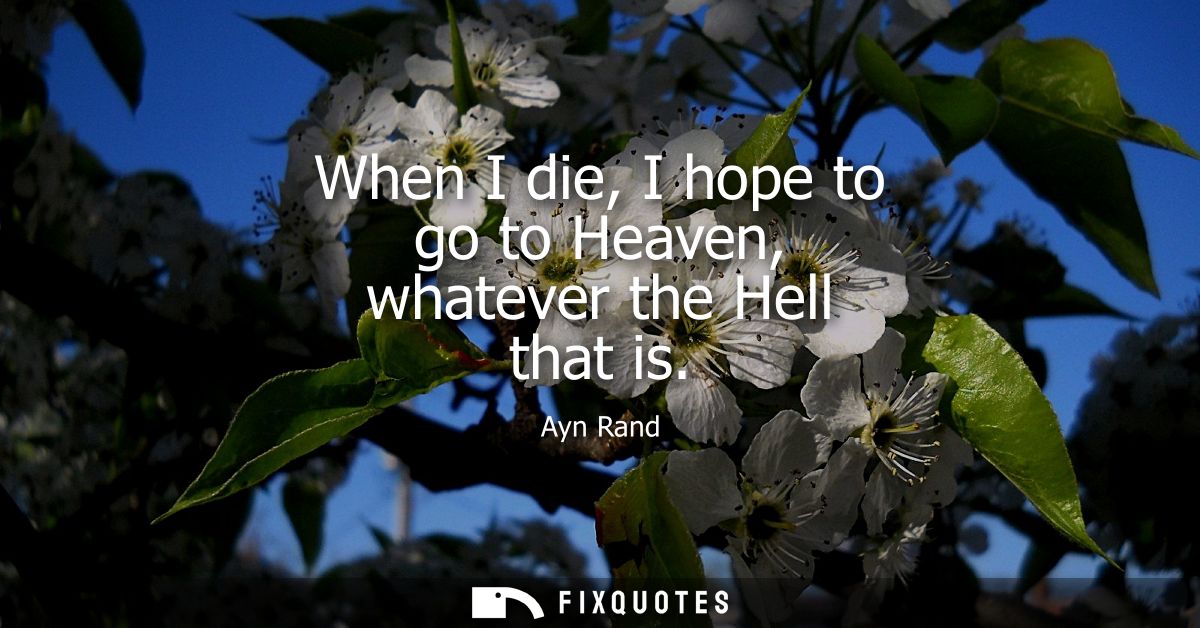
"When I die, I hope to go to Heaven, whatever the Hell that is"
About this Quote
Even in a line about the afterlife, Ayn Rand can’t resist sounding like an atheist crashing a church social. The joke runs on a tight little hinge: “Heaven” is invoked as a conventional aspiration, then punctured by the skeptical aside, “whatever the Hell that is.” Rand’s wit isn’t warm; it’s diagnostic. She’s exposing how religious language often functions less as belief than as social shorthand - a badge of virtue, a gesture toward comfort, a ritual phrase you’re expected to repeat on cue.
The subtext is classic Rand: don’t mistake secondhand notions for knowledge. “Hope” is allowed, but only as a human reflex, not a metaphysical commitment. By pairing Heaven and Hell in the same breath, she also scrambles the pieties. Heaven becomes vague, almost contentless; Hell becomes the only concrete word in the sentence, because it’s doing double duty as profanity and as theological concept. That inversion is the point: what people fear and what they claim to desire are both wrapped up in inherited vocabulary they rarely interrogate.
Contextually, Rand’s project was to dethrone faith-based authority in favor of reason and self-ownership. This line works like a cocktail-party version of that philosophy: sharp enough to signal allegiance, light enough to pass as banter. It doesn’t argue God out of existence; it ridicules the mental habit of outsourcing meaning. Even the punchline implies a demand: define your terms, or admit you’re reciting.
The subtext is classic Rand: don’t mistake secondhand notions for knowledge. “Hope” is allowed, but only as a human reflex, not a metaphysical commitment. By pairing Heaven and Hell in the same breath, she also scrambles the pieties. Heaven becomes vague, almost contentless; Hell becomes the only concrete word in the sentence, because it’s doing double duty as profanity and as theological concept. That inversion is the point: what people fear and what they claim to desire are both wrapped up in inherited vocabulary they rarely interrogate.
Contextually, Rand’s project was to dethrone faith-based authority in favor of reason and self-ownership. This line works like a cocktail-party version of that philosophy: sharp enough to signal allegiance, light enough to pass as banter. It doesn’t argue God out of existence; it ridicules the mental habit of outsourcing meaning. Even the punchline implies a demand: define your terms, or admit you’re reciting.
Quote Details
| Topic | Faith |
|---|---|
| Source | Help us find the source |
| Cite |
Citation Formats
APA Style (7th ed.)
Rand, Ayn. (2026, January 17). When I die, I hope to go to Heaven, whatever the Hell that is. FixQuotes. https://fixquotes.com/quotes/when-i-die-i-hope-to-go-to-heaven-whatever-the-35005/
Chicago Style
Rand, Ayn. "When I die, I hope to go to Heaven, whatever the Hell that is." FixQuotes. January 17, 2026. https://fixquotes.com/quotes/when-i-die-i-hope-to-go-to-heaven-whatever-the-35005/.
MLA Style (9th ed.)
"When I die, I hope to go to Heaven, whatever the Hell that is." FixQuotes, 17 Jan. 2026, https://fixquotes.com/quotes/when-i-die-i-hope-to-go-to-heaven-whatever-the-35005/. Accessed 12 Feb. 2026.
More Quotes by Ayn
Add to List