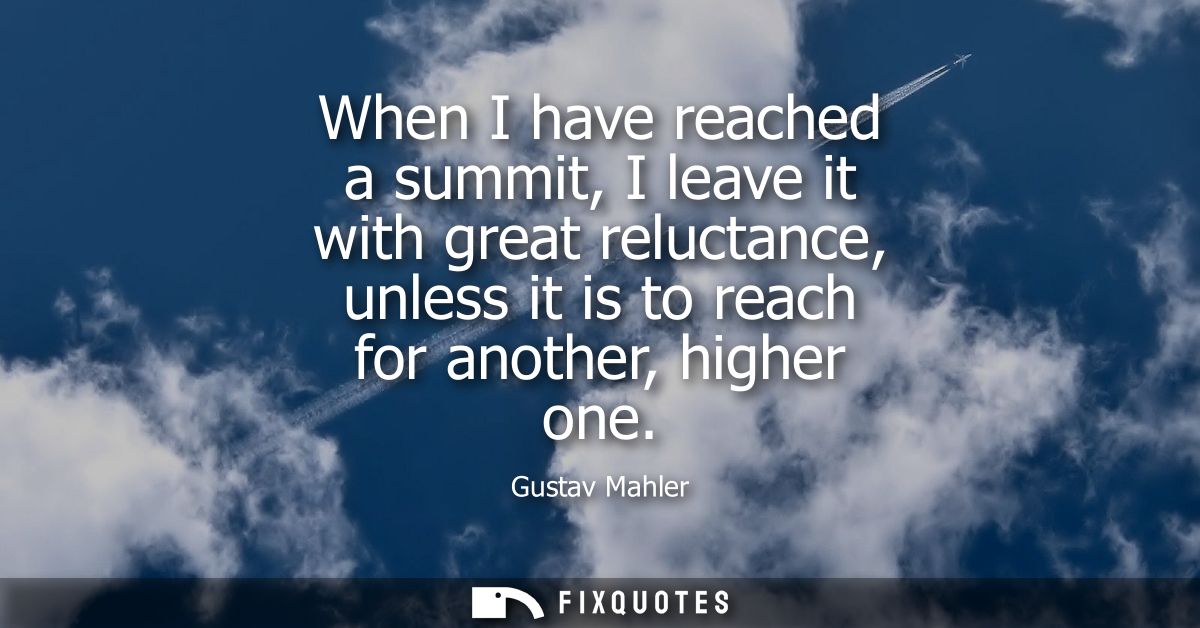
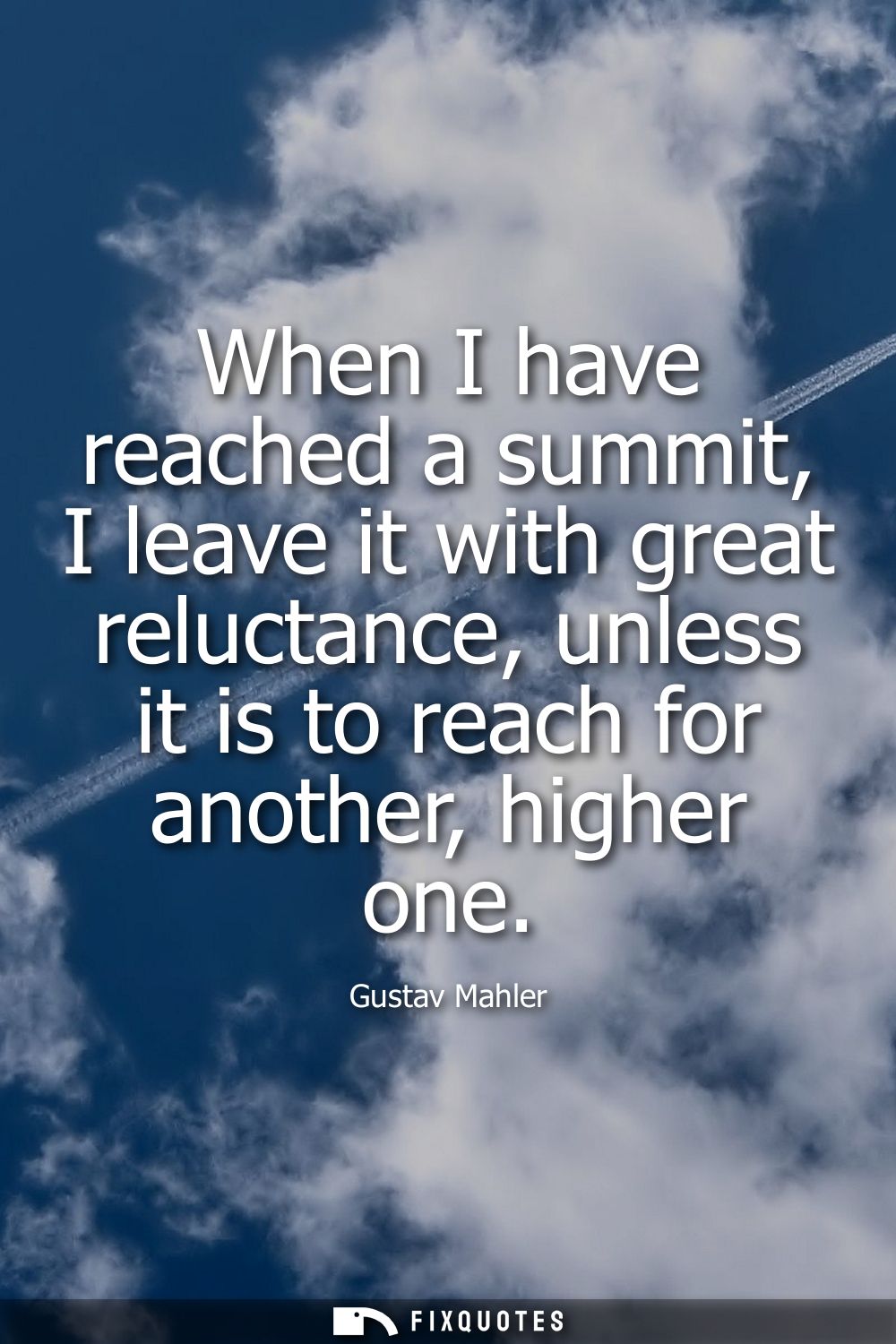
"When I have reached a summit, I leave it with great reluctance, unless it is to reach for another, higher one"
About this Quote
Ambition, in Mahler, is never the glossy kind that plays well in a commencement speech; it is the restless appetite of someone who can feel the ground giving way the moment he’s mastered it. The “summit” isn’t just a career milestone. It’s an artistic solution, a hard-won way of making sound tell the truth. Leaving it “with great reluctance” admits the private cost: each breakthrough becomes a temporary home he’s already preparing to abandon. Mahler’s genius lives in that tension between attachment and compulsion, between the comfort of arrival and the itch of the next question.
The line also sneaks in a defense against complacency. He’s not claiming he enjoys endless striving. He’s saying he can’t afford not to. In the late Romantic era, composers were wrestling with what comes after Wagner’s shadow and Brahms’s discipline, with tradition thick enough to feel like a ceiling. Mahler’s symphonies respond by expanding the summit itself: longer forms, harsher contrasts, folk tunes colliding with funeral marches, irony sharing space with prayer. His reluctance is the reluctance of an artist who knows that repetition is its own kind of death.
There’s biographical pressure here, too: a Jewish composer navigating Austro-German institutions, a conductor’s bruising public life, an inner world prone to grief. “Another, higher one” sounds triumphant until you notice the trapdoor: the climb is endless, and the view is never final.
The line also sneaks in a defense against complacency. He’s not claiming he enjoys endless striving. He’s saying he can’t afford not to. In the late Romantic era, composers were wrestling with what comes after Wagner’s shadow and Brahms’s discipline, with tradition thick enough to feel like a ceiling. Mahler’s symphonies respond by expanding the summit itself: longer forms, harsher contrasts, folk tunes colliding with funeral marches, irony sharing space with prayer. His reluctance is the reluctance of an artist who knows that repetition is its own kind of death.
There’s biographical pressure here, too: a Jewish composer navigating Austro-German institutions, a conductor’s bruising public life, an inner world prone to grief. “Another, higher one” sounds triumphant until you notice the trapdoor: the climb is endless, and the view is never final.
Quote Details
| Topic | Motivational |
|---|
More Quotes by Gustav
Add to List