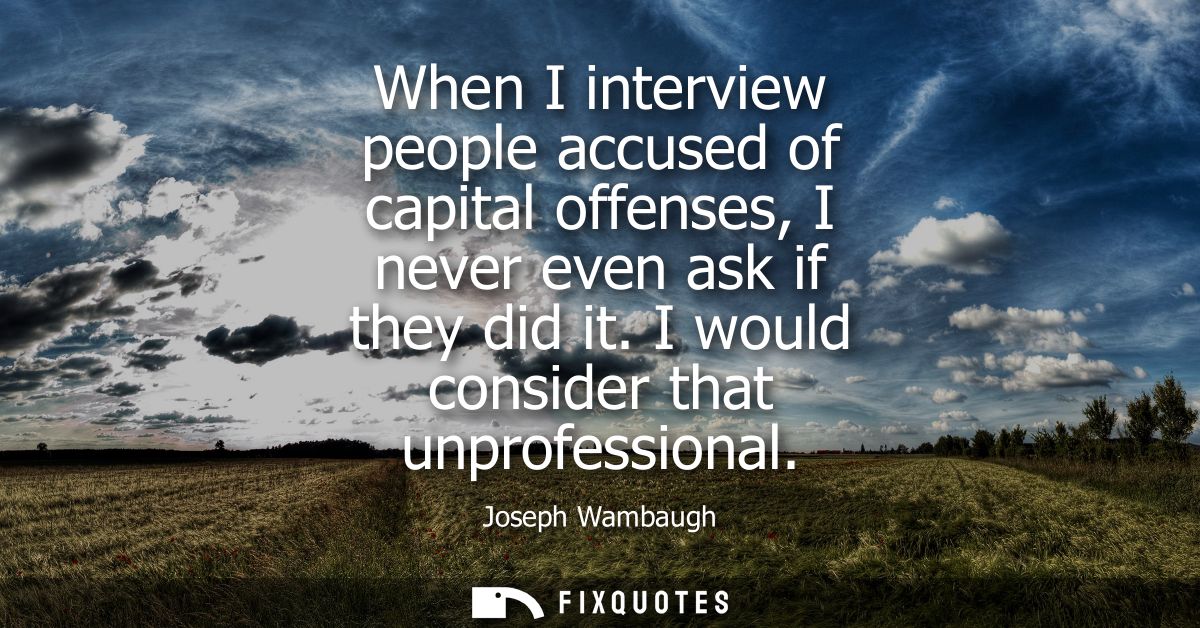
"When I interview people accused of capital offenses, I never even ask if they did it. I would consider that unprofessional"
About this Quote
The specific intent is less about defending lawyers, cops, or journalists than about exposing how institutions train people to manage risk. If you ask “Did you do it?” you invite a confession, a denial, a lie, a complication. You contaminate the clean lanes of your role: attorney-client privilege, admissibility, plausible deniability, the careful choreography between investigation and storytelling. Not asking becomes a strategy: a way to preserve control, avoid becoming a witness, avoid feeling responsible for what you now know.
Wambaugh, a former cop turned novelist of police life, understands how the justice system runs on narratives as much as facts. The subtext is bleak: guilt and innocence are often treated as distractions from the real work of case-building, career protection, and institutional survival. The line lands because it reframes “professionalism” as a cultivated blindness - not ignorance, but discipline.
Quote Details
| Topic | Justice |
|---|---|
| Source | Help us find the source |
| Cite |
Citation Formats
APA Style (7th ed.)
Wambaugh, Joseph. (2026, January 16). When I interview people accused of capital offenses, I never even ask if they did it. I would consider that unprofessional. FixQuotes. https://fixquotes.com/quotes/when-i-interview-people-accused-of-capital-111534/
Chicago Style
Wambaugh, Joseph. "When I interview people accused of capital offenses, I never even ask if they did it. I would consider that unprofessional." FixQuotes. January 16, 2026. https://fixquotes.com/quotes/when-i-interview-people-accused-of-capital-111534/.
MLA Style (9th ed.)
"When I interview people accused of capital offenses, I never even ask if they did it. I would consider that unprofessional." FixQuotes, 16 Jan. 2026, https://fixquotes.com/quotes/when-i-interview-people-accused-of-capital-111534/. Accessed 7 Apr. 2026.