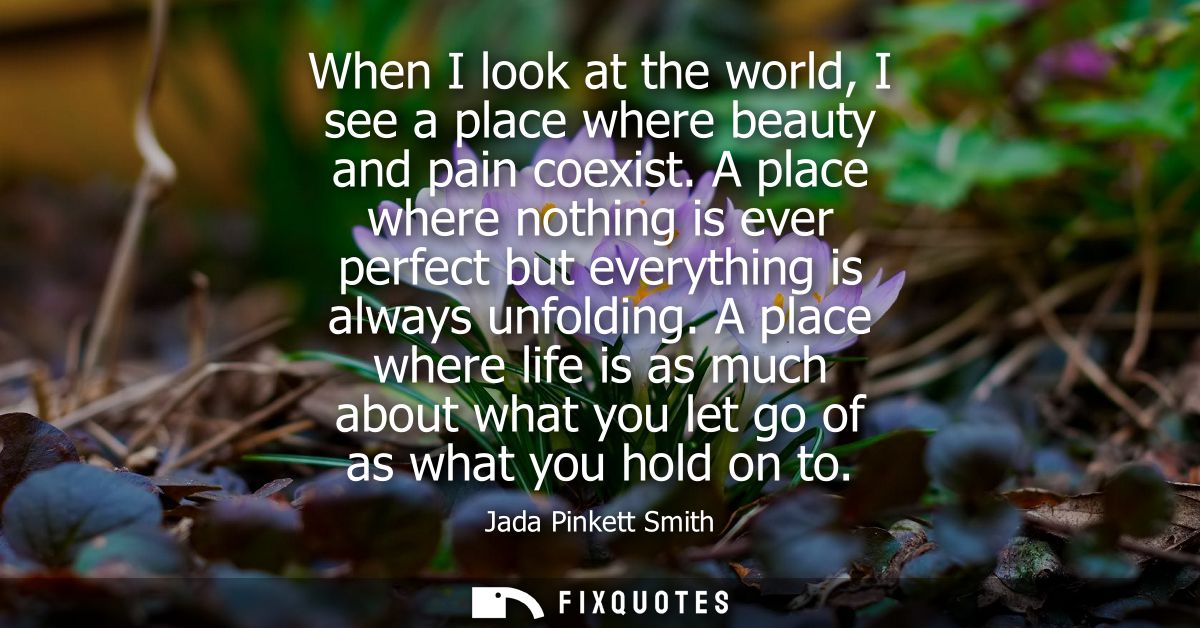
"When I look at the world, I see a place where beauty and pain coexist. A place where nothing is ever perfect but everything is always unfolding. A place where life is as much about what you let go of as what you hold on to"
About this Quote
Jada Pinkett Smith is selling a kind of hard-won steadiness: not optimism, not despair, but the emotional middle lane where you can admit the bruise and still notice the sunlight. The line works because it refuses the audience two easy exits. It doesn’t let you glamorize suffering into “everything happens for a reason,” and it doesn’t let you treat beauty as a consolation prize that cancels pain. “Coexist” is the hinge word: she’s framing life less as a problem to solve than a landscape you learn to navigate.
The second beat, “nothing is ever perfect but everything is always unfolding,” borrows the language of therapy and spiritual practice without sounding like a sermon. “Unfolding” implies process over verdict. It’s a rebuke to the culture of hot takes and instant closure - the demand that people (especially women in public) present a finished, coherent self at all times. Pinkett Smith’s public persona has been shaped by being relentlessly scrutinized: marriage, family, health, mistakes, reinventions. In that context, “unfolding” doubles as self-protection, a way of saying: stop freezing me in one frame.
The closing contrast - “let go” versus “hold on” - lands because it’s practical, not poetic. It’s about boundaries, grief, and ego. The subtext is control: you don’t get to curate the world’s chaos, but you do get to decide what you carry. That’s not passive acceptance. It’s a quieter claim to agency in a life lived loudly in public.
The second beat, “nothing is ever perfect but everything is always unfolding,” borrows the language of therapy and spiritual practice without sounding like a sermon. “Unfolding” implies process over verdict. It’s a rebuke to the culture of hot takes and instant closure - the demand that people (especially women in public) present a finished, coherent self at all times. Pinkett Smith’s public persona has been shaped by being relentlessly scrutinized: marriage, family, health, mistakes, reinventions. In that context, “unfolding” doubles as self-protection, a way of saying: stop freezing me in one frame.
The closing contrast - “let go” versus “hold on” - lands because it’s practical, not poetic. It’s about boundaries, grief, and ego. The subtext is control: you don’t get to curate the world’s chaos, but you do get to decide what you carry. That’s not passive acceptance. It’s a quieter claim to agency in a life lived loudly in public.
Quote Details
| Topic | Letting Go |
|---|
More Quotes by Jada
Add to List