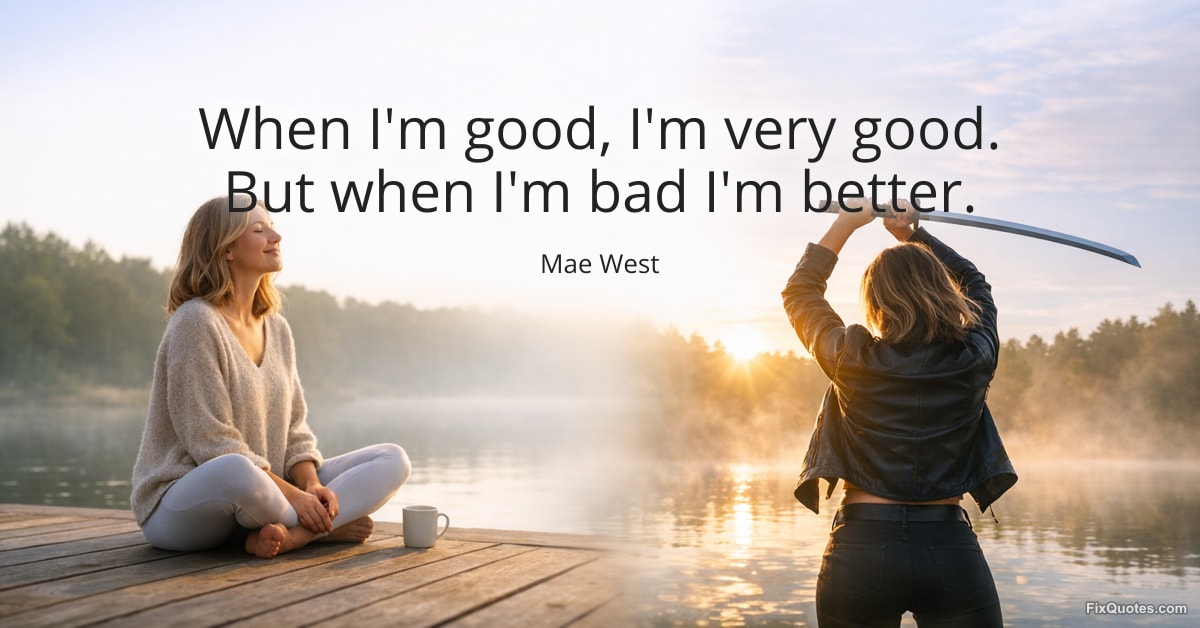
"When I'm good, I'm very good. But when I'm bad, I'm better"
About this Quote
Mae West’s line lands because it treats morality like a stage direction, not a commandment. “When I’m good, I’m very good” nods to the era’s polite expectations for women: be charming, be agreeable, be “good.” Then she flips the script with a kicker that’s half confession, half dare: “when I’m bad I’m better.” The joke isn’t just that “bad” sounds more fun. It’s that the culture’s definition of “bad” is so flimsy - basically any female appetite, ambition, or sexual confidence that refuses to apologize.
West’s intent is provocation with plausible deniability. On paper, it’s a playful paradox; onstage, it’s an invitation to the audience to enjoy the thrill of transgression while pretending it’s just comedy. That double move was her genius in the early 20th-century entertainment world, where censors and gatekeepers policed language and desire. She doesn’t argue against the rules; she seduces you into noticing how arbitrary they are.
The subtext is power. “Good” is performance for other people. “Bad” is agency: choosing pleasure, owning the gaze, driving the scene instead of being the scene. “Better” is the mic drop - she’s not merely admitting to misbehavior, she’s claiming it as an upgrade. West turns scandal into branding, and the audience’s judgment into her applause line.
West’s intent is provocation with plausible deniability. On paper, it’s a playful paradox; onstage, it’s an invitation to the audience to enjoy the thrill of transgression while pretending it’s just comedy. That double move was her genius in the early 20th-century entertainment world, where censors and gatekeepers policed language and desire. She doesn’t argue against the rules; she seduces you into noticing how arbitrary they are.
The subtext is power. “Good” is performance for other people. “Bad” is agency: choosing pleasure, owning the gaze, driving the scene instead of being the scene. “Better” is the mic drop - she’s not merely admitting to misbehavior, she’s claiming it as an upgrade. West turns scandal into branding, and the audience’s judgment into her applause line.
Quote Details
| Topic | Witty One-Liners |
|---|---|
| Source | Unverified source: I'm No Angel (Mae West, 1933)
Evidence: Primary/original appearance is as a spoken line in the 1933 film "I'm No Angel" (character Tira, played by Mae West). AFI Catalog (a primary film-reference authority drawing on studio and censorship/production records) specifically cites the line in an Oct 1933 letter about the film, indicating t... Other candidates (2) Mae West (Mae West) compilation97.1% reign im no angel 1933 when im good im very good but when im bad im better im no I Used to Know That: English (Patrick Scrivenor, 2012) compilation95.0% ... me come what may the powers that be ADJECTIVES ' The man who taught me to distrust adjectives as I would later ..... |
| Featured | This quote was our Quote of the Day on February 8, 2025 |
| Cite |
Citation Formats
APA Style (7th ed.)
West, Mae. (2026, February 16). When I'm good, I'm very good. But when I'm bad, I'm better. FixQuotes. https://fixquotes.com/quotes/when-im-good-im-very-good-but-when-im-bad-im-137571/
Chicago Style
West, Mae. "When I'm good, I'm very good. But when I'm bad, I'm better." FixQuotes. February 16, 2026. https://fixquotes.com/quotes/when-im-good-im-very-good-but-when-im-bad-im-137571/.
MLA Style (9th ed.)
"When I'm good, I'm very good. But when I'm bad, I'm better." FixQuotes, 16 Feb. 2026, https://fixquotes.com/quotes/when-im-good-im-very-good-but-when-im-bad-im-137571/. Accessed 16 Feb. 2026.
More Quotes by Mae
Add to List