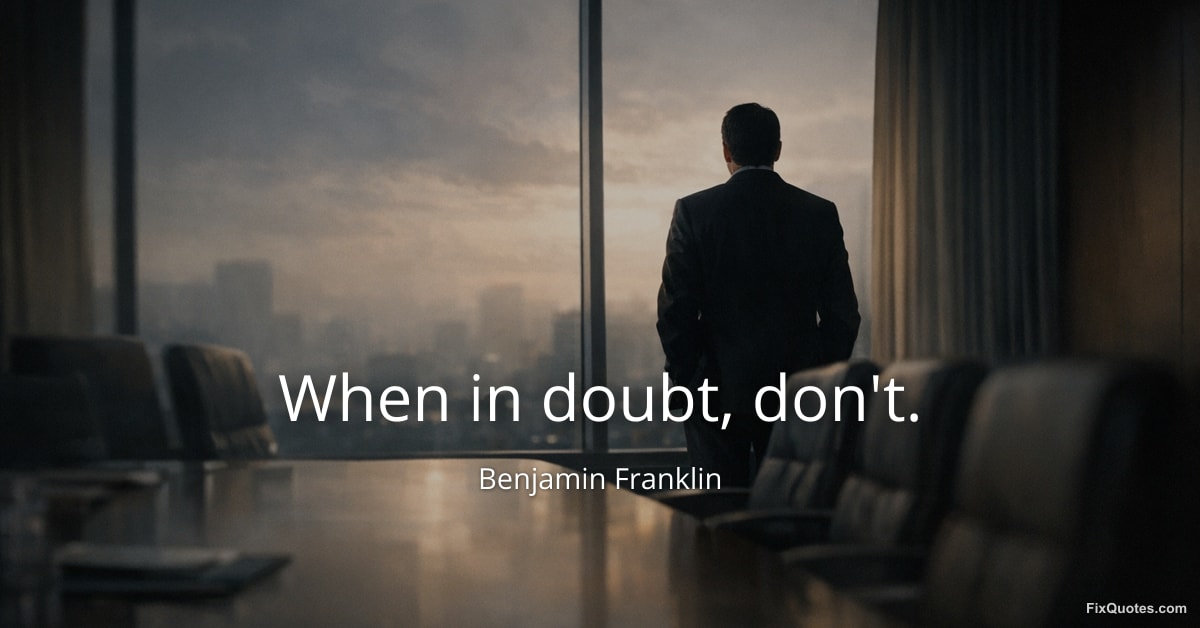
"When in doubt, don't"
About this Quote
Franklin’s line lands like a closed fist: not inspirational, not even comforting, just a hard stop. “When in doubt, don’t” turns the usual American bias toward action on its head. It’s a politician’s advice that distrusts impulse, and that’s precisely why it still stings. Franklin understood that public life rewards motion - speeches, schemes, alliances - while punishing the slow work of restraint only after the damage is done. The sentence is built to be portable and ruthless: five words, no qualifiers, no wiggle room for rationalizations dressed up as courage.
The intent isn’t timidity; it’s risk management in an era when a poorly timed pamphlet, a reckless loan, or a premature political commitment could ruin reputations and incite real-world consequences. Franklin’s world was dense with uncertainty: a young republic, unstable institutions, fragile credit networks, volatile diplomacy. Doubt wasn’t an abstract feeling; it was signal noise in a system where the cost of being wrong was high and the information pipeline was thin.
Subtextually, Franklin is making an argument about character. He’s betting that self-control is more reliable than self-confidence, that the ego’s hunger to “do something” is often just fear of looking passive. It’s also a quiet rebuke to moral shortcuts: if you’re unsure whether an act is wise, fair, or necessary, abstention is the only choice that doesn’t compound harm. The line works because it’s unfashionably conservative about human judgment, especially your own.
The intent isn’t timidity; it’s risk management in an era when a poorly timed pamphlet, a reckless loan, or a premature political commitment could ruin reputations and incite real-world consequences. Franklin’s world was dense with uncertainty: a young republic, unstable institutions, fragile credit networks, volatile diplomacy. Doubt wasn’t an abstract feeling; it was signal noise in a system where the cost of being wrong was high and the information pipeline was thin.
Subtextually, Franklin is making an argument about character. He’s betting that self-control is more reliable than self-confidence, that the ego’s hunger to “do something” is often just fear of looking passive. It’s also a quiet rebuke to moral shortcuts: if you’re unsure whether an act is wise, fair, or necessary, abstention is the only choice that doesn’t compound harm. The line works because it’s unfashionably conservative about human judgment, especially your own.
Quote Details
| Topic | Decision-Making |
|---|---|
| Source | Later attribution: Quotes: The Famous and Not so Famous (Terence M. Dorn Ph.D., 2021) modern compilationISBN: 9781662447952 · ID: ptZSEAAAQBAJ
Evidence: ... Benjamin Franklin It is easier to prevent bad habits than to break them . Benjamin Franklin In this world nothing can be said to be certain , except death or taxes . Benjamin Franklin When in doubt , don't . — Benjamin Franklin We are ... Other candidates (1) Benjamin Franklin (Benjamin Franklin) compilation50.0% s water all the world over it purifies it by distillation when it raises it in v |
| Cite |
Citation Formats
APA Style (7th ed.)
Franklin, Benjamin. (2026, February 2). When in doubt, don't. FixQuotes. https://fixquotes.com/quotes/when-in-doubt-dont-34432/
Chicago Style
Franklin, Benjamin. "When in doubt, don't." FixQuotes. February 2, 2026. https://fixquotes.com/quotes/when-in-doubt-dont-34432/.
MLA Style (9th ed.)
"When in doubt, don't." FixQuotes, 2 Feb. 2026, https://fixquotes.com/quotes/when-in-doubt-dont-34432/. Accessed 5 Mar. 2026.
More Quotes by Benjamin
Add to List