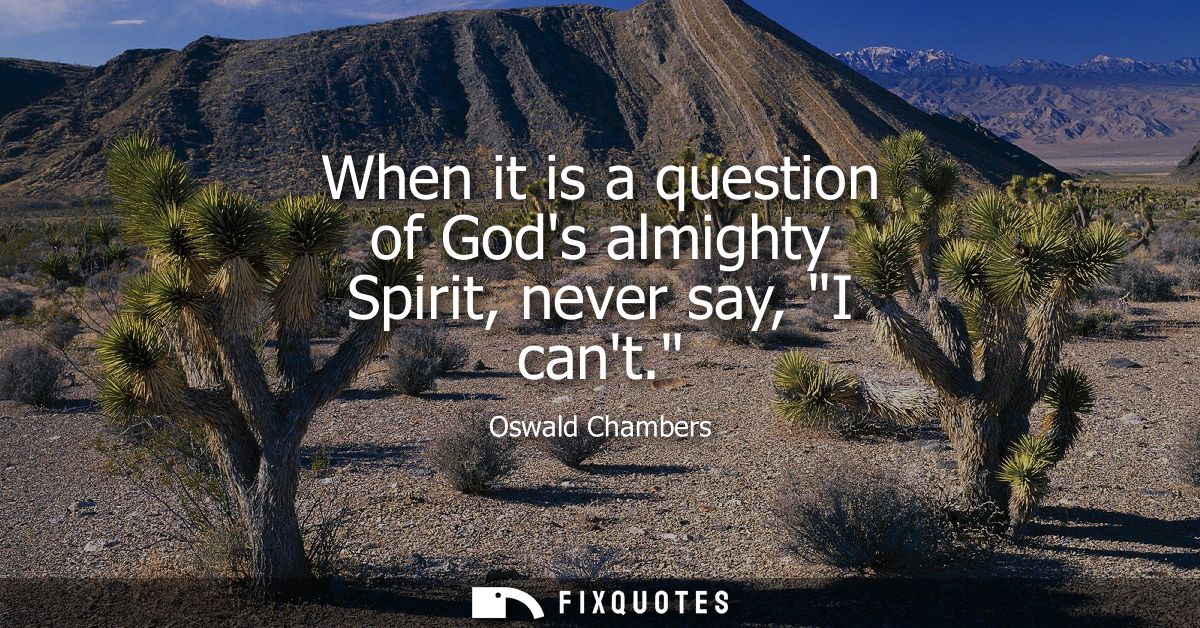
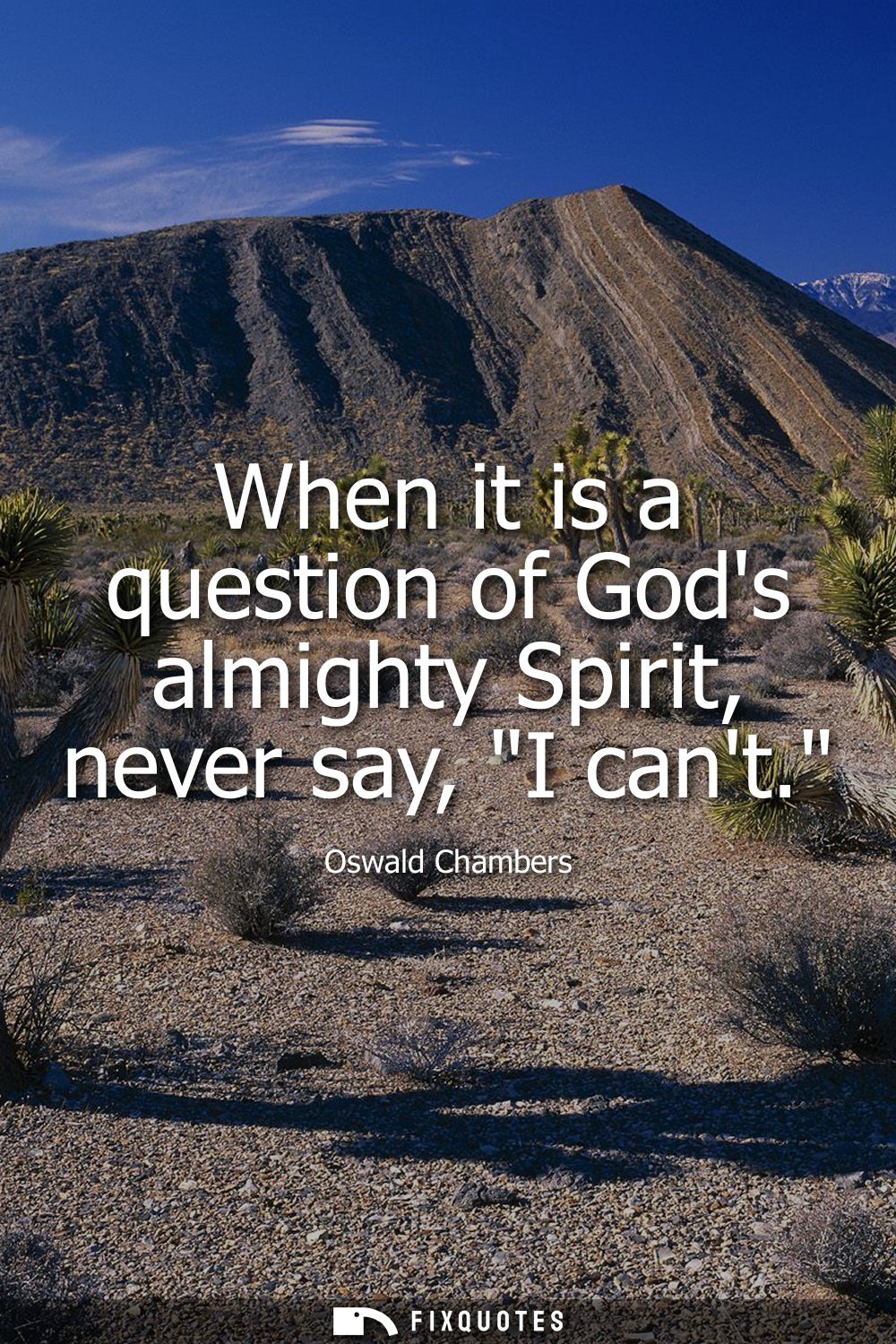
"When it is a question of God's almighty Spirit, never say, "I can't""
About this Quote
Chambers weaponizes two small words - "I can't" - and turns them into a spiritual diagnosis. The line isn’t pep talk; it’s a rebuke aimed at a particular kind of modern piety: the believer who treats obedience like a personality test, a matter of temperament, energy, or natural aptitude. By specifying "a question of God's almighty Spirit", he draws a hard border between human limitation and divine agency. The subtext is blunt: if the Spirit is truly almighty, then the only real obstacle left is not capacity but consent.
The phrasing does quiet rhetorical work. "Never say" is absolutist, deliberately leaving no loophole for self-exemption. Chambers knows how easily humility can curdle into self-protection: "I can't" can sound modest while functioning as a moral alibi. He presses the reader to notice what the phrase often hides - fear of change, attachment to control, or resentment at what discipleship costs. In that sense, the quote is less about empowering the weak than about unmasking the ways we bargain with God.
Context matters. Writing in the early 20th-century evangelical and holiness-inflected world, Chambers emphasized surrender, sanctification, and the Spirit’s enabling power over self-improvement. His era prized moral seriousness; his theology prizes dependence. The intent is to move the spiritual conversation from capability to availability: not "Do I have what it takes?" but "Will I yield to what God supplies?"
The phrasing does quiet rhetorical work. "Never say" is absolutist, deliberately leaving no loophole for self-exemption. Chambers knows how easily humility can curdle into self-protection: "I can't" can sound modest while functioning as a moral alibi. He presses the reader to notice what the phrase often hides - fear of change, attachment to control, or resentment at what discipleship costs. In that sense, the quote is less about empowering the weak than about unmasking the ways we bargain with God.
Context matters. Writing in the early 20th-century evangelical and holiness-inflected world, Chambers emphasized surrender, sanctification, and the Spirit’s enabling power over self-improvement. His era prized moral seriousness; his theology prizes dependence. The intent is to move the spiritual conversation from capability to availability: not "Do I have what it takes?" but "Will I yield to what God supplies?"
Quote Details
| Topic | God |
|---|---|
| Source | Help us find the source |
| Cite |
Citation Formats
APA Style (7th ed.)
Chambers, Oswald. (2026, February 20). When it is a question of God's almighty Spirit, never say, "I can't". FixQuotes. https://fixquotes.com/quotes/when-it-is-a-question-of-gods-almighty-spirit-1173/
Chicago Style
Chambers, Oswald. "When it is a question of God's almighty Spirit, never say, "I can't"." FixQuotes. February 20, 2026. https://fixquotes.com/quotes/when-it-is-a-question-of-gods-almighty-spirit-1173/.
MLA Style (9th ed.)
"When it is a question of God's almighty Spirit, never say, "I can't"." FixQuotes, 20 Feb. 2026, https://fixquotes.com/quotes/when-it-is-a-question-of-gods-almighty-spirit-1173/. Accessed 14 Mar. 2026.
More Quotes by Oswald
Add to List