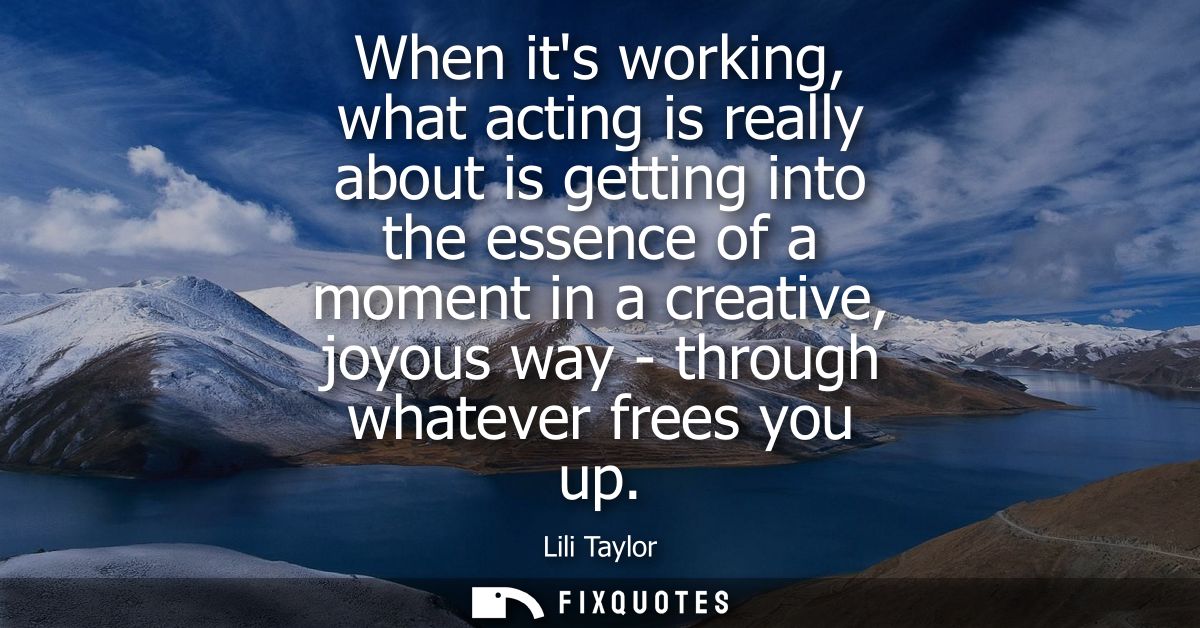
"When it's working, what acting is really about is getting into the essence of a moment in a creative, joyous way - through whatever frees you up"
About this Quote
Taylor’s line is a quiet rebuttal to the macho mythology of acting as suffering. No talk of “becoming” someone else, no fetish for darkness, no romanticizing of trauma-as-fuel. Instead, she frames good acting as essence-hunting: not a performance of feelings but a tuned-in capture of a moment’s core, arrived at with “creative, joyous” energy. That word choice matters. Joy isn’t a reward after the work; it’s evidence the work has unlocked something truthful.
The subtext is pragmatic and slightly insurgent. “When it’s working” admits the chaos: acting is inconsistent, dependent on chemistry, timing, nerves, the day’s weather inside your body. Her definition doesn’t promise mastery; it promises access. And “through whatever frees you up” is the most revealing clause. It’s an anti-dogma credo aimed at a culture obsessed with the One True Method. She’s blessing any tool that dissolves self-consciousness: play, improvisation, physical looseness, a director’s trust, a partner’s generosity. Freedom here isn’t indulgence; it’s the condition that lets instinct take over and the actor stop managing how they look.
Contextually, it tracks with Taylor’s career-long reputation for lived-in naturalism: performances that feel less like demonstration and more like presence. Her emphasis on “essence” implies a camera-era realism where the smallest truthful shift reads louder than virtuoso theatrics. The intent is to relocate acting from self-importance to attention: away from the actor’s pain and toward the moment’s pulse.
The subtext is pragmatic and slightly insurgent. “When it’s working” admits the chaos: acting is inconsistent, dependent on chemistry, timing, nerves, the day’s weather inside your body. Her definition doesn’t promise mastery; it promises access. And “through whatever frees you up” is the most revealing clause. It’s an anti-dogma credo aimed at a culture obsessed with the One True Method. She’s blessing any tool that dissolves self-consciousness: play, improvisation, physical looseness, a director’s trust, a partner’s generosity. Freedom here isn’t indulgence; it’s the condition that lets instinct take over and the actor stop managing how they look.
Contextually, it tracks with Taylor’s career-long reputation for lived-in naturalism: performances that feel less like demonstration and more like presence. Her emphasis on “essence” implies a camera-era realism where the smallest truthful shift reads louder than virtuoso theatrics. The intent is to relocate acting from self-importance to attention: away from the actor’s pain and toward the moment’s pulse.
Quote Details
| Topic | Art |
|---|
More Quotes by Lili
Add to List