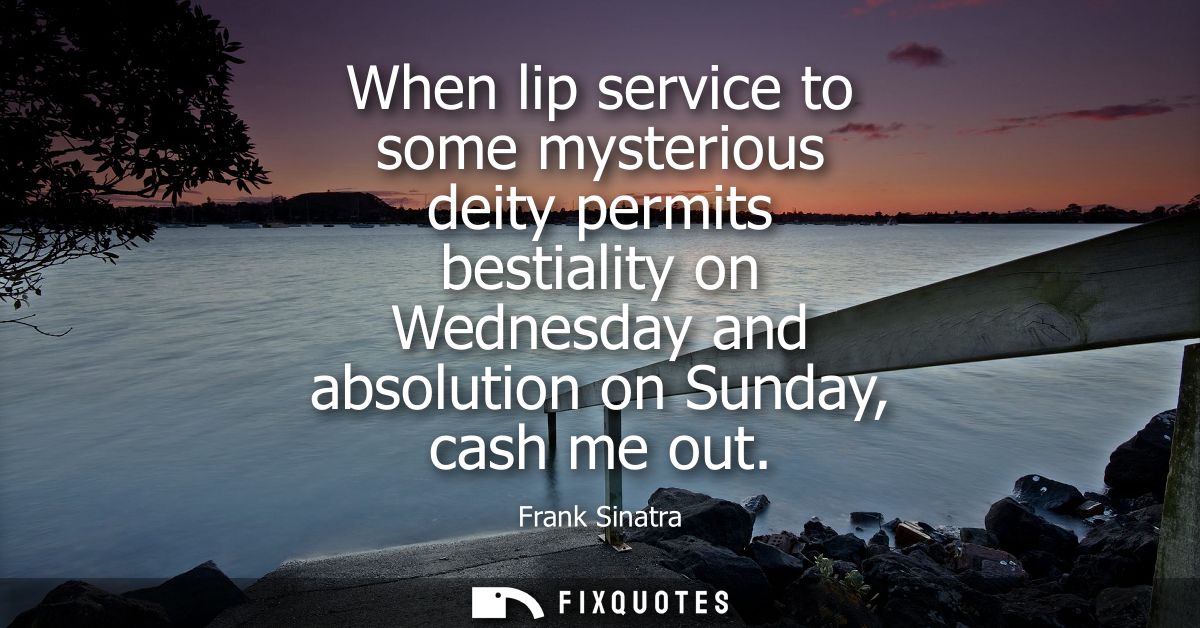
"When lip service to some mysterious deity permits bestiality on Wednesday and absolution on Sunday, cash me out"
About this Quote
The specific intent is refusal. “Cash me out” is gambler slang, a public exit from a rigged game. Sinatra isn’t negotiating with the institution; he’s walking away from a moral economy where confession or piety operates like a refund policy. Subtextually, it’s also a shot at the social power of religious respectability: how saying the right words, showing up at the right service, and adopting the right pose can convert predation into “a mistake,” then into “forgiven,” then into “none of your business.”
Context matters because Sinatra’s era was thick with public virtue and private vice: postwar America’s polished family values on top, messy appetites underneath. Coming from a pop figure whose own life was scrutinized, the line reads less like sanctimony and more like a demand for moral accounting that can’t be solved with a hymn and a handshake.
Quote Details
| Topic | Ethics & Morality |
|---|---|
| Source | Help us find the source |
| Cite |
Citation Formats
APA Style (7th ed.)
Sinatra, Frank. (2026, January 18). When lip service to some mysterious deity permits bestiality on Wednesday and absolution on Sunday, cash me out. FixQuotes. https://fixquotes.com/quotes/when-lip-service-to-some-mysterious-deity-permits-7006/
Chicago Style
Sinatra, Frank. "When lip service to some mysterious deity permits bestiality on Wednesday and absolution on Sunday, cash me out." FixQuotes. January 18, 2026. https://fixquotes.com/quotes/when-lip-service-to-some-mysterious-deity-permits-7006/.
MLA Style (9th ed.)
"When lip service to some mysterious deity permits bestiality on Wednesday and absolution on Sunday, cash me out." FixQuotes, 18 Jan. 2026, https://fixquotes.com/quotes/when-lip-service-to-some-mysterious-deity-permits-7006/. Accessed 3 Apr. 2026.