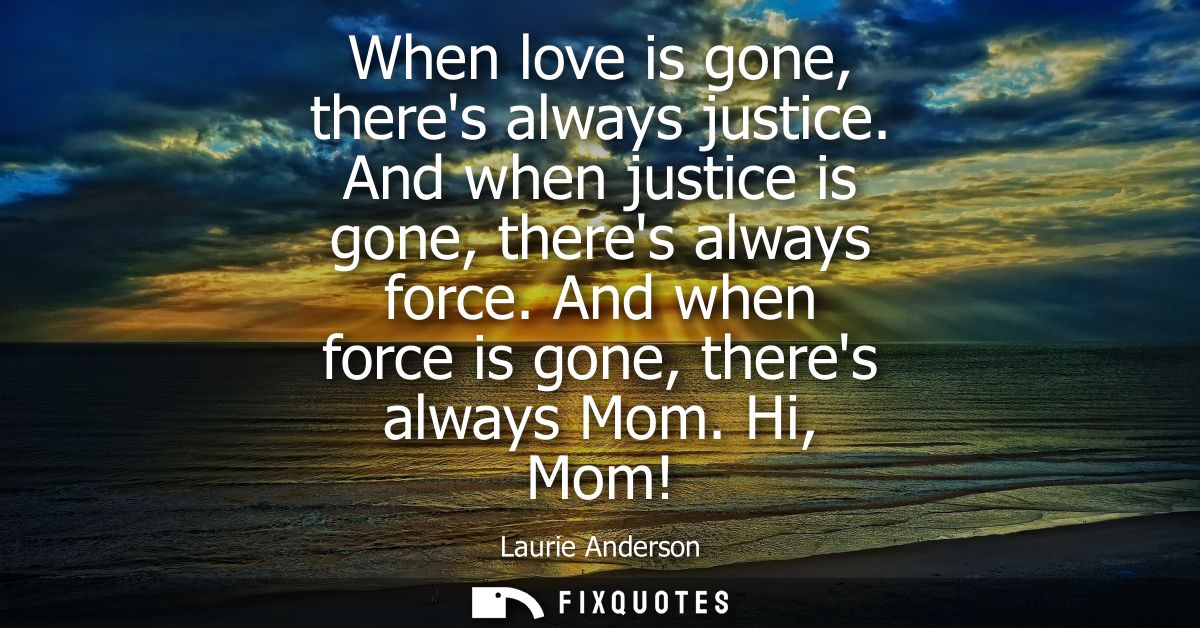
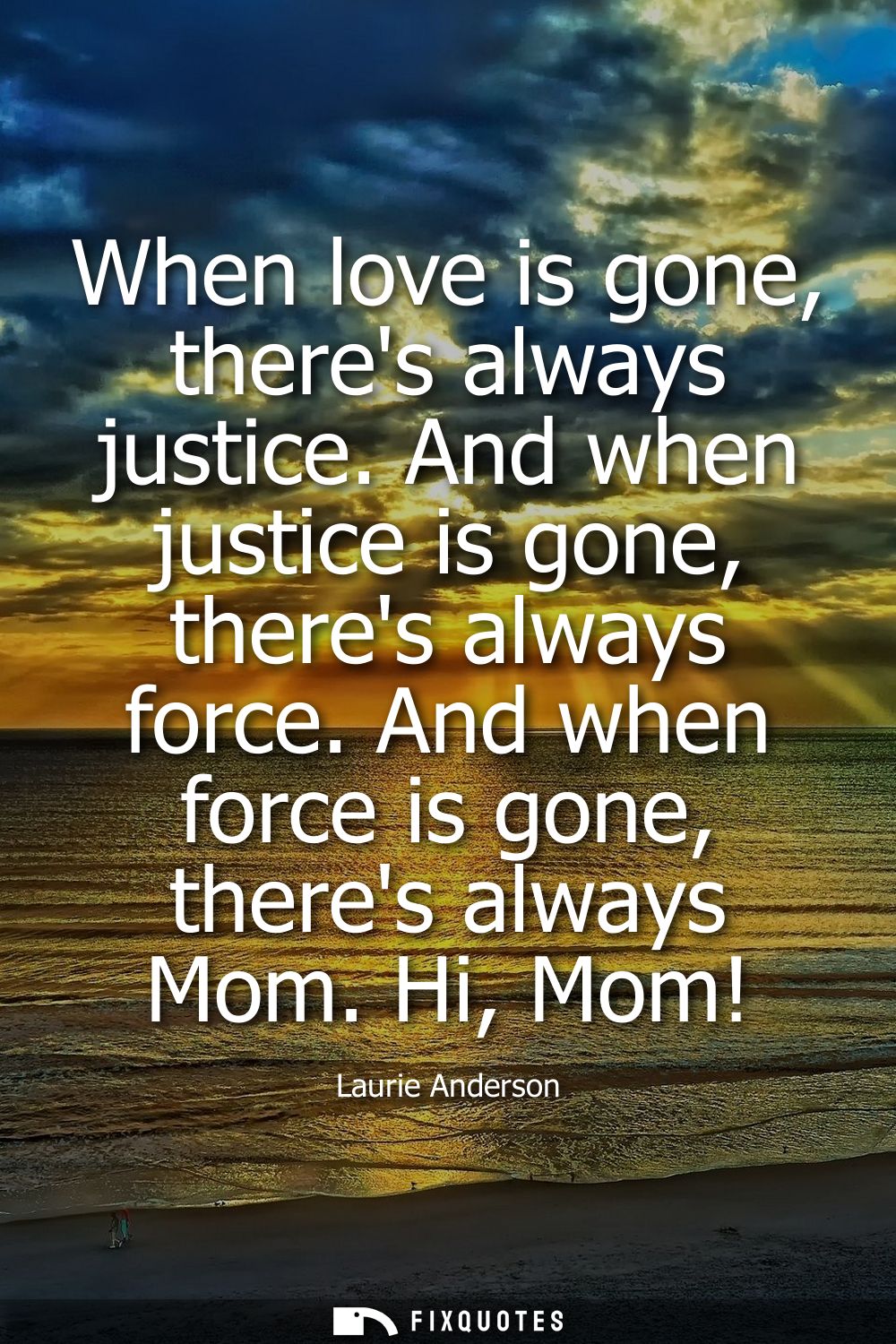
"When love is gone, there's always justice. And when justice is gone, there's always force. And when force is gone, there's always Mom. Hi, Mom!"
About this Quote
Anderson’s intent isn’t to mock love or justice so much as to expose how quickly our moral language turns into a cover story. We like to imagine justice as love institutionalized, force as justice’s last resort. She flips it: each term is a downgrade, a concession, a coping mechanism. “There’s always” repeats like a lullaby you tell yourself when the lights go out. It’s comfort phrased as inevitability.
“Mom” carries the subtext of origin and surveillance: the first authority, the first audience, the person you can’t quite stop performing for. “Hi, Mom!” is the vaudeville tag, the kid-on-TV wave, the reflex of seeking approval even while describing a world that’s fallen from tenderness into coercion. In the context of Anderson’s broader work - part art-pop, part social critique - the line plays like a glitch in the national anthem: family as the last refuge, and the last form of control, when every public ideal has been exhausted.
Quote Details
| Topic | Mother |
|---|---|
| Source | Verified source: O Superman (For Massenet) (Laurie Anderson, 1981)
Evidence:
Song: "O Superman (For Massenet)" by Laurie Anderson |
| Cite |
Citation Formats
APA Style (7th ed.)
Anderson, Laurie. (2026, February 8). When love is gone, there's always justice. And when justice is gone, there's always force. And when force is gone, there's always Mom. Hi, Mom! FixQuotes. https://fixquotes.com/quotes/when-love-is-gone-theres-always-justice-and-when-60525/
Chicago Style
Anderson, Laurie. "When love is gone, there's always justice. And when justice is gone, there's always force. And when force is gone, there's always Mom. Hi, Mom!" FixQuotes. February 8, 2026. https://fixquotes.com/quotes/when-love-is-gone-theres-always-justice-and-when-60525/.
MLA Style (9th ed.)
"When love is gone, there's always justice. And when justice is gone, there's always force. And when force is gone, there's always Mom. Hi, Mom!" FixQuotes, 8 Feb. 2026, https://fixquotes.com/quotes/when-love-is-gone-theres-always-justice-and-when-60525/. Accessed 4 Mar. 2026.