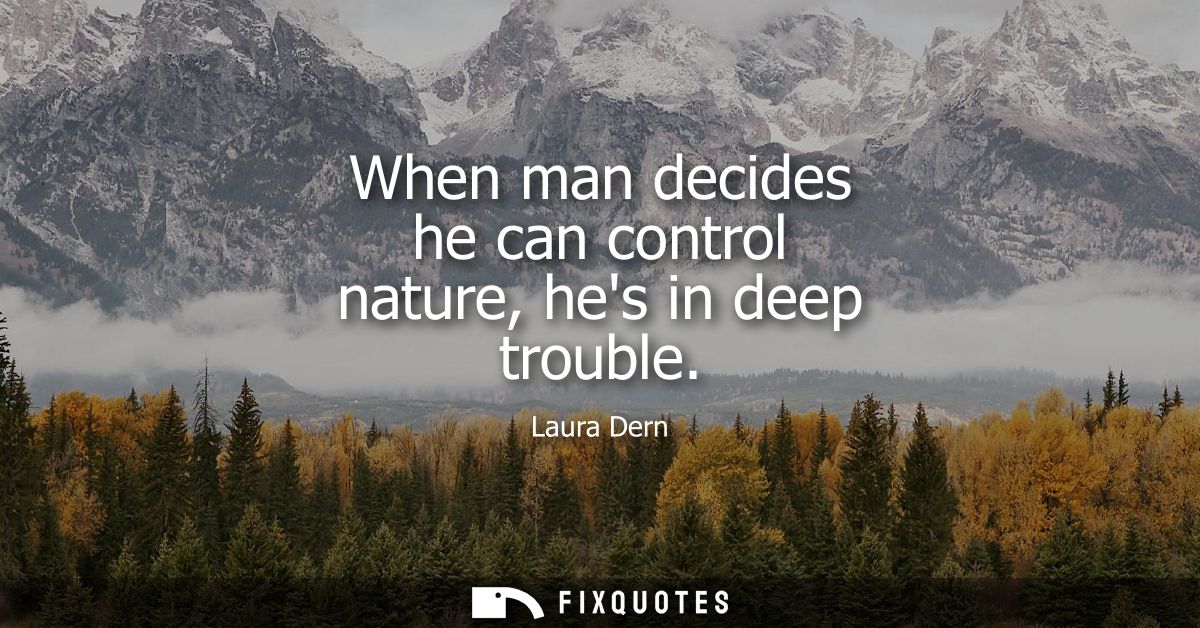
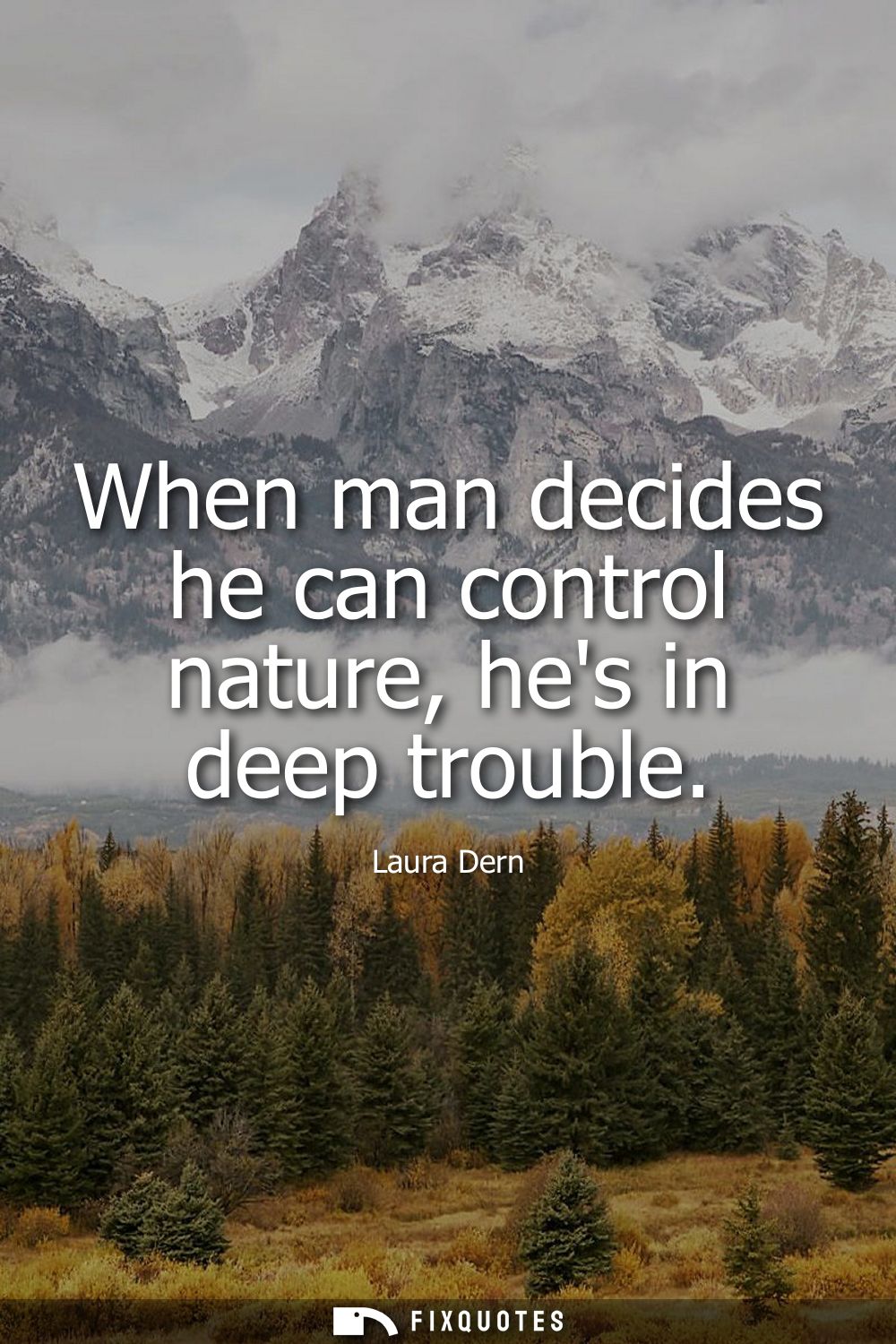
"When man decides he can control nature, he's in deep trouble"
About this Quote
Control is the oldest Hollywood villain origin story, and Laura Dern delivers it in one clean line: the moment we treat nature like a system with an off switch, we’ve already misread the plot. As an actress whose career is threaded through stories about hubris and consequence (Jurassic Park hangs in the background like a warning siren), Dern’s phrasing lands less as abstract eco-philosophy and more as lived cultural shorthand: you can hear the lab coats, the boardrooms, the grant pitches.
The intent is blunt, almost parental: a caution against overconfidence dressed up as competence. “Decides” is the key verb. It’s not that humans occasionally affect the environment; it’s that we choose the fantasy of mastery because it’s comforting, profitable, and legible. “Control” implies a steering wheel, a dashboard, a user interface. Nature doesn’t offer those. It offers feedback loops, delayed consequences, and randomness that looks like punishment only because we expected obedience.
The subtext is also about power. “Man” isn’t just humanity; it’s a certain tradition of masculinity and modernity that equates dominance with intelligence. That’s why the warning hits beyond climate rhetoric. It’s a critique of techno-solutionism, the belief that innovation can mop up any mess without changing the behaviors that made it. “Deep trouble” stays colloquial on purpose, refusing the soothing distance of statistics. It’s not prophecy; it’s an early tremor. The line works because it doesn’t beg for reverence. It just flips the burden of proof back onto the people selling control.
The intent is blunt, almost parental: a caution against overconfidence dressed up as competence. “Decides” is the key verb. It’s not that humans occasionally affect the environment; it’s that we choose the fantasy of mastery because it’s comforting, profitable, and legible. “Control” implies a steering wheel, a dashboard, a user interface. Nature doesn’t offer those. It offers feedback loops, delayed consequences, and randomness that looks like punishment only because we expected obedience.
The subtext is also about power. “Man” isn’t just humanity; it’s a certain tradition of masculinity and modernity that equates dominance with intelligence. That’s why the warning hits beyond climate rhetoric. It’s a critique of techno-solutionism, the belief that innovation can mop up any mess without changing the behaviors that made it. “Deep trouble” stays colloquial on purpose, refusing the soothing distance of statistics. It’s not prophecy; it’s an early tremor. The line works because it doesn’t beg for reverence. It just flips the burden of proof back onto the people selling control.
Quote Details
| Topic | Nature |
|---|---|
| Source | Help us find the source |
| Cite |
Citation Formats
APA Style (7th ed.)
Dern, Laura. (2026, January 15). When man decides he can control nature, he's in deep trouble. FixQuotes. https://fixquotes.com/quotes/when-man-decides-he-can-control-nature-hes-in-102113/
Chicago Style
Dern, Laura. "When man decides he can control nature, he's in deep trouble." FixQuotes. January 15, 2026. https://fixquotes.com/quotes/when-man-decides-he-can-control-nature-hes-in-102113/.
MLA Style (9th ed.)
"When man decides he can control nature, he's in deep trouble." FixQuotes, 15 Jan. 2026, https://fixquotes.com/quotes/when-man-decides-he-can-control-nature-hes-in-102113/. Accessed 27 Mar. 2026.
More Quotes by Laura
Add to List