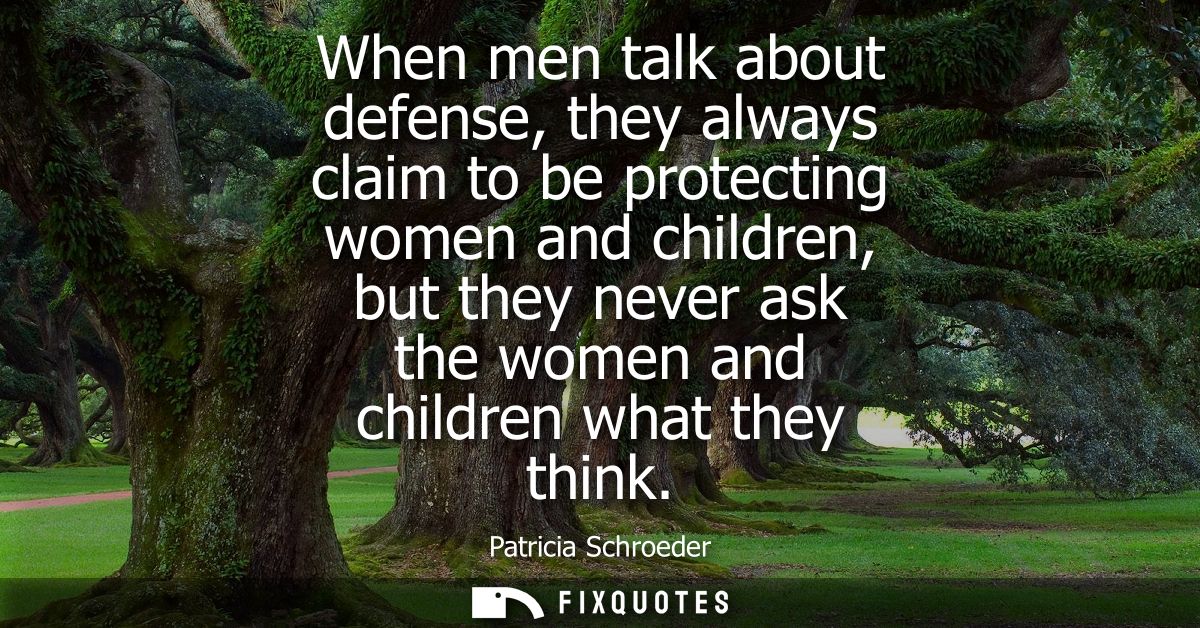
"When men talk about defense, they always claim to be protecting women and children, but they never ask the women and children what they think"
About this Quote
Schroeder’s intent is not merely to advocate listening. It’s to indict a gendered script that treats women and children as symbols rather than citizens. The subtext is blunt: the people used to justify force are the very people denied agency in deciding when force is necessary. “Men talk about defense” is less a biological claim than an institutional one: militaries, foreign policy committees, and national security establishments have historically been male-dominated, and their language reflects that hierarchy.
The quote lands with particular force in the late Cold War-to-post-Vietnam era when Schroeder built her career challenging Pentagon spending and the automatic reverence attached to military framing. “Defense” becomes a kind of linguistic body armor; she’s stabbing at the seam. By flipping the question to “did you ask them,” she forces a shift from paternalism to consent. It’s a rhetorical move that turns sentimental protection into democratic accountability, and it implies a deeper critique: a state that constantly speaks for the vulnerable is often preparing to act without their permission, and sometimes against their interests.
Quote Details
| Topic | Equality |
|---|---|
| Source | Help us find the source |
| Cite |
Citation Formats
APA Style (7th ed.)
Schroeder, Patricia. (2026, January 17). When men talk about defense, they always claim to be protecting women and children, but they never ask the women and children what they think. FixQuotes. https://fixquotes.com/quotes/when-men-talk-about-defense-they-always-claim-to-26683/
Chicago Style
Schroeder, Patricia. "When men talk about defense, they always claim to be protecting women and children, but they never ask the women and children what they think." FixQuotes. January 17, 2026. https://fixquotes.com/quotes/when-men-talk-about-defense-they-always-claim-to-26683/.
MLA Style (9th ed.)
"When men talk about defense, they always claim to be protecting women and children, but they never ask the women and children what they think." FixQuotes, 17 Jan. 2026, https://fixquotes.com/quotes/when-men-talk-about-defense-they-always-claim-to-26683/. Accessed 3 Apr. 2026.