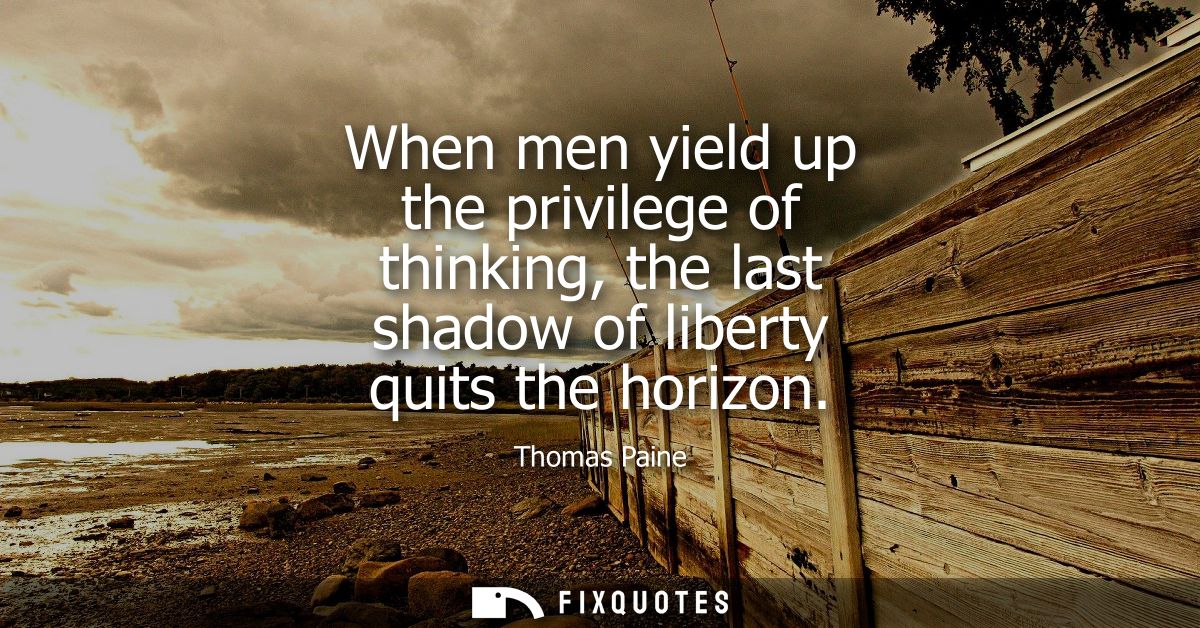
"When men yield up the privilege of thinking, the last shadow of liberty quits the horizon"
About this Quote
The phrase “yield up” is doing quiet work. It implies consent, even eagerness, a public that collaborates in its own unfreeing. Paine is indicting the social habits that make despotism possible: deference to inherited authority, clergy-as-thought, monarchy-as-common-sense, crowd opinion as a substitute for judgment. That’s the subtext: the enemy isn’t only coercion; it’s intellectual outsourcing.
Context sharpens the edge. Writing in the age of revolutions, Paine saw how old regimes survived not just through armies but through ideas that made hierarchy feel natural. Enlightenment rhetoric often flatters “reason”; Paine weaponizes it. Liberty, in his framing, is not secured by slogans or constitutions alone. It depends on an electorate willing to risk the discomfort of thinking for itself.
The closing image, “the last shadow of liberty,” is deliberately bleak. Not freedom itself, but its faint outline disappears from the horizon. By the time you notice the loss, you’re already living in the dusk.
Quote Details
| Topic | Freedom |
|---|---|
| Source | Help us find the source |
| Cite |
Citation Formats
APA Style (7th ed.)
Paine, Thomas. (2026, January 14). When men yield up the privilege of thinking, the last shadow of liberty quits the horizon. FixQuotes. https://fixquotes.com/quotes/when-men-yield-up-the-privilege-of-thinking-the-10474/
Chicago Style
Paine, Thomas. "When men yield up the privilege of thinking, the last shadow of liberty quits the horizon." FixQuotes. January 14, 2026. https://fixquotes.com/quotes/when-men-yield-up-the-privilege-of-thinking-the-10474/.
MLA Style (9th ed.)
"When men yield up the privilege of thinking, the last shadow of liberty quits the horizon." FixQuotes, 14 Jan. 2026, https://fixquotes.com/quotes/when-men-yield-up-the-privilege-of-thinking-the-10474/. Accessed 12 Feb. 2026.